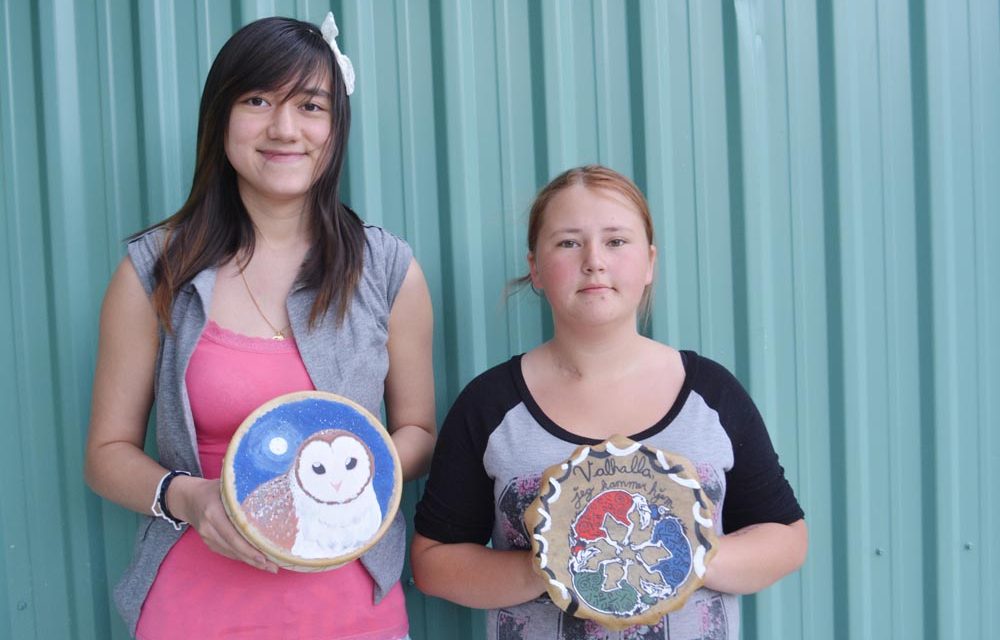

Christina Raposo (left) and Hannah Loseth show off their drums as part of the “Take-a-Risk” project at Southern Okanagan Secondary School. Photo by Lyonel Doherty
Teachers in School District 53 are taking a risk in the classroom and it’s making a world of difference for many students.
That was the consensus recently during a special presentation by all schools that received “Take-a-Risk” grants (of $1,000).
“Teachers wanted to take a risk and try new things,” said Superintendent of Schools Bev Young at the Education Committee meeting on June 8.
Starting things off was Lindsey McVicar from Southern Okanagan Secondary School who talked about her program – aboriginal drum making and connecting with elders.
A total of 25 art students made drums with an elder and started displaying them in the Oliver public library on June 15.
Grade 12 student Tina Raposo painted a barn owl on her drum.
“I never got to do a project like this . . . I’m really grateful.”
Fellow student Hannah Loseth said it was an awesome opportunity to incorporate her own heritage in the drum-making project.
Next up was Principal Karen Sinclair from Oliver Elementary School, who reported on the huge success of their recent production of The Lion King Jr. at Frank Venables Theatre.
Sinclair said their Take-a-Risk grant went towards hiring a teacher-on-call to fill in for music/drama teacher Lori Martine while she worked with the 30 young performers.
She noted the students took part in much of the design and planning work (which is normally done for them by adults).
“There were four shows in two days, and the cast formed a bond they will never forget,” Sinclair said.
Teacher Ryan Baptiste from Southern Okanagan Secondary took a risk and used the grant for a snowshoe-making project as part of the school’s EPIC (Experiential, Project-based Indigenous Community) program.
His students took a bunch of PVC pipe and made snowshoes, which they put to the test near Mt. Baldy.
“It was more of a learning experience for me because I’ve never made snowshoes in my life,” Baptiste said.
The teacher said the students really enjoyed the project.
Educators Margie Nazaroff and Graeme Baerg from SOSS talked about their “Zen Den,” a calming station for students experiencing anxiety and stress.
Their grant was used to furnish this room with various tools to promote and maintain a calm, alert state.
“We know there is a lot of anxiety out there, and it’s not something in the water,” Baerg said. “Students seem to be coming into high school with fewer coping skills. It’s a big problem that is impacting their learning.”
Baerg said people tend to forget that students have two identities to figure out – physical and virtual, shaped by the digital world.
Baerg noted that students deal with their anxiety in several ways, including avoiding school and staying home.
The Zen Den is a comfortable place for students to retreat, a place that doesn’t feel like school. The room has stress balls, sound relaxation, colouring books, a “Buddha Board” and a biofeedback monitor.
According to Baerg, the room has made a positive difference to the students.
Oliver Elementary School teacher Shari Rowland reported on her project involving primary pupils.
She admitted that kindergarten and Grade 1 students are very egocentric, and it’s hard for them to see greatness in other people.
So she decided to teach them social inclusion by having them create their own photo book, which they could share with other pupils to see similarities and differences – “to accept the uniqueness in everyone else.”
Similkameen Secondary School teacher Sarah Chobotar and Cawston Primary teacher Celia Brouwer introduced their “bridging generations” project involving Grade 11-12 students, Grade 2-3 pupils and elderly residents in the community (at Orchard Haven).
Chobotar said this intergenerational learning sees the students interacting with each other and the elderly through reading and other activities, such as Easter egg hunts.
She noted that high school students have a difficult time communicating with the older generation, unlike the younger kids who jump right in.
But Chobotar did note that many students who are not normally leaders took on that role in this Take-a-Risk project.
Brouwer said bringing the three generations together created relationships and fostered a sense of community.
Next up was Jacqueline Khodarahmi from Oliver Elementary and Thea Kitt from Tuc-el-Nuit, who introduced the fast and fun world of “speed stacking.”
This timed brain game involves stacking several cups on a mat, which improves fine motor skills.
Khodarahmi said it gives students a sense of belonging and accomplishment, and a chance to be competitive.
She noted that one child with autism got up in front of the school and demonstrated the skill.
The teacher said the schools might form their own speed stacking clubs next winter.
Lisa Kunz from Osoyoos Elementary School outlined an early intervention “blitz” that provided alphabet support for Grade 1 pupils.
She noted it definitely increased their knowledge of the alphabet.
This fall the school may consider adding a math blitz, Kunz pointed out.
“Walking Wednesdays” was Brouwer’s Take-a-Risk program at Cawston Primary. The grant money went toward buying the students a backpack with supplies, including a water bottle, nature notebook, a whistle and first aid kit.
Every Wednesday they went on a field trip to visit various locations, including the post office, Ginty’s Pond, Kobau Park and the local packinghouse.
Brouwer said the project resulted in better behaviour, less stress and better communication skills among the students.
“Many students who struggled in the classroom benefitted from the outdoors,” she noted.
The last presenters were Jason McAllister and Dean Rowland from Osoyoos Elementary School. They discussed their reporting model known as the digital portfolio framework that seems to be catching on with many parents.
The online report card model, similar to what Tuc-el-Nuit is using, keeps parents up to date on what their children are doing in school and how they are doing.
McAllister said parents can even comment on the report, noting it keeps them connected to their kids.
“The big task is identifying what parents want and need to know,” he said.
Rowland said the digital portfolio is very different and more engaging than the traditional reporting model.
He noted that it offers ongoing communication throughout the year.
One parent commented that, for a working mother who can’t get to the school, it’s a great model to visually see her daughter’s work online.
Rowland said the model also allows students to do their own self-assessments.
McAllister said the entire school will move to FreshGrade digital portfolios next year.
By Lyonel Doherty