By Don Urquhart, Times Chronicle
A failure at multiple points in a process involving Interior Health, School District 53, Osoyoos Secondary School as well as the parents themselves has resulted in a special needs child receiving an immunization his parents expressly did not want him to receive.
For Osoyoos resident Cheryl Das it’s been an upsetting ordeal but also a learning experience that she wants to share with other parents.
As for answers and concrete action, these have proven more difficult to achieve leaving Das deeply dissatisfied with many of the responses she’s received from the public health nurse involved, the health authority and the school district.
One thing she wants to make perfectly clear is that she is not against vaccinations. “I know they have a time and a place and I’m very responsible with those things,” she says adding “all of my children are vaccinated.”
For her, it’s one particular vaccination that she thought she had done everything in her power to ensure her special needs son was not given. Because of autism, he does not have the legal capacity to make the decisions that other kids over 12 years of age can.
“I just really feel the system has failed all of us because he should not have gotten this vaccine,” she says.
“I’ve done everything on my end and my due diligence to make sure it didn’t happen. So that’s where my concern lies.” She says she wants parents to know going forward what they need to watch out for should they not want their child to get a particular vaccination. “There were some things that I should have or could have done differently that I didn’t know either.”
She notes that her son does have an Education Assistant (EA) who is supposed to be with him “almost constantly” during school, she notes.
However, the EA was not around when he was pulled from his English class to come and get his vaccination. She says that a school administrator told her that he thought it was unusual to see her son lining up for the vaccination and thought about calling her but didn’t.
“So yeah, there were a few new things that happened that shouldn’t have,” she says. “It’s been upsetting, it’s been an ordeal,” she adds. In this case, it was just this one particular vaccine that after having done her research on it she learned that it’s caused problems with some children and because her son has had a vaccine injury in the past, “it was important for me to try to avoid this one.”
This particular immunization is for Human papillomavirus (HPV) which is used to help prevent what is a common sexually transmitted infection that can lead to cancer.
One important thing that Das learned from this experience and she wants to highlight to other parents, is that the consent forms (necessary in this case because her son doesn’t have the legal capacity to make his own decisions) expire every two years.
“So I had signed a consent form in grade nine for my sone, no HPV vaccine, and apparently, it expires. I didn’t know it expires.” She said she has been assured by an SD53 official that reminders will go into the school newsletter at the beginning of every year.
The other thing that was not helpful was the fact a letter had been sent out about the upcoming vaccination clinic at the school, but it arrived the day before the clinic. “And this letter was very vague,” she added. “It just said that there is a clinic coming to your child’s school and that your child might be eligible for a vaccine and then there’s a QR code on there and no other information.”
Scanning the QR code took her to the My Health portal page but because her son is a minor there is no login for him yet, “so it didn’t do me any good.” She encourages parents to get access to their children’s health portal early on so they are prepared.
Had she known it was going to be the HPV vaccine she would have called the school to remind them she says.
She’s disappointed with the school because “sadly it’s the same excuse I got the last time they screwed up something with my son – ‘well the damage is done so what can we do going forward to make sure this doesn’t happen again,’ and I hate that conversation,” she adds.
She also spoke to the public health nurse who gave the vaccination and was told that the clinic was part of the post-pandemic “catch up” to update vaccinations that had lagged. But Das said she was told that neither the students’ files nor consent forms were on hand when the clinic was conducted.
But what really annoys her is the fact the nurse told her that her son “didn’t present as autistic”. “What the heck does that mean? He doesn’t present as autistic because he sat there and nodded his head and it looks like he understood what you were saying?”
Her son even proudly sent her a phone message saying he had gotten his vaccination with a photo of the card. When she messaged back expressing her shock and asking what happened his reply was “don’t worry mom it’s just a flu shot.”
“So he didn’t even understand,” Das says. “They never explained it to him, they just sat him down and put it into his arm. They gave him a cookie and a juice box and told him to go back to class.”
Again Das highlights that while vaccines are controversial for some people, she’s not being a standard bearer for the anti-vaxers, she just wants to alert parents to what happened and the steps that need to be taken if they really don’t want a particular vaccine be given to their children.
The next level of frustration stems from the school district, where she says a trustee spoke on her behalf at a recent school board meeting but “they just shut her right down. They wanted nothing to do with it, it seems really outrageous,” she adds.
Das says their argument is that they only provide the venue for the clinic. This holds no water for Das who says they also have a responsibility because it is a school clinic.
The Times Chronicle reached out education officials including SD 53 but none were available for comment due to the Spring Break.
Meanwhile, Das had already begun working her way up the chain at Interior Health and was not yet satisfied with the responses she was getting.
In response to questions from the Times Chronicle, Interior Health declined to comment citing privacy restrictions but said it “appreciates this mother’s concerns and have reached out to her directly.”
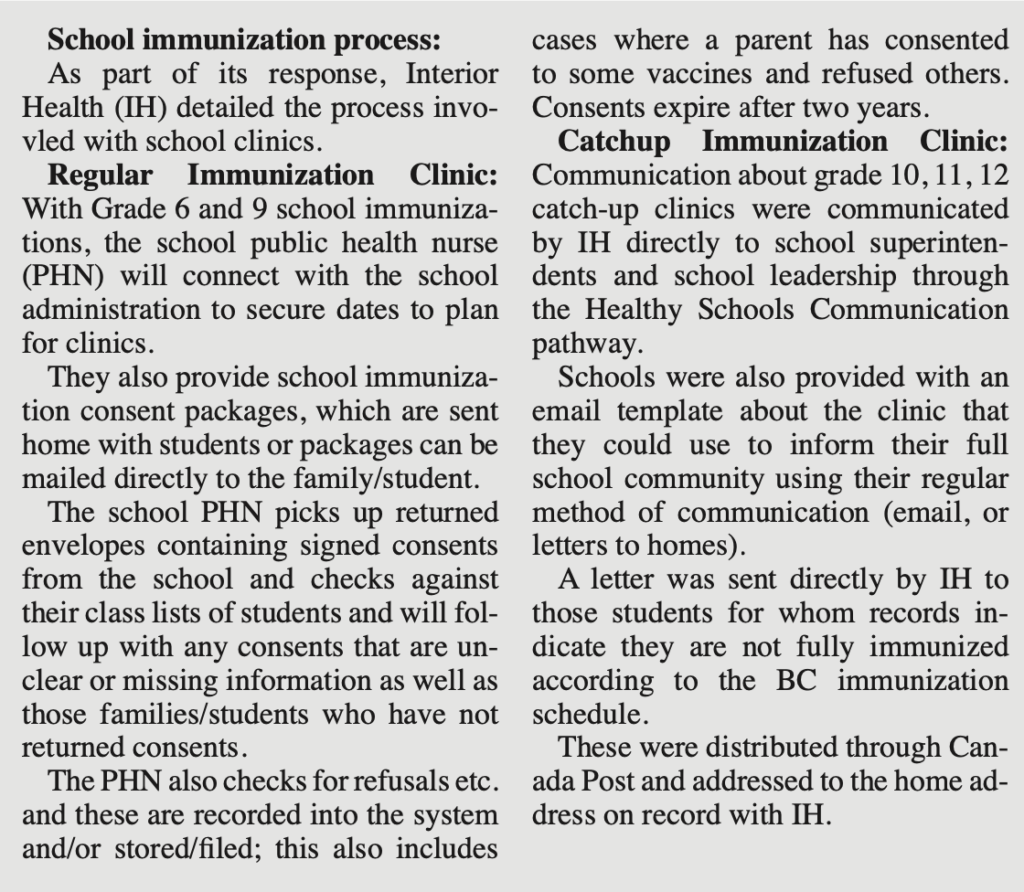
The health authority also notes that students in Grades 10, 11 and 12 can provide “mature minor consent” to immunization under the BC Infants Act.
This consent stipulates that a youth who demonstrates an understanding of the benefits and risks of a health service can consent or refuse that service independent of a parent or representative.
Before accepting consent from a child, a healthcare provider has to give the child information about the vaccine including:
- Which vaccine they are due to get
- The benefits of getting immunized
- The risk of not getting immunized
- Common and expected side effects
- Rare serious side effects
- Medical reasons to not receive a vaccine
The child will be given time to read over the information and to ask questions. The child will then be asked some questions to make sure they understand the information and are ready to make a decision.
“This process was followed at this clinic,” Interior Health stated about the Osoyoos Secondary School clinic. On the issue of autism, Interior Health said it “varies in degree along the spectrum, [and] does not specifically preclude an individual from providing consent,” adding “our priority is to support individuals and families in having access to the protection they need from communicable diseases through immunization.”
For Das this experience is indicative of the need for change. “Something needs to change here,” she says. “It’s our right to be able to protect our children, especially ones with special needs so that this sort of thing doesn’t happen to them.
“They are vulnerable and they just don’t know any better. My heart just aches over this.”