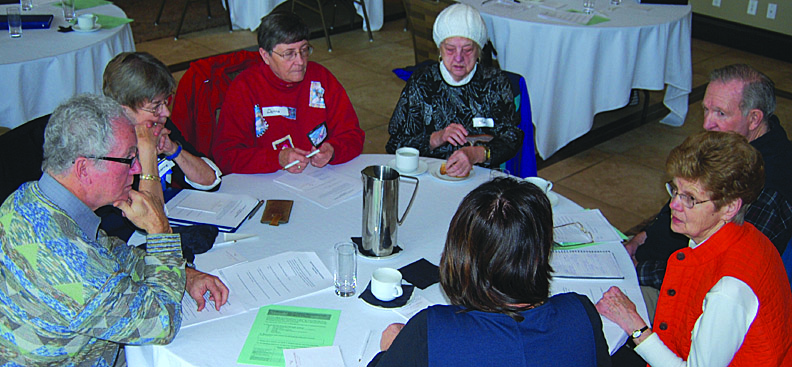
About 15 people attended a public meeting on Dec. 10 at Osoyoos’s Walnut Beach Resort to give their input about the status of services available to Osoyoos’s senior citizens who want to continue to live in their own homes. Clockwise, from left: Mike Vanderbeck, the project’s co-facilitator, Joanne Mepham from the Soroptimists International of Osoyoos, Donna Kelso from the Osoyoos Kiwanis Club, residents Mary Marcino, Ed and Virginia McQuarrie and Janis St. Louis. Photo by Laurena Weninger - Click on picture for larger image
OSOYOOS TIMES-December 16, 2009
By Laurena Weninger – Osoyoos Times
“Mostly what’s working well is the support from family and good neighbours,” said Janis St. Louis. “The rest is quite fragmented, and people are not aware of what is available.”
St. Louis, an Osoyoos resident who was attending a public meeting on Dec. 10 about challenges facing senior citizens who are trying to remain in their homes, was offering up some of the answers thought up by her brainstorming workgroup.
The meeting, held at Osoyoos’s Walnut Beach Resort, was hosted by Dawn Lybarger, the coordinator of a project called Community Action for Seniors’ Independence (CASI) and was attended by 15 people.
Those who came to the workshop included seniors who are currently struggling to continue living on their own, as well as representatives from Interior Health, the Osoyoos branch of the Royal Canadian Legion No. 173 and service groups like the Osoyoos Kiwanis Club and Soroptimists International of Osoyoos.
A few of those people present at the meeting are currently caring for seniors in their own homes and wanted to weigh in about what they think is necessary to help someone remain independent.
St. Louis falls into this category.
She cares for her mother and father, who reside with her.
The key goal of CASI is to find out what communities need in order to help keep senior citizens independent, and in their own homes, longer.
“We know that some seniors, they’re in their own homes, but it’s getting harder to stay in their own homes,” Lybarger said. “They need help, but it’s hard to find, and it’s expensive, especially in small communities like this.”
According to a handout given out at the meeting, it is important to allow seniors to remain in their homes as long as possible because it lowers the “human costs” of giving up familiar faces, places and supports.
It postpones the higher costs of institutional care, as well.
But senior citizens who live alone still need help.
That can include assistance with home repairs, housekeeping, meal preparation and transportation.
Attendees at the meeting here in Osoyoos said the top priorities should be establishing more assistance with transportation and escort services, having a central agency for seniors and their caregivers to contact to find out what services are available and how to access them, and respite for those caring for spouses or parents who are elderly.
CASI is a partnership between the B.C. Ministry of Healthy Living and Sport and the United Way of the Lower Mainland.
It is a three-year project, focused on finding ways to help communities fine-tune their support systems for seniors.
There are five pilot communities in B.C.: Dawson Creek, Newton, Renfrew-Collingwood and Maple Ridge/Pitt Meadows.
Osoyoos was chosen to represent B.C.’s Interior and also because of a few other criteria, Lybarger said.
It’s small, has a high percentage of senior citizens and while it doesn’t offer a lot of services, there are some.
In October, the CASI team met in Osoyoos for the first time.
They brainstormed about the project, about what seniors need and what is needed in Osoyoos.
On Dec. 10, the same questions were asked at the public meeting.
“That’s what we’re interested in – if you agree with this stuff,” Lybarger told those in attendance.
The end goal is for the community to come up with a way to increase these services and to develop a lead agency or committee to spearhead the project locally.
If the project comes to fruition, there will be a paid coordinator and initial funding, but in the long run it will have to be sustainable.
That means those using the service will have to pay – likely on a sliding scale – and some of the effort will have to be made by volunteers.
While all five communities have been named for the pilot project, one community will be chosen to start first and it isn’t going to be Osoyoos, Lybarger explained.
That is in part because the United Way of the Lower Mainland is one of the major funders and that means one of the Lower Mainland communities will see the service first.
The B.C. Ministry of Healthy Living and Sport is contributing $700,000 to the project and the United Way is contributing $250,000.
All of the suggestions from the public meeting will be compiled and taken back to a future meeting with Osoyoos stakeholders before any further decisions are made.
Information updates on the project can be obtained by emailing [email protected].
[email protected]