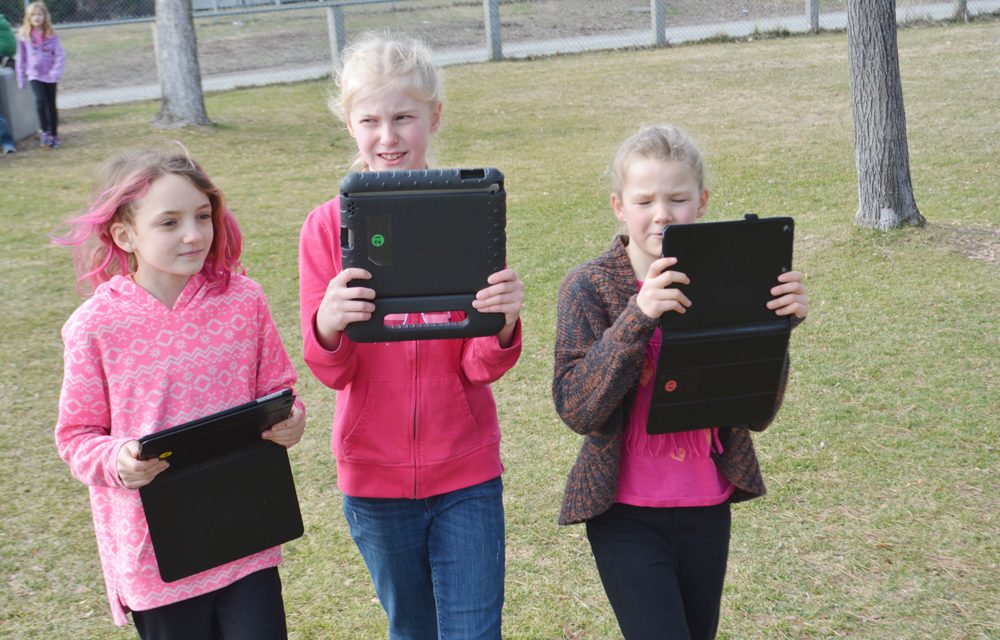

From left, Ruth Otto, Kaeli Lester and Maya Baerg use iPads to record random acts of kindness at Tuc-el-Nuit Elementary School on Pink Shirt Day. Photo by Lyonel Doherty
Our fathers always told us to stand up to bullies; to get the first punch in.
“He won’t know what hit him, and he’ll think twice about bothering you again.”
Our mothers told us to just walk away, or tell a teacher.
But Ben Somerville had a different approach when a bully put the hurt on him.
“I killed them with kindness . . . be nice to them (like a sucker punch, they won’t see it coming).”
And it worked because they stopped being bullies. In fact, “we became friends,” Somerville said.
The Link Crew member at Southern Okanagan Secondary School joined his classmates in organizing an assembly for Grade 8 pupils on Pink Shirt Day last week.
Classmate Gavin Buttar described how one student’s act of kindness in Grade 8 gave him the strength he needed to carry on.
This student witnessed how Buttar had no friends in high school.
“When I was younger I didn’t have friends; I didn’t have people who wanted to talk to me.”
Besides being excluded and feeling terrible, he was also bullied. (It was like a teen movie on Netflix and he was the star victim.)
Then one lunch hour this person hung out with him after seeing what was happening.
“That one lunch hour gave me such a huge boost,” Buttar said.
Link Crew coordinator Alison Podmorow said it’s the tiny acts of kindness that make a big difference in people’s lives.
Over at Tuc-el-Nuit Elementary School, Cindy Dos Santos organized a project that saw students roaming the playground recording acts of kindness on their iPads.
Grade 3 pupils Kaeli Lester and Maya Baerg learned a little about filmmaking in the process.
Maya said random acts of kindness are important because it “shows the world that we care.”
Kaeli filmed Maya picking up a ball that was dropped by some pre-school kids.
Honey Baptiste said it’s important to be kind so that no one bullies each other. “And it feels good to be nice.”
Grade 5 student Ruth Otto described how she was bullied one day by some girls from a neighbouring school.
“I was walking to school and these girls called me names because of my hair. I told my parents about it and my parents told me to tell the principal.”
She did.
“If they didn’t stop, she (my principal) would talk to their principal,” Ruth added.
The little girl said if someone bullies you, the best thing to do is walk away and tell an adult, or talk to a friend.
She explained that bullies are lonely with no one to play with.
“If you are nice to them, they will be nice to you . . . give them a chance.”
Honey said you shouldn’t be scared of a bully because they are people just like you. But she admitted that being bullied is stressful to the point you can’t learn.
Back at the high school, Alison Podmorow said the concept of Link Crew started in the United States with a group that wanted to stop the hazing of college freshmen.
Instead of welcoming new students in a positive way, they stuffed them into lockers (or made them drink out of the toilet).
Link Crew was created at SOSS in order to build a link between the older students and younger students. And it is definitely working because many Grade 8s feel that positive connection when they enter the high school.
Unfortunately, a lot of the bullying today starts on social media, said 16-year-old Mikayla Podmorow.
“People have the idea that they can say whatever they want (without being held accountable for their actions and the hurtful impacts),” she said.
Fellow student Sky Thompson said it’s easy to be behind a phone where you can do a lot of damage while being protected by a digital screen.
She has seen one comment on an issue quickly spiral into 200 comments (like a virus).
When Mikayla was 13, someone commented on social media that her glasses made her look unattractive. The person stated she looked much prettier without them.
Mikayla felt hurt, so her mother had her remove (delete) the social media (AskFm).
“Parents have to be aware (of what’s going on and what’s being said),” Alison said.
The teacher acknowledged that bullying in this generation is brutal online because it causes so much pain (mentally) due to the “stupid things” young people say to each other.
But ironically, students are so tolerant of cultural differences today, she pointed out.
“They are more tolerant of each other, but cyber bullying . . . behind the screen they turn into vipers.”
Link Crew member Jojo Abellan remembered being bullied in Grade 3 when she wore Dora the Explorer clothing. But the bully realized how hurtful this was and subsequently apologized.
“She saw how hurt I was, and we became friends.”
Abellan believes that if bullies can see the damage they are doing to their victims, their attitudes would change.
Ironically, it’s not strangers who are the bullies, it’s so-called friends who bully each other, Abellan said.
Thompson said some people are very nice to you face-to-face, but are quick to criticize behind your back or on social media. And all it takes is a little misunderstanding or the wrong perception to start a social media virus against someone.
Alison said if a teacher is aware of a bullying incident, he or she has the power to do something about it.
For more information on cyber bullying, visit http://www.stopcyberbullying.org/
By Lyonel Doherty