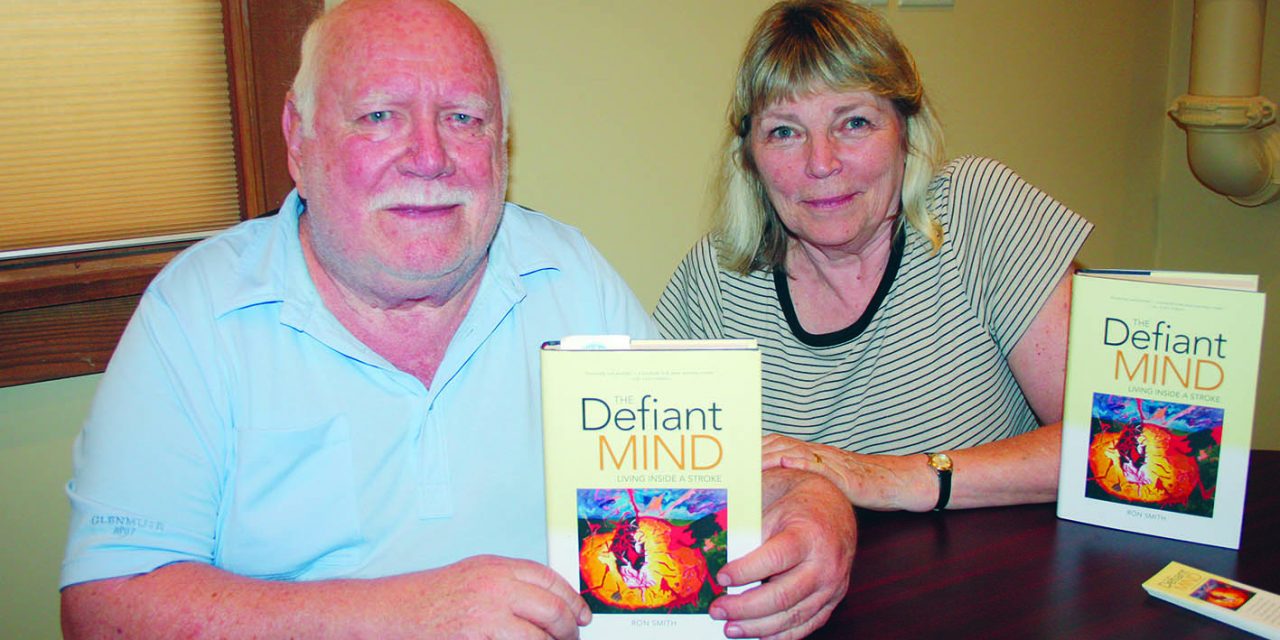
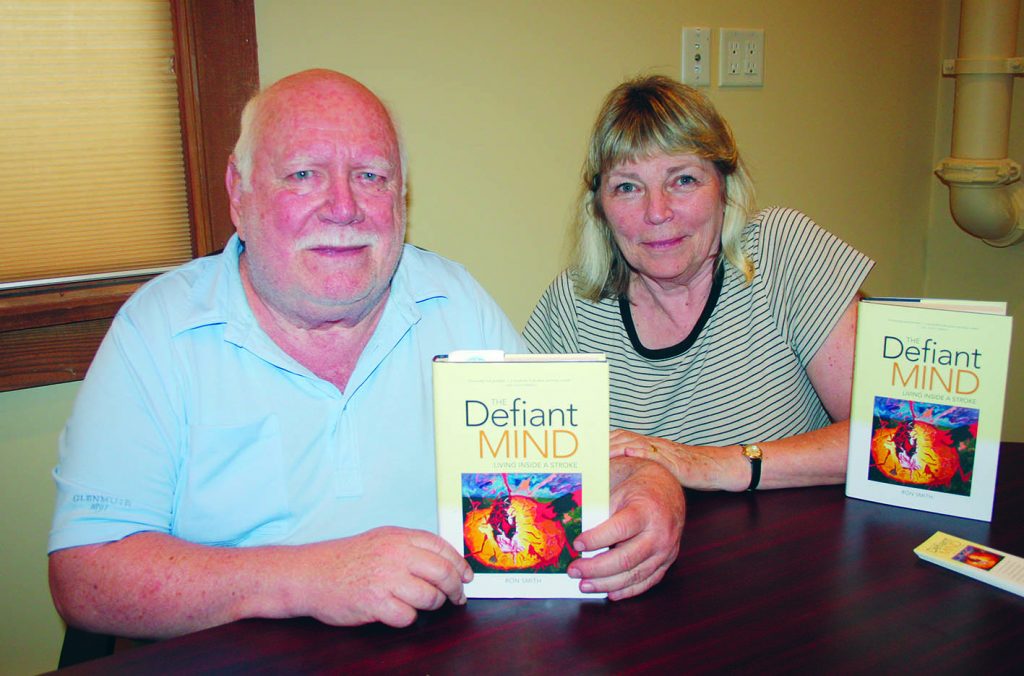
Ron Smith, shown with his wife Pat, wrote a book about his recovery from a massive stroke. He also discussed major medical advances in stroke research during a recent visit to Osoyoos. (Keith Lacey photo)
Canadian researchers are on the verge of the most dramatic and effective treatment for stroke sufferers in more than two decades, said a Nanaimo college professor and publisher, whose life was changed forever five years ago after suffering a massive stroke.
Ron Smith, the proud new author of the book called The Defiant Mind: Living Inside a Stroke, visited Osoyoos recently and made a presentation about his new book and his personal journey since almost dying as a result of his stroke five years ago.
During a 75-minute presentation, Smith detailed his near-death experience, the challenges he faced in writing his new book while recovering from a stroke and major advances being made in Canada to improve patient outcomes.
The most promising development in stroke research anywhere in the world is currently taking place by Canadian researchers, led by Dr. Michael Hill, and his team at the University of Calgary, said Smith.
A randomized controlled trial showing that a clot retrieval procedure, known as endovascular treatment (ET), can dramatically improve patient outcomes after an acute ischemic stroke, he said.
Ischemic stroke is caused by a sudden blockage of an artery to the brain that deprives the brain of critical nutrients, such as glucose and oxygen.
Currently, the international standard of care based on Canadian, U.S. and European guidelines is to administer a drug called tPA when appropriate. Known as a “clot buster,” the drug dissolves the blood clot.
In the University of Calgary trial, 316 patients who fit the criteria for ET and arrived for treatment within 12 hours of their stroke were randomized to standard medical care (which included the clot-busting drug tPA where appropriate) or standard medical care plus ET.
ET is performed by inserting a thin tube into the artery in the groin, through the body, and into the brain vessels to the clot. This is done under image-guided care using an X-ray. The clot is then removed by a retrievable stent and pulled out, restoring blood flow to the brain.
Close to 85 per cent of strokes are ischemic, while the other 15 per cent are hemorrhagic, said Smith.
Positive outcomes for patients have increased from 30 per cent to almost 70 per cent and instead of suffering major neurological disability, patients can go home once the clot is removed and resume their normal lives, said Smith.
Incredibly, the treatment to remove the clot in the brain is still effective up to 12 hours after someone suffers a massive ischemic stroke, said Smith.
“This is the leading scientific study in the world on stroke … but so few people even know about it,” said Smith.
This procedure has recently been offered at Victoria General Hospital and Vancouver General Hospital, he said.
This latest research is encouraging, but most stroke sufferers know nothing about it and neither do most medical professionals, said Smith.
Smith recalled the day he almost died from his massive stroke like it happened yesterday.
He was on his computer at home and knew something wasn’t right, but he choose to ignore his symptoms, until his wife Pat insisted he go to hospital.
“I had been feeling odd since noon … I thought I had the flu,” he said.
Even though his right hand had formed “a lobster claw” and he knew something wasn’t right, “a certain amount of ego takes over” and he ignored the symptoms and went to bed, said Smith.
When he told his wife in bed about his day, she insisted he go to the hospital.
If he hadn’t finally agreed, he would have died, said Smith.
“We drove in and thank God we did, because I would have died,” he said. “She saved my life.”
While he passed some basic tests given to all patients relating to possible stroke, the doctor in charge told him he was keeping him under observation for up to five days.
“I had my stroke in the Emergency Room,” he said. “I wouldn’t be here today if I hadn’t gone to the hospital that night.”
Over the past five years, his road to recovery has been long and frustrating and he and his wife have had to overcome many major hurdles, but he’s thrilled to be alive and enjoying life, said Smith.
One harsh reality is “too many doctors don’t listen” to what patients have to say and believe there’s only so much they can do to assist stroke survivors, he said.
When you suffer a massive stroke “a part of your brain dies” and it’s difficult to deal with, but the human brain is capable of amazing things and not enough time and effort has been directed towards utilizing other parts of the brain in stroke recovery, said Smith.
“It’s simply a fact that they (medical professionals) don’t have enough information about the brain,” he said. “I had one doctor tell me there are two frontiers … outer space and the other is the three-pounds sitting on top of your shoulders.”
Before his stroke, he was able to type more than 80 words per minute, but could only type eight to 10 words per minute using one finger after his stroke, said Smith.
He knew within eight months after leaving hospital that he wanted to write a book about his journey from suffering to recovering from a massive stroke, he said.
He wrote the book because so many stroke survivors suffer alone in silence and he wanted to provide a voice, he said.
“So many of us feel alone in the world,” he said. “Part of my brain is gone and I knew that. There were many things I couldn’t remember and I felt adrift. When I talked to other stroke survivors, most of them clammed up and no one said anything.
“It takes courage to get up and talk about things you are experiencing … and that’s what I’ve tried to do with this book.”
Copies of Smith’s book are available on Amazon.com and in most major bookstores in B.C.
KEITH LACEY
Osoyoos Times