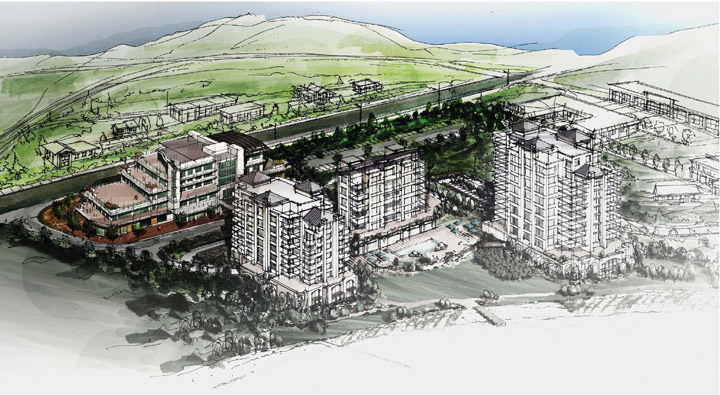
An artist’s rendering of the proposed Oasis development. The project, if approved, would be built on vacant land near Peanut Lake and would consist of a five-storey medical-commercial building and three residential buildings at six, eight and 10 storeys in height. Image courtesy of the Town of Osoyoos - Click on picture for larger image
OSOYOOS TIMES-August 11, 2010
By Paul Everest – Osoyoos Times
Osoyoos council has laid the framework for one of the town’s most ambitious development projects.
At a special meeting on Aug. 4, council gave first reading to an amendment to Osoyoos’s Official Community Plan, a zoning amendment bylaw as well as a phased-development agreement bylaw that will, if approved, allow for the Oasis development to be built between Hwy. 3 and Peanut Lake northwest of the Avalon Mobile Home Park.
The project includes a proposal to build a five-storey medical-commercial building along with three residential buildings that would be six, eight and 10 storeys in height and contain 237 units.
The amendments to the OCP and zoning bylaw would convert the existing land use designation for the property from High Density Residential to Comprehensive Development which allows for the medical-commercial building as well as the residential units.
If approved, the development would be built in four phases over a 10-year period, with Phase 1 consisting of construction of the medical-commercial building next year.
There will be separate development permit processes for each phase.
Before going ahead with first readings for the amendments and the phased-development agreement bylaw, council expressed concerns with a timeline put forward by Town of Osoyoos staff for a public information session on the project and the public hearing and further readings for the development.
Staff had originally recommended having the information session on Aug. 10, but Mayor Stu Wells said that date would not give the Town enough time to adequately inform the public of the session.
He added that council had been accused of not doing its “due diligence” in informing the public on other recent matters such as the proposed marina project for Lions Park or water zoning policies and the timelines set forth by Town staff would further inflame such concerns.
Coun. CJ Rhodes agreed that the project would have a “profound effect” on residents in the Peanut Lake area and giving the public plenty of advance notice of the session is mandatory.
Coun. Michael Ryan said he felt the staff suggestion to hold second and third readings immediately following a public hearing on the project on Aug. 16 was not a good idea, saying the timeline was “too compressed.”
Alain Cunningham, the Town’s director of planning and development services, said, however, that the project has been on the Town’s radar for some time and the timeline was meant to reduce further costs to the developer.
Council approved a new timeline where an information session on the project hosted by Town staff would be held on Aug. 25 at 4 p.m. and the public hearing would be held on Sept. 7 at 7 p.m.
Both meetings will be at the Sonora Community Centre.
Part of the project includes a proposal to build a new public road through the site that will extend from Vedette Drive to Hwy. 3
Coun. Margaret Chadsey asked if Vedette Drive residents and nearby businesses could receive notices in their mail advertising the information session and Cunningham said “sure.”
Wells called the project the “biggest development that I’ve seen in the history of Osoyoos” in terms of its “overreaching implications.”
Cunningham said the development is consistent with “Smart Growth” goals laid out in the town’s Official Community Plan as well as the Regional Growth Strategy for the area in that the project would focus urban growth in an already urbanized area.
Council also brought up the probability that some within the community will have issues with the proposed height of the residential buildings, each of which is far beyond the Town’s four-storey limit and Wells said he’d be interested to know what people think of the planned building heights.
The zoning amendment bylaw also deals with the issue of a density bonus for the project.
The developer aims to build out to the residential component of the project to the maximum number of units allowed under the property’s current zoning — 100 units per hectare.
At 2.37 hectares, that comes out to 237 units.
The medical-commercial building would force the concentration of the residential buildings into a 1.44-hectare portion of the property, however, meaning the developer would exceed the limit by 93 units.
Going over the limit would mean that the developer has to apply for a density bonus.
Council agreed, however, that the medical-commercial building would be a sufficient public benefit to waive the need for the density bonus.
Instead, the Town will receive $500,000 in “amenity value” cash payable at a starting rate of $1.20 per square foot.
The cash will be paid by the developer to the Town at the issuing of the building permit for each phase.
Part of the proposed phased-development agreement between the Town and the developers also includes a clause that if 35 per cent of the space within the medical-commercial building is not filled within six months of its opening, the developer will pay the Town $300,000.
Half that cash would come at the end of Phase 3 and the other half at Phase 4 if the 35-per-cent occupancy rate is not met.
The developers of the project, Desert Lagoon Holdings Ltd., a company made up of Ron Bartsch of Osoyoos, who owns the parcel of land where the project would be built, and partner Stanley Yasin of Vancouver, intend for the medical-commercial building to house medical, professional and retail space.
Bartsch has said that, if built, the centre would have facilities to accommodate day surgeries and emergency services.
The developer would also dedicate parkland around Peanut Lake and the Town would receive more than $1.5 million in public works attached to the project, including roads, sewers, storm-water treatment, landscaping and the upgrading of Vedette Drive.
The phased-development agreement bylaw would give the mayor and the Town’s corporate officer the right to execute a phased-development agreement with the developer.
Such an agreement has to be in place before zoning changes for the property are approved.
The agreement, which would run for 10 years, would prevent future councils from altering the zoning on the property.
[email protected]