By Sebastian Kanally, Times Chronicle
To share this story click here to generate a link.
Stage one water restrictions are now in place in Oliver, but not all councillors agreed they should be declared.
The decision to enact these restrictions was not unanimous as Councillor David Mattes and both Water Councillors Rick Machial and Bhupinder Dhaliwal voting against the action.
Mattes explained, “I don’t think we have ever had watering restrictions this early in the year, we might be jumping the gun a little bit. I recognize that the snowpack is certainly a factor, but we also don’t know how wet our spring and early summer will be . . . I just think this may be a little bit premature”.
The April 1, 2024 provincial snow survey shows that BC is only at 63 per cent of normal snowpack levels, with the Okanagan being at 73 per cent.
Lower than normal snowpack levels can signify potential water scarcity issues in the upcoming months and the report to council expressed that this necessitates proactive measures to manage water resources effectively.
These snowpack levels, along with Observational Wells 405, 407 and 332 in Oliver reaching concerning levels contributed to the town seeing this as necessary.
Machial agreed with Mattes that it was too early, commenting that “people are not really watering much anyway.” But his main reason for disagreeing was the tax revenue the town will miss out on if they implemented water restrictions.
He explained, “we rely on that revenue, if we cut back we don’t have any revenue, where do we get the revenue for our budget?”
He continued to say that if our wells are too low then that’s fine, but if we are just enacting these restrictions “to keep up with the Joneses then I disagree wholeheartedly.”
Mayor Martin Johansen responded, “about losing revenue if you don’t have water, who cares about revenue? You don’t have a town, people’s property values go down. What does that say about what we are doing here? I mean I am willing to wait, but I think having water is more important than having revenue.”
“The Joneses” Machial was referring to are nearby municipalities that either have water restrictions all year or have already declared them which the town included in the report.
Some of these are as follows:
- Penticton – stage one restriction May 1st to Sept. 30th, alternate days.
- Osoyoos – normal water restriction, rural system eight & nine, alternate days.
- Regional District of the Okanagan-Similkameen (RDOS) – all year normal water restriction, alternate days.
- West Kelowna – stage one, restriction all year, alternate days.
Machial further pointed out that “a lot of our wells are actually charged from the (Okanagan) river, I have never seen the river so low . . . At some point, our river is going to go up, and I got a feeling our wells will go up with it.”
Johansen disagreed with Machial and responded to these comments by saying there are indeed concerning facts here, the Rockcliffe Well has nothing to do with the river and it’s down the most at 1.4 metres (4.6 feet).
He went on to say, “When you look at Okanagan Lake, it’s three feet below full pool. They are not letting any water out because they want to try and get to a full pool which they are probably not going to get to. So I would think if you are banking on the river coming up I think you are going to be out of luck.
“I am willing to wait a little bit, but waiting till we are out of water . . . the data is showing we are on the bottom end of where we should be and if it goes down and the river doesn’t come up and those don’t recover, I would rather be a little more proactive then be concerned about a little drop in revenue.”
Councillor Petra Veintimilla agreed with Johansen that “I don’t think there is any harm in being a little cautious and a little proactive”. She also explained that it is not a bad thing to get people into the habit of using water wisely.
“Three days a week is not overly restrictive, there’s no extra restrictions on washing your car or washing your house, things they have already put in other communities.”
The stage one restrictions passed four votes to three. Now that water restrictions have been implemented, the observations are on two week cycles. If wells increase and the levels are above the standard for two weeks, then the restrictions will be taken off. If they go down further the same two week cycles are in effect.
As of April 22, the report showed that almost all the wells are below what they were last year. The Miller Road Well is 0.8 metres lower than last year at this time. Buchanan Well is 0.7 metres lower, Black Sage Well is 0.98 metres lower, and the Rockcliffe Well is 1.4 metres lower. The Tucelnuit Wells are about the same level as they were last year.
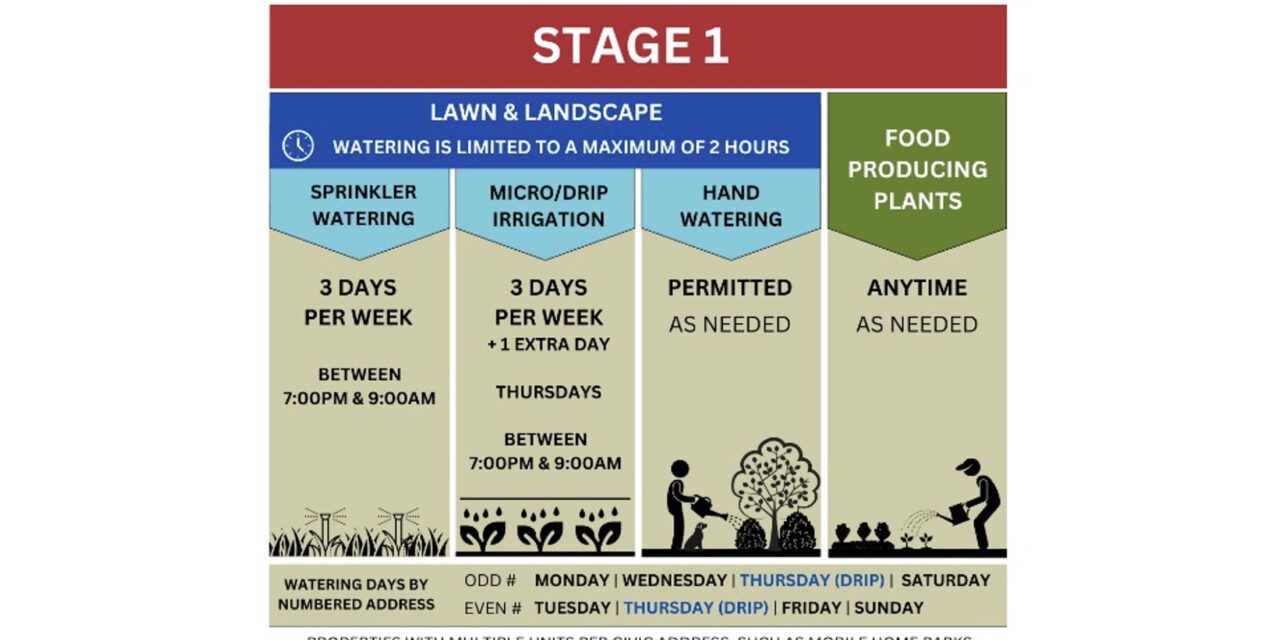
Stage one water restrictions impact domestic and non-agricultural water users. Stage one water restrictions mean that properties with water flowing through a water meter, or using domestic groundwater for irrigation must restrict their watering based on their house number.
Watering may take place for no more than two hours on each irrigation day and only between the hours of 7 p.m. to 9 a.m.
If the property has an odd numbered address watering is permitted on Monday, Wednesday and Saturday. Even numbered addresses are permitted to water on Tuesday, Friday and Sunday.