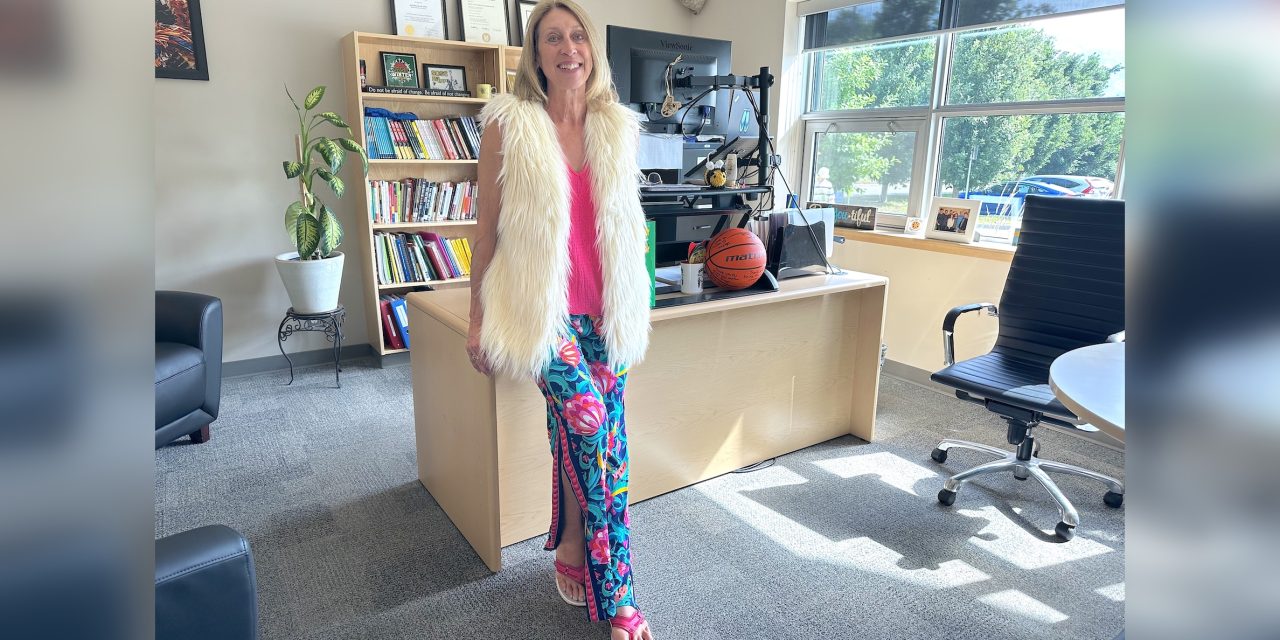
By Don Urquhart, Times Chronicle
(video below)
When the Times Chronicle asked Tracy Harrington in late June how she felt about being on the verge of retirement after 27 years teaching and administrating at Oliver’s Southern Okanagan Secondary School (SOSS), she paused ever so slightly before replying, “nervously excited”.
“You know, part of the next chapter, right? I just feel like it’s my time now, and I’m still loving what I’m doing. I love the people that I work with, the kids. It’s a good time to be going when things are going well and I just want to start doing some other things,” she says, adding it’s been 35 years in total she’s been in education.
Harrington has been a keen fixture at the school moving from PE teacher, to vice principal, to principal over the course of two and half decades, something she acknowledges is not very common. “Very few people are able to do that, I’m just super grateful,” she adds.
She has no specific plans at the moment adding she just wants some down time but doesn’t rule out tapping her long career experience at some point going forward. “I just really want some time to unwind and relax and breathe a little bit, yeah, and then I still have tons of energy to do other things but I think I’ll be selective on what I choose.”
She says it’s been a “big job but a very fulfilling one”. It’s also one that started pretty much as a six day a week job. “As I’ve grown into the job over the last 14 years, I’ve been able to take weekends off,” she laughs.
There’s a lot of work still, she says with meetings and events during weekday evenings, so the days are a little bit longer than many jobs. She adds that she’s enjoyed mentoring Cameron Adam who came on as vice principal about a year and a half ago and takes over as principal from her.
When asked what is one of the biggest changes over the years she laughs when she recalls that they didn’t even have photocopiers when she first became a teacher. Instead the technology of the day was mimeographs which used a stencil and ink to create copies that required hand cranking to produce the copies. “So when we got a fax machine, that was huge,” she laughs.
That evolution of technology now finds the school environment facing something a little more sophisticated, if not challenging, than the mimeograph – AI.
“With AI, it can be used for good and it can be used for bad. So, you know, we’re just at the early stages of figuring out how to work with kids to make sure that they’re safe using it, understanding the pros and cons of using it, and how to use it appropriately. So those are things that we’re working on right now. But there are a lot of benefits to it as well,” she adds.
Kids now as young as Grade 8 learn about the social side of technology. “Digital literacy is very important. We have to be able to keep our kids safe online,” she says.
It is nonetheless a game of catch up she admits because of just how fast technology changes. “I think everybody’s trying to catch up, but the district is actually doing a great job. They’re putting together something that we can use to work with our kids and our teachers. And that’s, that’s huge, the consistency is really helpful.”
Mental health is another key area that gets keen focus now, as compared to even 10 years ago when it wasn’t really talked about very much, she says. This includes various strategies to help kids regulate. “I think it is definitely something that we’re prioritizing because we’re recognizing the impact of mental health, social anxiety, all of those things, and how it impacts our kids getting to school, their academic success.
“I’m grateful that we are paying attention to those things, because when those strategies are put in place, they really help kids beyond high school. So those are strategies that they can use to help them with success beyond here.
As for the COVID-19 pandemic she says it was quite impactful. ”Kids staying at home and isolated for as long as that can’t help but be impacted.” Things are easing on that front she says, in large part because a few years have put some distance in between. “But I think for some of those kids, the lasting impact is still there.”
There is of course another topic that is on the minds of educators and that’s cell phones. “I think the idea of no phones in school is really, really great. I think the management of the policy is challenging,” she concisely sums it up.
There are numerous reasons for this difficulty, including both kids and in some cases parents, who “believe that they need their phones.”
They are supposed to be away in lockers or backpacks, only used for research and for use on the breaks and at lunchtime.
“But it’s hard when you have a lot of different kids, large staff and everybody has their own ideas, it’s hard to keep it consistent, but I think it’s really, really important to not just let it slide.”
One thing that helped was by providing students with data on why it’s important to have phones put away. “Helping them understand, rather than just enforcing it, we found less push back,” she says.
And is it still an awarding career being a teacher? “Oh, I think so. Teachers have the greatest opportunity to impact kids every single day. It’s the best job ever, because you can actually see when you make a difference with kids.
“I think we get very high quality teachers in our area. We’re very fortunate,” she says, noting that many of the teachers here have been here for over 30 years. “This has been their only school that they’ve taught at, that’s very unusual,” she says.
“It’s a good reminder that good teachers in good environments with great kids and great families don’t want to move. And I’m happy about that because then you can build that sense of community, that family, which I really feel SOSS has.”
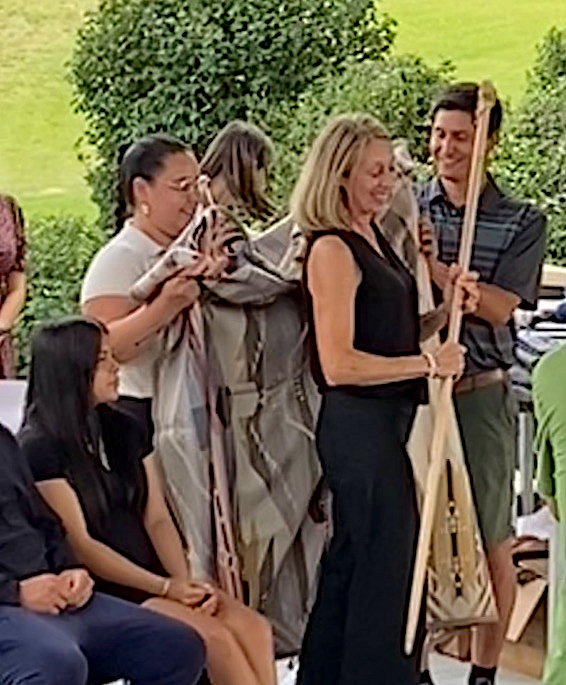
Tracy Harrington is gifted a blanket and paddle by the Osoyoos Indian Band’s Taylor and Ryan Baptiste. Taylor did the art work on the paddle, Ryan created the paddle and Wade (no last name indicated) harvested the wood for the paddle from yellow cedar.
The blanket and paddle were gifted on behalf of the OIB in recognition of the 300+ band members that she was involved with in enhancing their educational experience and potential for their future. It also recognized her efforts in creating and enhancing recognition of the numerous indigenous cultural components of the shared community.
Contributed photo
Among the many memories she points out a few that come immediately to mind, including trips to the Gulf Islands, a trip to Europe last year and of course the fact Venables Theatre burned down only four days into her new role as VP back in the day – “That’s a big one,” she says with a mist of reminiscence.
The pandemic was also pretty memorable, she notes, because it was “really, really hard, really hard, to keep those connections with kids and families and staff doing everything online.” And it was a time of so much uncertainty with conflicting sets of memos coming in the same day, she says of the administrative challenges of the pandemic.
One thing that is clearly important to Harrington is the idea that the school is a family. “I’ve continued to try to nurture those relationships. That’s the most important thing here. And I think just paying attention to my staff and connecting with them and making sure, like regular check ins are important, to make sure that they’re good, and then, you know, by proxy, then they’re doing that with their kids in their classes.
“So just kind of role modelling the behaviours that we want to see, knowing that if we’re struggling and our kids are struggling, that, you know, we need to help each other, we need to support each other.”
That notion of family also works its way out in how the school runs, as she rattles off a dozen or so events and happenings that see significant turnout to help with and support events covering everything from school breakfasts to their Circle of Courage, student run assemblies, and on and on.
The sense of “belonging and gratitude and mastery and independence are all really, really important, and we’re trying to work really closely with the students to provide more of those leadership opportunities,” in preparation for the larger world outside.
There is of course the inescapable acknowledgement that many families struggle and she is grateful for not only the government funding like the provincially funded Feeding Futures meal program, but the support of the community in general.
When asked if there is anything she could wave a magic wand and change with the current education system there’s no hesitation on Harrington’s part. “I don’t know that I would change much, I like where education is going, and if we can continue to help kids understand how to be independent thinkers, thinking critically, taking ownership, taking responsibility for their learning, being more independent,” she says.
Preparing the kids not simply to graduate, but to go boldly forward and succeed after they walk out of SOSS’ doors for the last time is absolutely important to her and the teachers. In reference to the grade twelves who were set to graduate in a couple of weeks when we were talking, she says it’s also about “making sure that we prepare them for life after high school, because the big bad world is a scary place for them. And you know, many of them have never lived away from home, cooked for themselves, and financial costs are quite huge right now.
“So I think, with the educational piece, just preparing them, making sure that they have the skills that they need to be successful beyond SOSS,” and know how to access resources, “I think that’s important too.”
Another aspect she likes about the current education system is the “new curriculum” which she laughs adding it’s “not new anymore”, that is more based on competencies. “So it’s not just content based – kids can just research content pretty quickly, so now, with the core curricular competencies, it’s meant to create that lifelong learner. So those things are really important.”
And finally what does she make of the rise of discrimination against 2SLGBTQA, influenced more generally by the sharp swing to the right in the US? “Our umbrella here is always, our filter is always, what’s in the best interest of kids.
“I think if that continues to be the mantra down the road, I think we’re on the right path, and we’re making decisions based on the fact we try to recognize all of our kids, and we want that to be part of our culture, our fabric – we welcome everyone, and everybody is important. Everybody’s voice is important.”