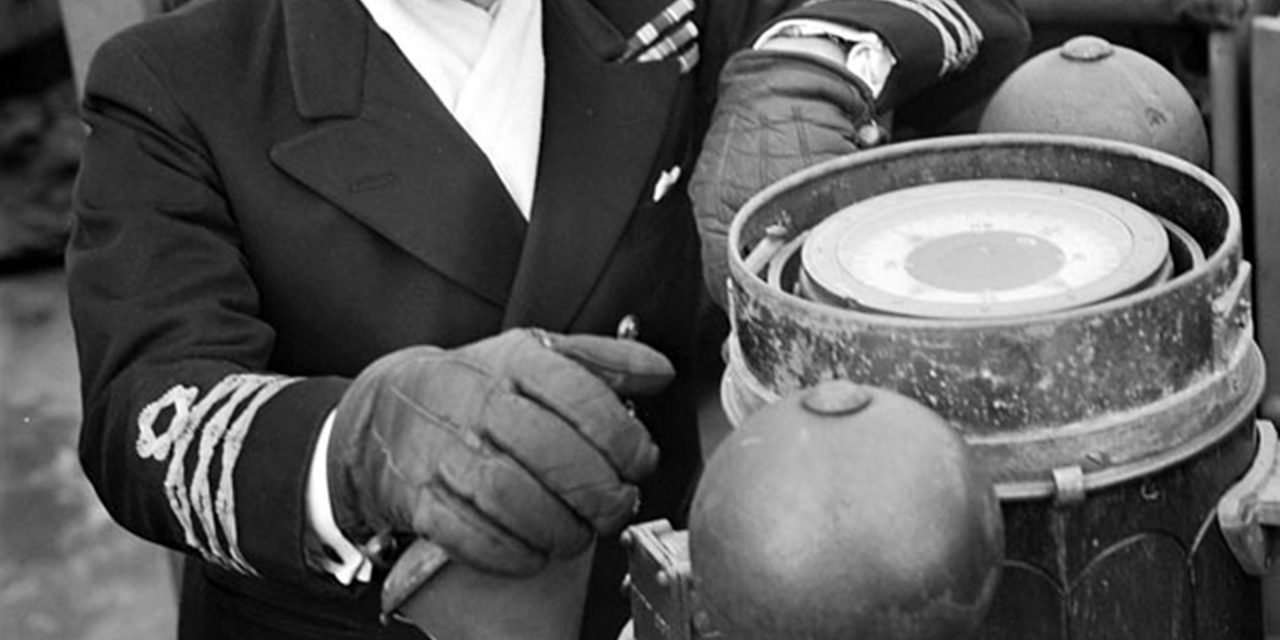

Commander Clarence A. King is pictured on the frigate HMCS Swansea around December 1943 to January 1944. In August 1942, he sank a German U-boat in the Caribbean, capturing its commander and other prisoners. He is buried at Osoyoos Lakeview Cemetery. (Lt. Gilbert A. Milne / Canada Dept. of National Defence / Library and Archives Canada / PA-191029)
When Remembrance Day services take place this Sunday, once again, as is traditional, the ceremony will include reading the honour roll – the names of the local men and boys killed in action in war.
Some in Osoyoos may be old enough to remember them, while others recall their names from previous Remembrance Day services.
Honoured less often on Remembrance Day are some of those who fought in past wars, accomplishing great successes, but returning to Osoyoos alive.
“Osoyoos has had quite a few war heroes,” said Terry Schorn, an Osoyoos area old-timer and member of Branch 173 of the Royal Canadian Legion. “I do a little bit of military history and I’ve been reading up on them. It’s funny that they all ended up here. And they did some pretty famous things during the war.”
Most of the men and boys Schorn refers to distinguished themselves during the Second World War, but some took part in the First World War.
Schorn has never served in the military – the closest he came was being active in Air Cadets as a teenager – but his passion for military history is partly inspired by his grandfather, Cpl. James Campbell Kempston, who died in 1916 in Belgium.
That, of course, was long before Schorn was born in Bridesville in 1934. But Schorn knew Kempston’s widow, his maternal grandmother, who remarried, becoming Olive Johnston and serving as postmistress in Bridesville for more than 30 years.
He’s done research into his grandfather, who was born in Dublin, Ireland, and served in India, Crete, Sudan and the Boer War in South Africa before joining the Canadian Expeditionary Force in 1914 to fight in the First World War.
But Kempston, who was blown up by artillery at the Second Battle of Mont Sorrel at Ypres, is the exception. The other local war heroes Schorn mentioned in an interview last week all survived their wartime experiences.
Of those, only Jack Shaw, now 93, is still living. He served as Osoyoos mayor in the early 1970s.
The others – Captain Clarence A. King of the Royal Canadian Navy Reserve, John “Jack” C. Keswick of the Army, Wing Commander Royd M. Fenwick-Wilson of the British Royal Air Force, and Les Goodman, who served in the Army in the First World War – are now gone.
King, who died in 1964, and Keswick, who died in 2001, are both buried at Osoyoos Lakeview Cemetery.
The British-born King was already a veteran of the First World War when as Lieutenant-Commander he commanded the Oakville, a Navy corvette tasked with escorting oil tanker convoys between Halifax and Aruba in the Caribbean.
Born in 1886, King was 56 in the summer of 1942, a generation older than others in his position.
At the time, German U-boats – submarines – posed a threat to shipping even along the Atlantic coast of North America and into the Caribbean.
There were several chokepoints for Allied convoys and one was the Windward Passage between Cuba and Haiti. There, on Aug. 28, 1942, the German U-boat U-94 lay in wait for the 21-ship convoy, TAW-15.
A U.S. Navy flying boat dropped depth charges, crippling the German sub before it could launch its torpedoes.
King then gave orders for the Oakville to ram the U-boat. Twice this was unsuccessful, but after King ordered depth charges, damaging the U-boat, a third ramming did the trick.
In the end, King captured the German commander and five other prisoners while some of his men boarded the sub and engaged in combat before it sank. The Oakville was badly damaged in the encounter, but King brought it safely to port.
After the war, King farmed at the north end of Osoyoos Lake, just below Graveyard Hill.
Schorn didn’t know King, but he remembers seeing him driving through Osoyoos in a Rover, a British car not commonly seen in Osoyoos.
Fenwick-Wilson was born in Greenwood. He served with the British Royal Air Force, earning praise for his role as a flying instructor.
He is remembered as the commander of No. 218 Squadron during Operation Glimmer, a combined air and naval diversion to mislead the Germans about where the D-Day invasion would land.
The “spoof” operation was intended to convince the Germans that a large invasion convoy was heading to the French port of Boulogne, a considerable distance northeast of the actual D-Day landing locations in Normandy.
The Allies had developed a technique to fool German radar by dropping clouds of aluminum foil, called “Window,” which appeared as a continuous blip on the radar, like an approaching fleet.
Combined with small boats, wireless equipment, reflecting balloons and other techniques, they created an illusion in the early morning hours of June 6, 1944 that an invasion force was headed to the Pas-de-Calais.
The deception involved flying aircraft in long circles, commanded by Fenwick-Wilson. There were no Allied casualties and the deception reinforced the German belief that the Allies were invading near Calais. And this delayed the Germans’ appreciation of the actual location of the invasion.
After the war, Fenwick-Wilson returned to Osoyoos and, like some other former military, he worked at the border as a customs officer.
He was subsequently posted to the embassy in Rome, said Schorn. Fenwick-Wilson still has family living in the Rock Creek area.
Schorn knew Fenwick-Wilson a little, but the war hero and his wife became good friends of Schorn’s parents.
Keswick was known for his role in the liberation of the Netherlands. Schorn recalls him after the war.
“When I knew Jack, he was a customs officer at the border,” said Schorn. “I never really talked to him about his history.”
But another old-timer, Ruth Schiller, recalls visiting Amsterdam about 50 years ago with her daughter and learning first hand about the high regard the Dutch had for Keswick.
As commander in the region, Keswick operated from the Amstel Hotel, a major and historic hotel in the Dutch city. He was stationed there with other Canadians after the liberation.
Schiller said she wanted to check out some of Keswick’s war stories, “that just get to be bigger and bigger.”
Keswick told her to say, “Keswick sent you.” Those seemed to be the magic words that led the hotel manager to roll out the red carpet for her.
She couldn’t believe the reception she got as they told her anecdotes about Keswick’s stay.
“He was just the star,” she said.
Jack Shaw, who was profiled in the Osoyoos Times in November 2014, flew Lancaster bombers on some 34 trips over Europe.
As Germany was collapsing and Allied troops were advancing, Shaw participated in the bombing of the eastern German city of Dresden in February 1945.
A couple months later, just days before the German surrender, Shaw took part in a bombing raid on Adolf Hitler’s Berghof home in the Bavarian Alps. The Allies wrongly believed Hitler had gone there, but in fact he was still in Berlin where he committed suicide five days later.
Schorn knows the least about Les Goodman, a captain in the First World War. But a picture of him downstairs at the Legion serves as a reminder of Goodman’s role. Schorn believes Goodman subsequently was in charge of the Veterans Guard of Canada in the Okanagan during the Second World War.
Schorn hopes that these local men and others will also be recognized and memorialized for their contributions to Canada’s various war efforts.
“I’m sure some of these other people have stories that may be similar or may be different,” said Schorn. “It would be nice to have them recognized, I think.”
RICHARD McGUIRE
Osoyoos Times

Terry Schorn, who is in charge of charities and bursaries for Branch 173 of the Royal Canadian Legion, thinks we should also celebrate the war heroes from Osoyoos and area who were not killed in action. (Richard McGuire photo)

Clarence A. King is buried at Osoyoos Lakeview Cemetery. He played an important role in stopping German U-boat attacks on Allied convoys during the Second World War. (Richard McGuire photo)

The cremated remains of John C. (Jack) Keswick are buried in the Legion section of Osoyoos Lakeview Cemetery. He played an important role in the liberation of the Netherlands. (Richard McGuire photo)

Jack Shaw is pictured at the age of 18 before going overseas. Shaw flew a bomber named T Tommy at historic moments in World War II, including the bombing of Dresden in 1945 and the bombing of Adolf Hitler’s Berghof in the Bavarian Alps just days before the Nazi dictator killed himself. Shaw is the only hero featured here who is still living. He served as Osoyoos mayor in the early 1970s. (Contributed photo)