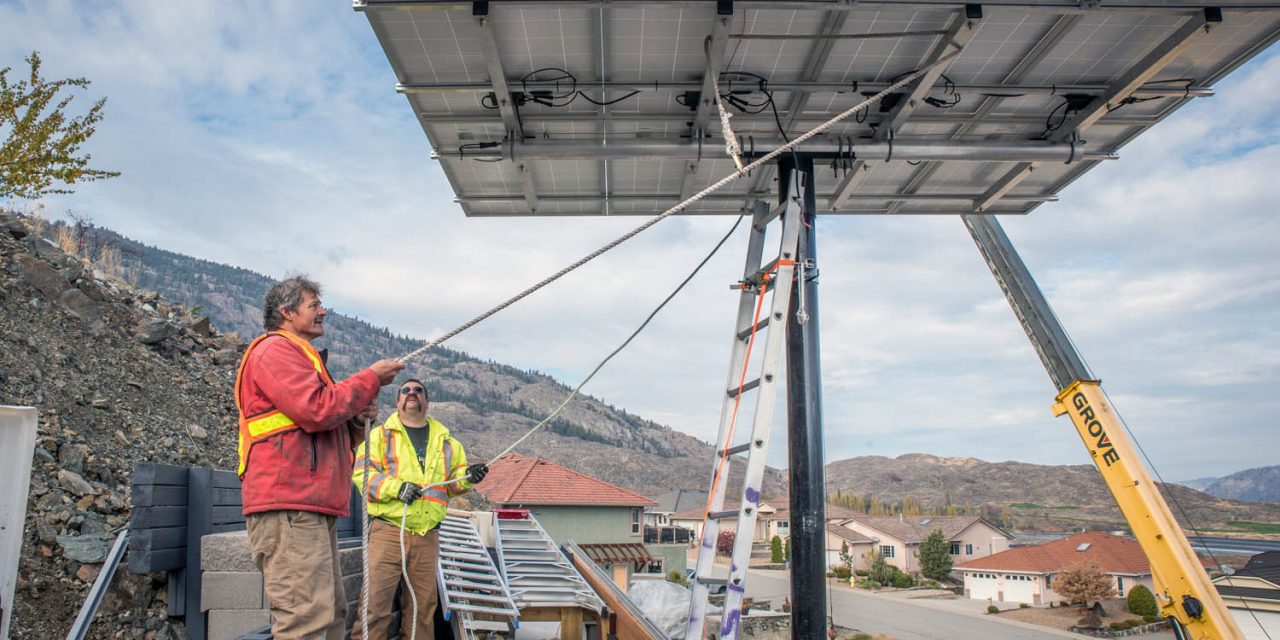
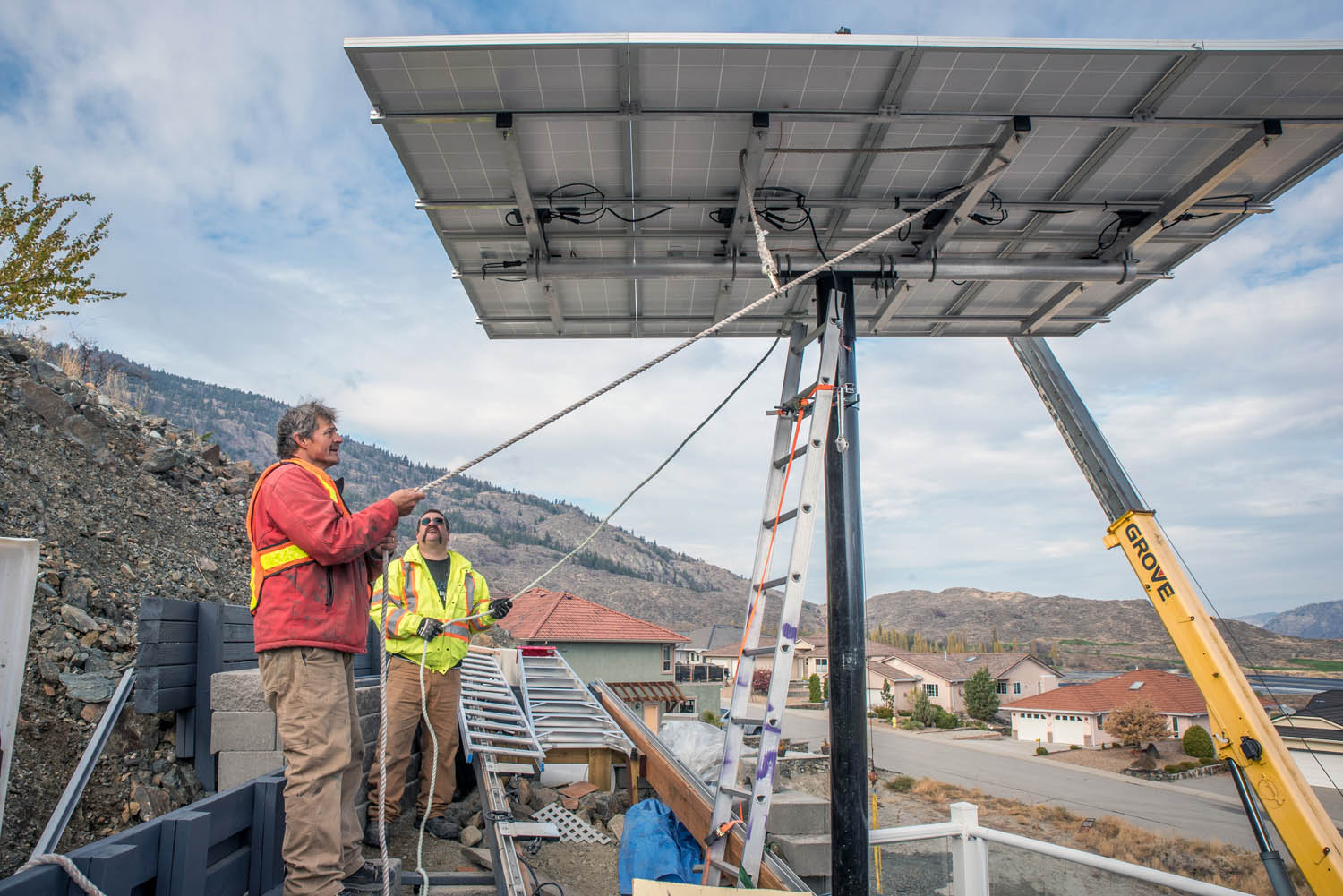
Roger Huber (left) and Richard Steuble of Swiss Solar Tech position solar panels on a pole behind Paul McCavour’s house. There McCavour will be able to angle them according to the season to capture the most sunlight. The panels were previously on the ground where they were often shaded after 2 p.m. McCavour preaches the merits of solar power to reduce electricity bills over the longer term and contribute to a greener planet. (Richard McGuire photo)
A tall crane lifted a wall of solar panels to a new position at the home of solar energy evangelist Paul McCavour recently.
Wearing a hard hat, McCavour kept an eye on the operation, helping when he could, as Roger Huber of Swiss Solar Tech Ltd. of Summerland carried out the operation.
McCavour and his wife Julie Turner originally installed 24 panels at their home on La Costa Lane above the golf course in June 2014. They wanted not only to cut their electricity bills, but also to contribute to a greener planet.
“A lot of people, including myself at times, take better care of our car or house than we do the environment,” said McCavour. “We tend to forget it because it’s always there. That’s one of the main reasons why I’m doing what I’m doing.”
McCavour is not adding to the total of 40 panels he now has since adding 16 rooftop panels last summer – he is simply relocating the original ones on the ground that didn’t get enough sun.
He did the original 24-panel installation himself since he hadn’t yet connected with Huber, who has been in the solar energy business for more than 30 years in Switzerland and Canada.
But by doing the work himself, he made mistakes in the way he placed the panels on the hillside behind his house.
“When I first put them in, I was a novice,” said McCavour. “I didn’t have any experience with this at all. Now that I also have them on the roof, I can see the huge difference in the amount of solar energy I get, because the ones on the ground were just not as efficient as they could have been.”
Huber moved the panels that were on the ground earlier this month to a new position on a thick pole behind the house where they can be manually rotated according to the angle of the sun with each season.
In total, McCavour said he has invested more than $40,000 in solar energy at his home, money that he believes will be more than paid back in energy savings over the years. The cost to move the panels, he said, is around $6,000.
While solar panels are a large up-front cost, once installed they require very little maintenance and they last for decades. Many panels these days carry a 25-year warranty.
McCavour stays connected to the electricity grid of FortisBC, buying electricity from the utility when his panels aren’t producing enough power and selling his surplus back to the utility at the same price when his panels are harvesting the sunshine.
As utilities keep raising electricity rates and as panel prices come down, the economics of photovoltaic (PV) solar energy become more and more attractive.
Calculating the payback time from solar is tricky because the efficiency of panels depends, as McCavour discovered, on their positioning.
It also varies greatly from location to location. Although the Okanagan is well known for its warm summer sunshine, many areas of southern Alberta actually receive substantially more hours of sunshine over the course of a year.
Panels do lose their efficiency over the decades, but most last at least 25 to 30 years.
Finally, government programs, utility rates and even the method used by utilities to set prices have an impact on the payback period.
Some utilities bill customers according to time of day, charging more for electricity during peak demand during the daytime. This would be an advantage to customers selling solar power back to the grid because they would be paid at a higher rate when the sun is shining.
McCavour said it’s difficult to calculate his own savings since installing the panels because the original panels weren’t in the best position and because he has since removed his natural gas and gone to electric heating.
Nonetheless, he said his total energy bill from March to September of 2013, before installing any panels, was $998.17. For the same period in 2015, his energy bill was just $190.30 – a savings of $807.87, he said.
By moving the panels, he believes he will see even more savings. His ground panels were sometimes in shade by 2 p.m., depending on the time of year, while his rooftop panels saw an extra four or five hours of sunlight.
“I expect even better results next year,” said McCavour.
The solar energy evangelist has convinced several neighbours to add solar panels and he says they’ve been happy with the results.
“They are very happy and they are thinking of putting on more,” he said.
He also hopes to convince the town to install panels on buildings such as the Sonora Community Centre.
McCavour said he’s hopeful that solar energy will get more support as a result of the recent change of the federal government.
“There’s more people all the time calling me and interested in doing something,” he said. “They’re waiting for the government to come out with some grants. I believe the Liberal government will be starting a green grant program, so maybe things are going to move in that direction. The Harper government was more interested in oil, gas and coal.”
RICHARD McGUIRE
Osoyoos Times
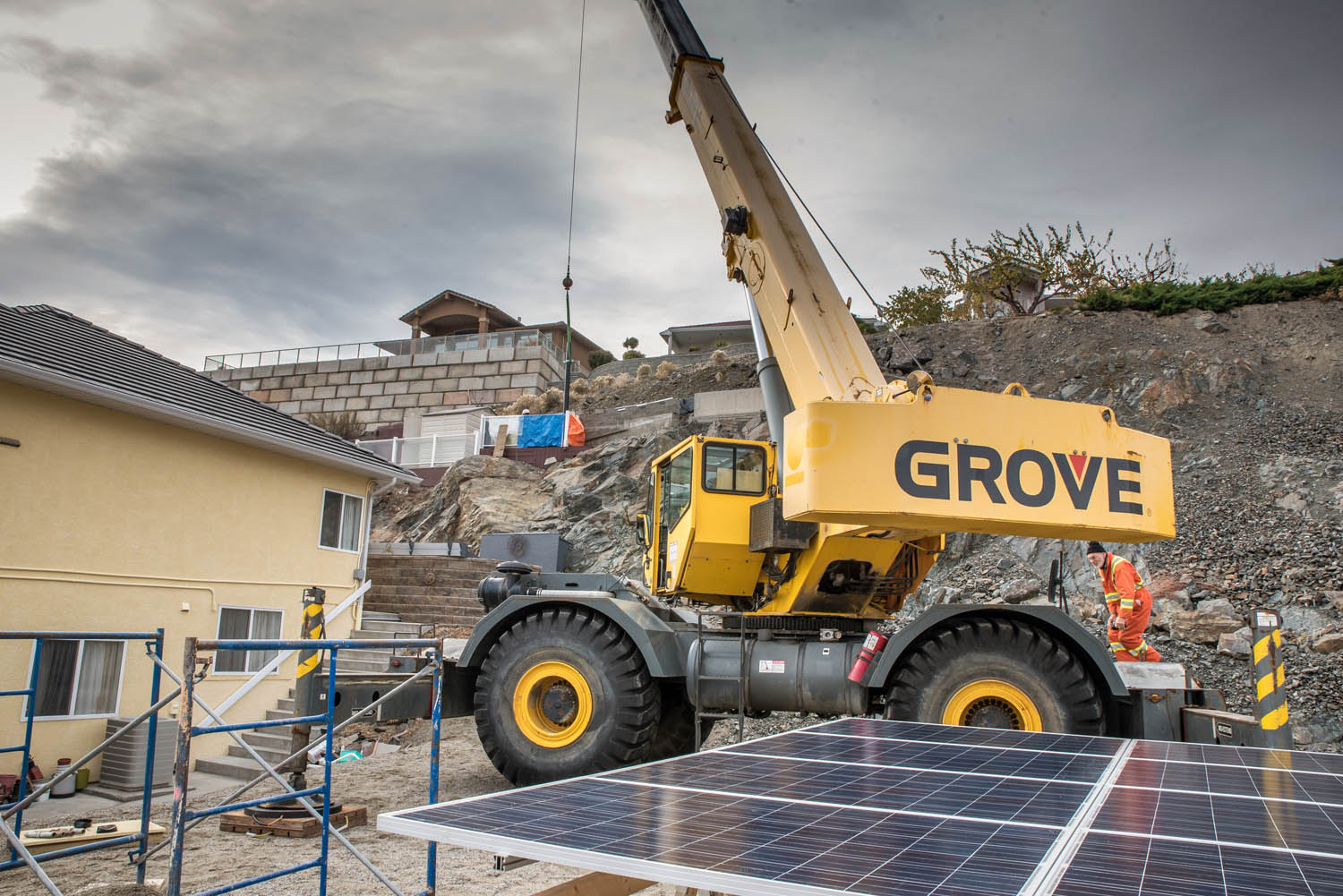
A crane is prepared to lift a wall of solar panels to a pole on the hill behind Paul McCavour’s house. There McCavour will be able to angle them according to the season to capture the most sunlight. McCavour preaches the merits of solar power to reduce electricity bills over the longer term and contribute to a greener planet. (Richard McGuire photo)
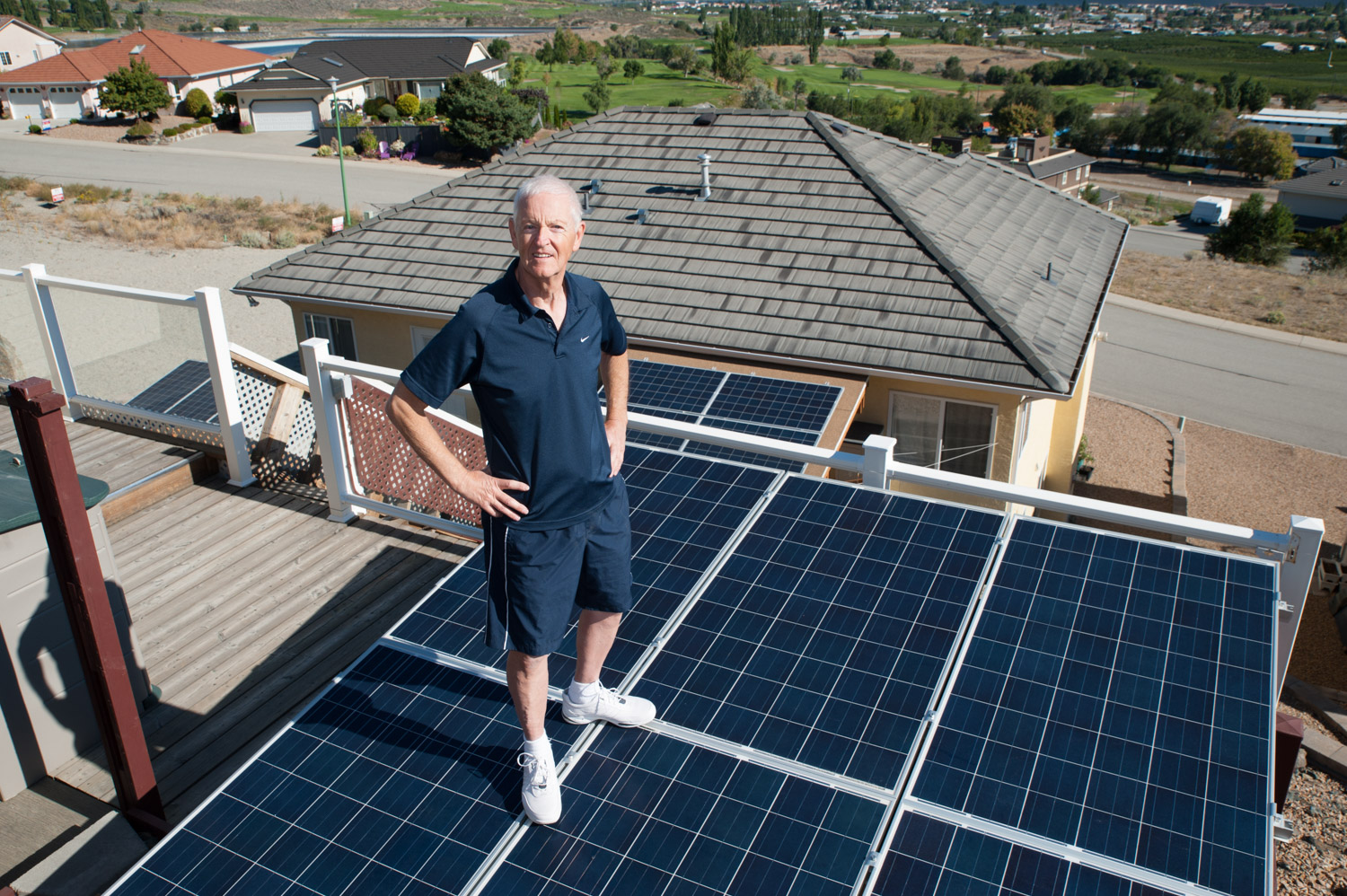
Paul McCavour shows off some of the 24 solar panels above his house when he first installed them at his home in June 2014. (Richard McGuire file photo)