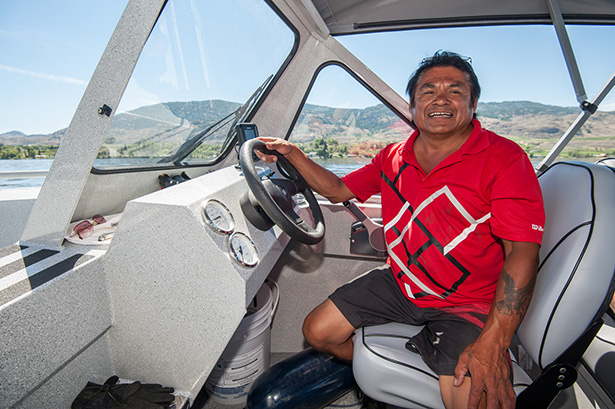

Louie Baptiste of the Osoyoos Indian Band begins working this year as a sports fishing guide. He acquired a new boat just over a week ago and will be working with the B.C. Sportfishing Group, which has been mentoring him. An experienced fisherman on Osoyoos Lake, Baptiste says he has been working the last 10 years to achieve his goal of becoming a fishing guide. The return of the salmon fishery and support from the Okanagan Nation Alliance and B.C. Sportfishing Group have helped his dream to come true.
The sockeye salmon sports fishery continues on Osoyoos Lake, but numbers are expected to be lower than last year’s exceptional salmon run.
An official with the federal Department of Fisheries and Oceans (DFO) said the season will be shorter this year, probably two weeks, due to lower stocks. The fishery opened August 1. The exact closing date will be determined by daily monitoring of salmon numbers and environmental conditions.
“It will probably be a little bit more restricted fishing this year because of the lower return that we’re seeing in the Okanagan sockeye,” said Les Jantz, area director for B.C. Interior with DFO. “We’re anticipating about a two-week fishery unless things really start to turn around in a bad way.”
Jantz said rules for sports fishers are expected to be the same as last year and only the duration of the fishery will be different.
Last year sports fishermen with the proper fishing license and salmon stamp were permitted to take two salmon per day. Those on guided fishing trips were permitted to catch more, but any fish over the limit of two had to be turned over to the Okanagan Nation Alliance (ONA) for sale in their local fish market.
Fish could also only be taken from the portion of Osoyoos Lake north of the Hwy. 3 bridge.
Richard Bussanich, a fish biologist with the ONA, says he’s hesitant to draw comparisons with last year’s record-breaking salmon run because last year was a statistical outlier.
“Last year was a banner year, unseen in recorded history since 1938,” said Bussanich. “We’re seeing a weaker run this year, however the sockeye trend is still positive.”
He expects this year’s run will still be among the top five of runs over the past 15 years.
Bussanich estimates there will be about 45,000 to 60,000 spawners on the spawning ground this year, which will meet minimum escapement goals. Escapement is the number of fish able to escape the fishery and spawn.
“There’s opportunity for food fishing, which our members are currently doing, and likely a limited opening for recreation and commercial fishing on Osoyoos Lake.”
The fishing, he added, will be small and very regulated and will be monitored almost daily to determine how long to keep the fishery open.
ONA biologists and other agencies believe this year’s run could have been stronger, with between 80,000 to 90,000 spawners, however numbers will likely be about 30 per cent less, Bussanich said.
The Testalinda slide in 2010 likely impacted the Osoyoos Lake sockeye population according to monitoring data, Bussanich said.
The dam holding back an 80-year-old reservoir lake on Testalinda Creek near Oliver collapsed on June 13, 2010, causing a mudslide into the river system, also destroying five homes.
Jantz of DFO said the number of sockeye entering the Columbia River from the Pacific Ocean is estimated at 125,000 this year, which is slightly higher than earlier forecasts in the 110,000 to 115,000 range.
Numbers, however, are reduced during the migration on the Columbia and Okanogan rivers as some fish are caught in the U.S. fishery, some die along the route and some don’t make it past dams.
The salmon must pass by nine hydro-electric dams on the Columbia River, some easier to cross than others.
Numbers arriving at Osoyoos Lake will be somewhere in the 80,000 to 100,000 range, Jantz said. This is a sufficient number for the food fishery and limited recreational and commercial fisheries, he said.
Despite the fluctuation in numbers of salmon returning from year to year, the overall trend in the past 15 years has seen a remarkable improvement. Numbers dropped to just 5,000 sockeye returning to Osoyoos Lake in 1995.
Two years later, the ONA began looking at ways to restore the fishery. Then in 2003, they began a hatchery project in cooperation with the federal Department of Fisheries and Oceans (DFO) and the U.S. Army Corps of Engineers, which oversees the migration route through the United States.
Since then, numbers have rebounded so that by 2010 the ONA was licensed to launch a pilot fishing enterprise.
Will the salmon fishery keep improving in coming years? Bussanich of the ONA is optimistic that next year will be a big year.
“We’re expecting good survival and good returns next year,” he said, “but we won’t know until the fish are here.”
After that, “the crystal ball gets a little bit hazy,” Bussanich said, noting the possibility of what’s called a “regime shift” on the Pacific Ocean. This occurs when ocean patterns change from “La Niña” to “El Niño,” affecting water temperature and climate.
Current oceanographic studies suggest such a shift is likely to occur and this could adversely affect the stock of sockeye in the Columbia River, Bussanich said.
He also noted that this year’s fishery, as in the past, is considered a “community support fishery.” This means that limited amounts of Okanagan sockeye will be sold at local fish markets in select locations and partial proceeds will go back into fish conservation.
In Osoyoos, local sockeye is being sold at the gift shop of the Nk’Mip Desert Cultural Centre. Two locations in Kelowna will also sell the fish, along with a consumers outreach guide, who will sell fish at farmers markets in Penticton and Kelowna while educating consumers about the fishery, Bussanich said.
Richard McGuire
Special to the Chronicle