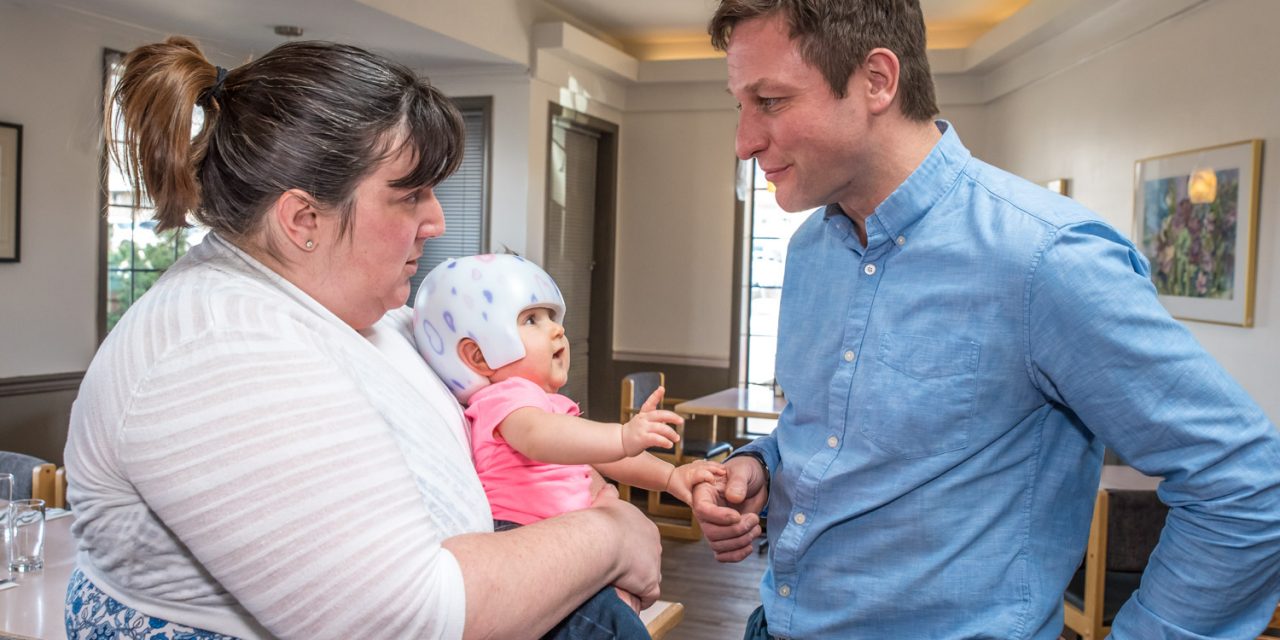
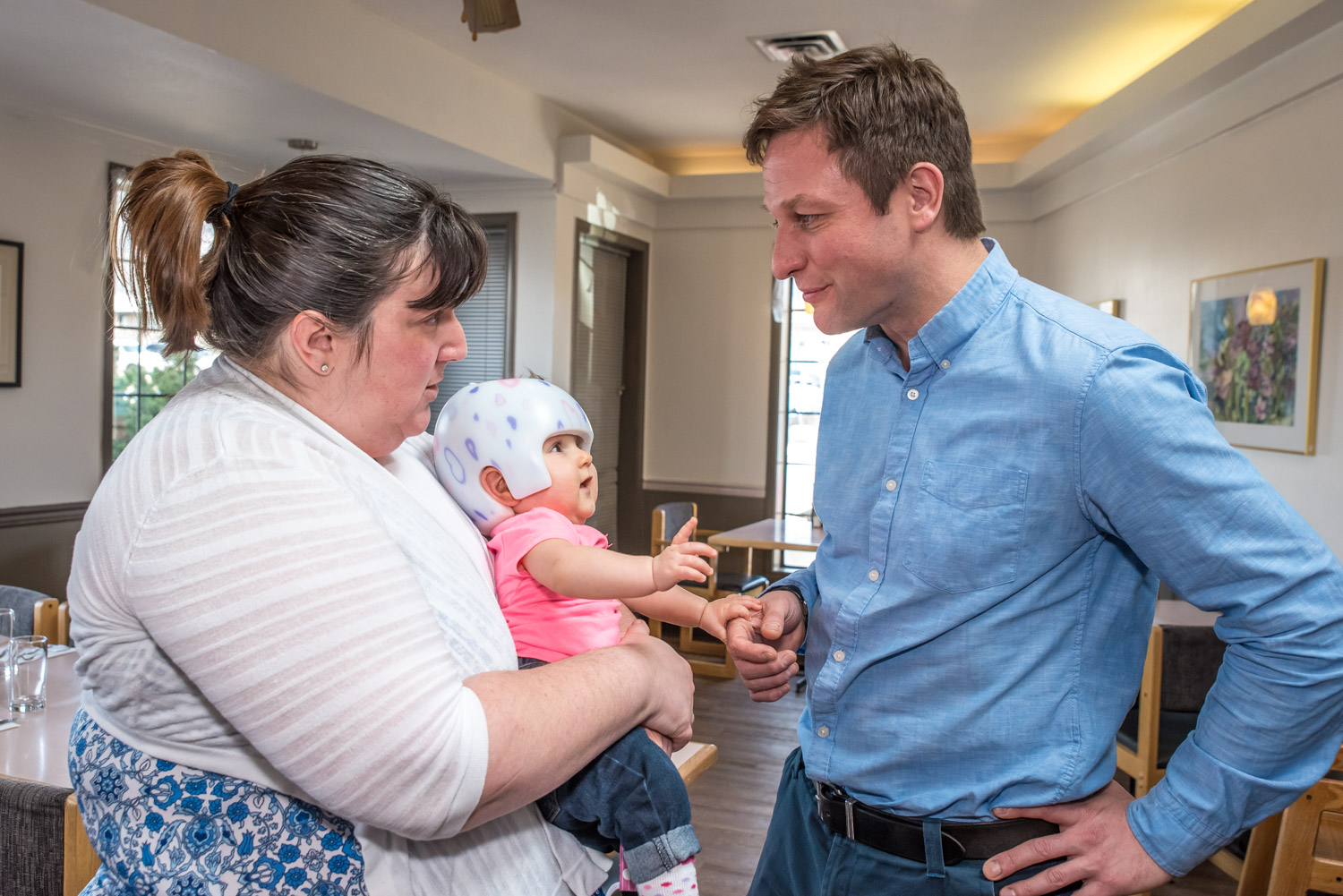
NDP Education Critic Rob Fleming chats with Cheryl Smith, wife of Troy Bratton, owner of Troy’s Grill. Scarlett Bratton, not quite 8 months, wants to join in the conversation. Troy’s Grill hosted an informal event Tuesday to discuss the school closure issue. Fleming was in Osoyoos to attend Tuesday night’s public consultation meeting on the closure of Osoyoos schools. Smith hopes Scarlett will be able to go to OSS in the future. (Richard McGuire photo)
Osoyoos is unique in seeing its only high school faced with closure, but throughout the province school districts are faced with the issue of closing schools in the face of a funding crunch.
Across the Okanagan and Shuswap, the Lower Mainland, Vancouver Island and the north, school districts are now holding public consultations aimed at closing schools in a desperate attempt to balance budgets, which they are required to do by law.
Since 2002, a total of 240 schools in B.C. have been closed, according to a tally kept by the B.C. Teachers Federation (BCTF), which doesn’t include those now facing closure.
All but a few of these are elementary schools.
The few high schools that have closed are in communities where, unlike Osoyoos, there is another high school in the same community.
The B.C. Ministry of Education says 300 schools have been closed since 2001, with 48 new schools built and 70 replaced. In addition, space has been added at 186 schools and 149 have been “seismically upgraded”, a ministry spokesperson said.
The B.C. Liberal government took power in May 2001. The following year it brought in a new per-student funding formula, which provided an incentive to school boards to close schools as falling enrolments meant less funding.
It also removed the requirement to obtain the Education Minister’s permission to close a school.
In the recent rash of school closures, the opposition NDP has attacked the government for underfunding public education.
But Education Minister Mike Bernier responds that in absolute dollar terms, funding has risen in the province, despite declining enrolments.
“At the same time as having 70,000 fewer students, we are at the highest level recorded for funding in schools – over $5.2 billion in the public education system,” Bernier responded last week in the legislature when NDP MLA Doug Donaldson criticized the government for the funding pressures.
As a percentage of the provincial budget, however, Kindergarten to Grade 12 funding has been steadily declining since the B.C. Liberals came to power.
In 2002-03, K-12 education accounted for roughly 19 per cent of the government’s budget. In 2016-17, it will account for about 12 per cent, according to government budget estimates.
At the same time that public education is being squeezed, government funding for private education has been increasing at a greater rate.
“Between 2005-06 and 2010-11, public school funding increased by 13 per cent while funding for independent schools increased by 34 per cent,” says a 2012 research report by the BCTF.
Critics point out that Premier Christy Clark sends her son to the private St. George’s School in Vancouver, which charges about $20,000 a year in tuition. They question her commitment to public education.
Depending on the category or “group,” independent schools in B.C. receive up to 50 per cent of the government funding per student that public schools get – on top of fees charged to parents – and they get to choose who attends.
B.C. is one of just five provinces that publicly fund private schools. Ontario and the four Atlantic provinces do not.
Many public schools closed in the initial years after the B.C. Liberals came to power, but closures have continued in the years since.
In the last three years, 38 schools have closed in districts around the province, according to the Ministry of Education. Of these, almost all are elementary schools.
In School District 72, Campbell River, the school district currently faces a deficit of $1 million and Oyster River and Discovery Passage schools are facing closure.
In a letter to Bernier last month, board chair Susan Wilson expressed her board’s concern with provincial government actions.
“I am writing to express our concern with the constant downloading of education costs to our district,” she told Bernier, adding that funding reductions have reduced educational programming and forced the district to defer maintenance. Recent government actions mean the district faces “unplanned cuts of $1,021,570,” she said.
“This course is unsustainable,” she wrote. “Without providing the funding that would allow (school districts) to address these increase costs, (it) is causing serious damage to the public education system in this province.”
Parents have been rallying to support their schools with banners saying: “Don’t take the heart out of Oyster River.”
Not far away, in Courtenay in School District 71, parents have organized in an effort to save Ecole Puntledge Park Elementary School, a school in an idyllic setting where children are exposed to nature on three sides.
Facing a budget squeeze of $2.4 million, Comox Valley School District plans to close Puntledge and send children to nearby Lake Trail, which is currently a middle school, but will be retrofitted as an elementary school.
Dan Vie, one of the parents fighting the closure, says students will be moved to a school that is in worse shape in terms of seismic upgrades. And they’ll lose the nature education that has inspired numerous children with special needs.
“Unfortunately, the bottom-line attitude of the school board doesn’t want to listen to anything that doesn’t have to do with the money pressures,” Vie said in an interview last week. “Some of those money pressures are fabricated. It’s not entirely to do with ministry demands.”
Nonetheless, Vie believes the provincial government has “a vendetta against public education that has been escalating for a very long time.”
Although Puntledge has been operating at full capacity, the outlook for the school doesn’t look hopeful when the school board votes on closure next Tuesday.
In 2008, parents at nearby Cape Lazo School won a court victory when the Supreme Court of B.C. ruled that the closure process “appeared to be a sham” and overturned the closure.
Since then, school districts have been more diligent about making it at least appear there is open consultation with communities.
Closer to home, in School District 67, Okanagan Skaha, six schools in Penticton and Summerland are currently being considered for closure.
These include Carmi Elementary, McNicoll Park Middle, Parkway Elementary and West Bench Elementary in Penticton along with Giant’s Head Elementary and Trout Creek Elementary in Summerland.
Summerland Mayor Peter Waterman recently wrote to the school district about the damage the closures would inflict on his community.
“When considering whether or not to close a school, the community must be given the opportunity to influence the final decision,” Waterman wrote. “If the outcome is a foregone conclusion, it is not a real consultation. It is incomprehensible that no other options besides school closures have been considered for public consultation.”
A special board meeting to decide on those closures takes place this Wednesday. The school district faces a $1 million budget shortfall in 2016-17.
Farther up the valley, in North Okanagan Shuswap School District 83, more public schools face closure.
Last month the school board initiated consultations on closing elementary schools in Armstrong and Salmon Arm as they sought to cut their 2016-17 budget by $1.3 million.
The historic old brick Armstrong Elementary School would close, as would Silver Creek Elementary School in Salmon Arm. Other schools in the area would be reconfigured.
The board is also looking at amalgamating Salmon Arm Secondary School into a single campus.
Much farther north, upset parents packed the school gym last month at Lake Kathlyn Elementary School in Smithers. That school was given notice in January by School District 54 that it too faces closure. The board will make its final decision in mid-April.
In Nanaimo, two more schools are closing this year on top of 12 others closed since 2004.
Not all school districts in the province face immediate school closures, but all face funding pressures.
Prince George has closed 22 schools since 2002, 14 of those in the first two years after the B.C. Liberals were elected.
In past years, partly as a result of those closures, that school district accumulated a surplus that is now at $6.4 million.
But like other school districts, it too is now facing budget shortfalls, forcing it to run down that nest egg each year to balance budgets – something trustees say is not sustainable.
School districts rely almost entirely on the province for funding, but they are forced to assume expenses that are beyond their control – directly or indirectly set by the province.
Hydro increases, teacher and support staff salaries and benefits, mandated administrative cuts, deferred maintenance, mandated programs – all reduce the bottom line, leaving school districts with few options but to close schools.
Declining enrolments have reduced the funding that school districts receive, but often school closure decisions are based on projections of future enrolments.
As Vie, the Courtney parent points out, those projections are typically based on computer models rather than actual real-world data.
“All those graphs and numbers are generated based on a software projection that doesn’t actually tell you who is moving into the neighbourhood or who is being born,” said Vie. “It’s just talking about known data, so there’s no way to actually project headcounts.”
Bernier insists that elected trustees make decisions about school closures at the local level.
“I’ve lived through school closures in my riding. Closing a school is not an easy decision,” Bernier said last week in the legislature when confronted by NDP Education Critic Rob Fleming. “School closures are made because of lack of students, not because of lack of funding.”
RICHARD McGUIRE
Osoyoos Times

Mike Bernier, B.C. Minister of Education