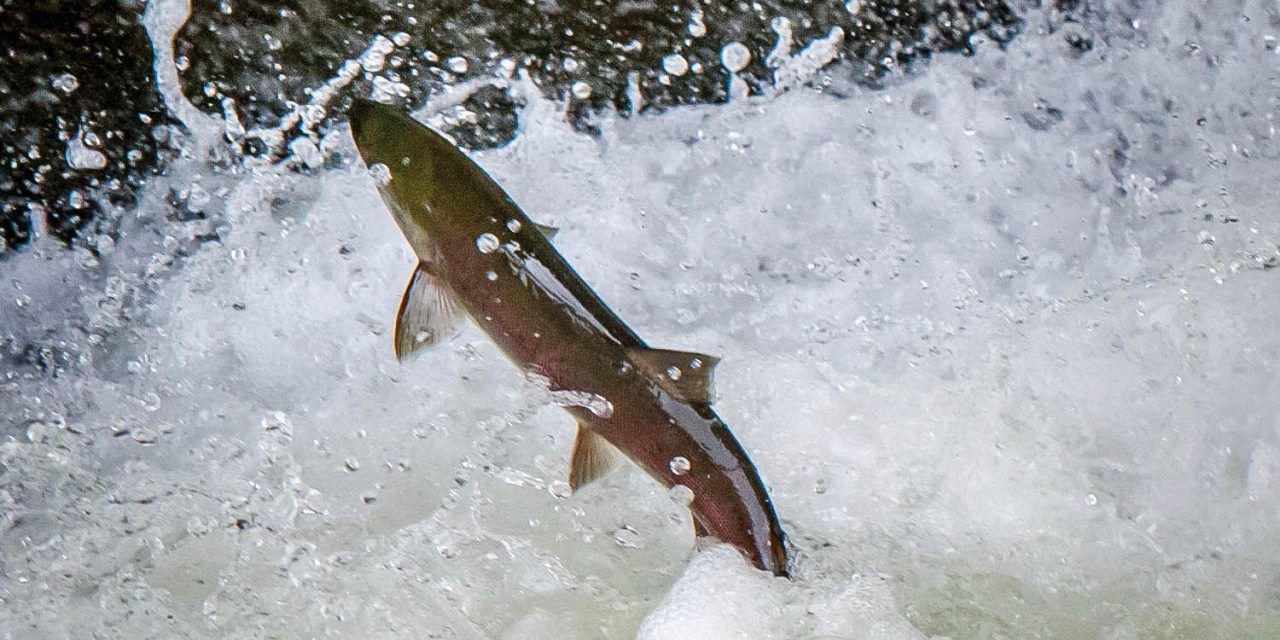

Sockeye salmon attempt to swim up one of the gates at the Zosel Dam in Oroville, Washington in a file photo from last year’s large migration. This year many sockeye have died on the Columbia River below the Wells Dam in Washington and only small numbers have made it into Osoyoos Lake. (Richard McGuire file photo)
Sockeye salmon are dying off in huge numbers on the Columbia River and very few have made it to Osoyoos Lake, prompting the extended closure of the recreational and commercial fisheries this year.
The federal Department of Fisheries and Oceans (DFO) announced the closure last Thursday of fishing for all salmon species in Region 8, which includes Osoyoos, as well as Region 3.
“Water levels in many systems in the Thompson and Shuswap are extremely low and temperatures in many cases are reaching lethal limits for migrating salmon,” says the Fishery Notice issued July 23.
“We’re hopeful that this is just one year,” said Richard Bussanich, fisheries biologist with the Okanagan Nation Alliance (ONA). “The real issue is going to be if we see back-to-back, three-plus years of this. Then we’re really going to have a conservation issue. We’ll be talking stock collapse.”
Initially it appeared that 2015 would be a strong migration for sockeye entering the Columbia River and making their way up into Canada through the Okanagan River system.
As of this week, more than a half a million sockeye have passed Bonneville Dam on the lower Columbia River.
But warm river temperatures have caused much higher than normal mortality rates as the fish migrate up the Columbia River. Of those that have survived, many are in poor health, covered with lesions and fungus, said Bussanich.
Dean Allan, resource manager with DFO in Kamloops, says normally between 75 and 80 per cent of the fish that make it past Bonneville Dam continue on to the pool above Wells Dam.
That dam is located near Brewster, Wash. just below the confluence of the Columbia and Okanogan rivers.
As of this week, however, fewer than 180,000 sockeye had made it to Wells Pool. Sockeye normally wait there until the water temperature on the Okanogan River (as it’s called in Washington) cools enough that they can continue to Osoyoos Lake.
Allan believes many salmon are holding in reservoirs along the Columbia River, waiting for waters to cool so they can proceed upriver.
“There are reports of some dead fish at different places along the Columbia,” Allan said. “We don’t have a sense that there’s a large amount of fish that died as far as reports of large amounts of dead fish anywhere, but there’s definitely fish that died en route. To what extent, we really don’t know.”
Bussanich, however, believes that because of the warm waters, sockeye mortality on the Columbia River is double or more the normal rate.
Two other trends this year are also reducing the numbers of fish reaching Wells Pool, he said.
About 10 per cent of sockeye are getting “confused,” he said, and are swimming up other tributaries.
“The theory right now is that they’re just trying to seek any cold water they can,” he said.
Sockeye migrating up the Columbia River head for two main tributaries – the Okanogan River and the Wenatchee River. Small numbers also migrate up the Snake River.
Bussanich said another factor influencing the low count at Wells Dam is that a higher proportion of sockeye this year are migrating up the Wenatchee, according to tag information.
The confluence of the Wenatchee and Columbia rivers is below Wells Dam.
Of the fish making it to Wells Pool, far fewer are successfully migrating up the Okanogan River to Osoyoos Lake.
“Before July 24, we only saw two very small pulses of fish try to go into the Okanogan and then into Osoyoos Lake,” said Bussanich. “Based on our tag information, for every 100 fish that tried to ascend the Okanogan River, only one to five of those made it into Osoyoos Lake on two separate occasions.”
This means there are fewer than 5,000 to 10,000 sockeye in Canada currently, said Bussanich.
Allan, however, puts the number at between 1,000 and 3,000 sockeye now in Osoyoos Lake.
Asked if the sockeye fishery could open if the weather cools and more fish start migrating, Allan was noncommittal.
“We’re leaving the options open,” he said. “Right now it’s hard to say, depending on how many fish actually make it back into Canada and when they come. Our number one goal is conservation and we want to make sure we’re going to get enough on the spawning grounds first.
“The other thing we have to consider is the Okanagan Nation hasn’t had an opportunity to fish for their food fish, so after conservation, it’s the first priority.”
While the DFO regulates salmon in co-operation with the ONA, because salmon are oceangoing, the province regulates other fish species such as trout and bass.
Those fisheries are still open on Osoyoos Lake, although fishing in rivers and streams is now prohibited because of the drought.
Bob Otway, a member of the Mid-Fraser, Thompson Okanagan Sports Fishery Advisory Council said he’s not hopeful that there will be a late sockeye fishery.
“I’m not optimistic because those fish are in bad shape,” he said. “I think even if they open the fishery, they wouldn’t be that good to catch. The Americans are still fishing them, but the fish that they are catching are pretty beaten up and they’ve got a lot of lesions on them.”
Otway said he fully supports the decision by DFO and the ONA to close the sockeye fishery.
Bussanich said he’s received reports from the U.S. that between 30 and 50 per cent of sockeye have physical damage such as lesions, fungal attacks and other health problems that would make people question whether to keep them.
He thinks the number of fish eventually making it to Osoyoos Lake and going on to spawn could be in the range of 18,000 to 30,000, which would be much lower than the 50,000 target.
Despite the bad news for this year’s sockeye fishery, Bussanich points to several bright spots.
Recruitment of volunteers for the community based commercial fishery is up 300 per cent over last year. This means there would be more than 30 vessels and more than 100 participants the next time the fishery is able to open.
As well, the ONA has been working to increase numbers of Chinook, which migrate in September when waters are cooler.
Bussanich compares this to portfolio diversification.
“You can’t just draw on sockeye,” he said. “If the sockeye tank, we may have an opportunity to diversify our portfolio and think about the ecosystem.”
RICHARD McGUIRE
Osoyoos Times