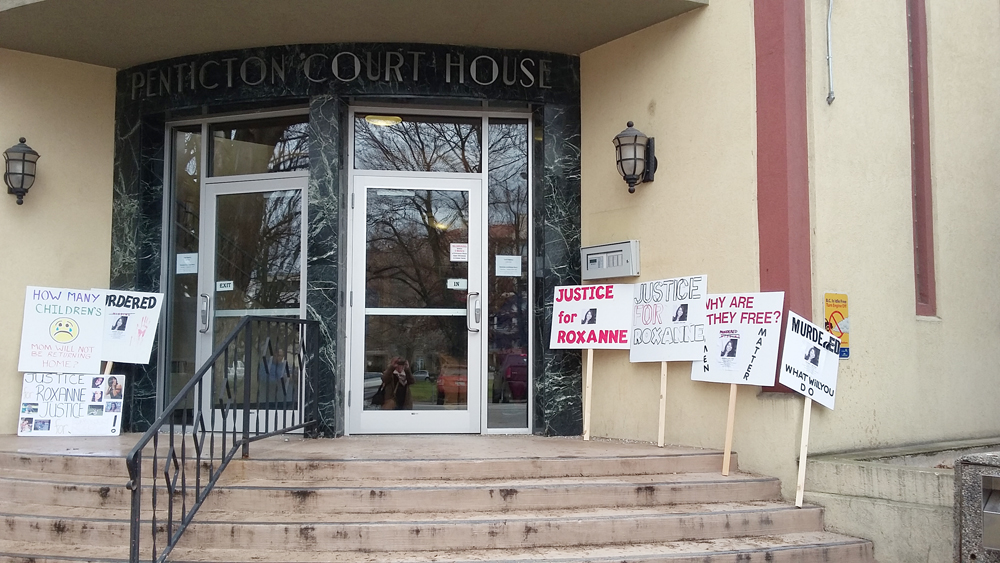

Calls for justice in the murder of Roxanne Louie continue at the Penticton courthouse. Photo by Erin Christie
Bev Louie and Roger Hall don’t know if there will ever be justice for their daughter Roxanne.
The preliminary inquiry into the 26-year-old Osoyoos Indian Band member’s brutal murder last January began nearly one year ago and was expected to wrap up on Feb. 19.
Instead, the preliminary hearing has been adjourned until March 10.
Against the solemn back beat of ceremonial drumming from the rallying members of all corners of the Okanagan First Nation community gathered in support of Louie and her family, in front of the Penticton courthouse last Friday morning, Judge Meg Shaw told the audience of roughly 30 of Louie’s friends, family members and supporters gathered in the courtroom that it was not her first choice to have an adjournment in the matter, but had agreed to defence lawyer Don Skogstad’s request as long as court could reconvene “in a reasonable time frame.” Skogstad requested the additional time to respond to comments made by Crown prosecutor Iain Currie.
“Basically this is being drawn out further over a lawyer’s hissy fit,” Louie family spokesperson Laurie Wilson said following Friday’s hearing.
“Right now most of the [Louie] family is in preservation mode. They aren’t saying too much. But for them, this is the part that is terrifying. They don’t know what horrible piece of the story of how their daughter died they are going to hear next and they don’t know if the people who killed her are going to face any real consequences.”
Wilson, who is a family law advocate and policy analyst with the Okanagan Nation Alliance, later said that the mistrust of Canada’s legal system is fairly common among Canada’s First Nations communities.
“It’s pervasive throughout our justice system,” she noted. Roxanne Louie’s story, she added, is a perfect example.
Described by Wilson, and Louie’s friend, and the organizer of Friday morning’s rally Darlene George, as “a lively, happy woman with a million-dollar smile,” Louie spent much of her short life in the South Okanagan.
Last fall, after ending her long-term relationship with her partner, with whom she had a three-year-old son, Louie decided to start a new life in Vancouver.
Wilson, whose daughters were close friends of Louie’s since childhood, said the young woman planned to continue her post-secondary education and study fashion design.
Last Christmas Louie and her son returned to the Okanagan to visit friends and family over the holidays.
Two days after she failed to make her scheduled flight from Penticton home to Vancouver, on Jan. 4, she was reported missing.
After a week-long search by her family and the Penticton RCMP General Investigation Service and South East District RCMP Major Crime Unit, Louie’s body was discovered Jan. 12 in the woods near Chute Lake about 40 minutes from Penticton. Louie died between Jan. 3 and 6.
On Jan. 11, 2015, Grace Elinor Robotti, 66, and her brother Pier Louis Robotti, 62, turned themselves in, in relation to Louie’s death.
Grace, who was Louie’s grandmother-in-law, was later charged with the second-degree murder of Louie. Pier was accused of interfering with human remains and being an accessory after the fact.
The charges against Pier were upgraded and he, too, was charged with second degree murder.
A publication ban regarding Louie’s murder is currently in effect and prohibits the media from revealing any further details.
Last March both Robottis were released on $25,000 bail each.
The bail conditions of the co-accused siblings include a 9 p.m. to 6 a.m. curfew and a no contact order between them.
For Wilson, the notion that the Robottis were eligible to post bail is infuriating.
“It’s unbelievable that despite the violent nature of Roxanne’s death, that her killers are walking around free,” Wilson said on Feb. 22.
She said unfortunately, no one within the Okanagan First Nations community, is surprised.
“If Roxanne were white and the Robottis were aboriginal, they would have been brought in to that courtroom in chains – they wouldn’t have been allowed out on the street,” noted a Penticton band member who requested not to be named.
Wilson says comments made by the RCMP during the missing-person phase of the investigation suggesting Louie may have disappeared to go partying marginalized Louie’s disappearance and cut the impetus and urgency to find her, while George, who organized Friday’s rally, says Louie’s death, which came on the heels of the announcement of the approved national inquiry into murdered and missing indigenous women, sheds “much needed” light on what she says is the persistent issue of systemic tolerance of violence against aboriginal women.
An RCMP report published in 2014 revealed indigenous women represent four per cent of the Canadian population, but they account for 16 per cent of all murdered women and 11 per cent of all missing women.
Across the country, there were nearly 1,200 investigations into missing and murdered indigenous women from 1980 to 2012. The report continued that there were 225 unsolved cases, including 120 homicides and 105 suspicious missing persons cases.
“We all know that court is not where you go for justice in this country if you’re a woman – especially if you’re an Indian woman,” George said on Feb. 22. “Justice is just not something that aboriginal women can expect.”
By Erin Christie