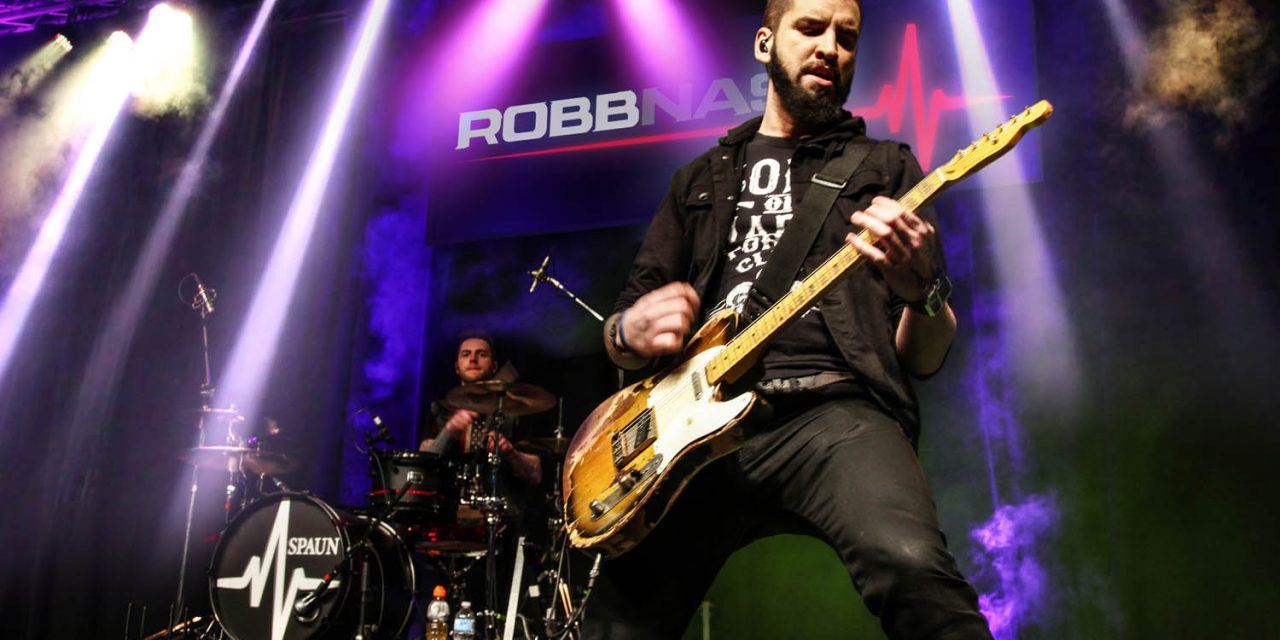

Robb Nash performed at Osoyoos Secondary School during a series of concerts in South Okanagan schools on May 27 to 28. The school tour was made possible by the local Crime Stoppers chapter. (Lawson Kons photo)
In the quiet moments before his show at Osoyoos Secondary School last Thursday, Robb Nash reclined in a theatre seat talking in a subdued voice.
Sporting a bushy beard, skinny jeans and trendy haircut he looked like a rock star – which for a while, by many standards, he was.
But that was before he shredded his record deal, turned his back on the commercial business and started touring schools, prisons, reserves and detention centres playing music and telling his story.
Nash’s act is a mix of music and storytelling. Over an hour-long show he aims to connect with kids, inspiring them to rethink self-harming behavior by sharing his own incredible story.
In the moments before his show May 28 he told that story, recalling how as a 17-year old he was pronounced dead after he and his friends crashed head-on into a transport truck. After miraculously waking up with a reconstructed skull, he spent months not remembering friends, family or what put him in the hospital.
For a long time he was angry.
“People came up to me with all of these clichés, trying to make everything better, and everyone told me that everything happens for a reason,” he said. “And that made things so much worse because now I had to figure out why it happened, and I thought it was because I was bad.”
When he stopped blaming himself, he turned a corner and on the other side was the inspiration to start helping young people – so they didn’t have to go through a traumatic experience like he did to make changes in their lives.
“I was in this really dark place emotionally where I didn’t want to be alive, and I didn’t tell anyone. I thought: how many other kids have been through some tough stuff and are holding it all inside?
“So we do this tour for one reason: I don’t want others to die like I did before they start to live.”
Adults have a way of trying to reach young people “on their level” and failing spectacularly. Nash’s humour, willingness to nudge boundaries and legitimate musical credentials allow him to mostly avoid this.
On stage he talks frankly about his own struggles with depression and suicide. His show is a slick combination of songs, crisply produced videos of the people he’s inspired, and his own insights into depression.
While not every joke or songs hits the mark, his sincerity and lack of preachiness go a long way.
“Kids can see bullshit a mile away – and they can tell when you’re genuine and when you’re not,” he said, flashing a grin at the ceiling.
“We don’t go up there trying to say ‘hey, be like us we’re perfect.’ We’re not perfect people, we’ve made a shit-load of mistakes, and we’re just willing to start over. And we’re trying to show [these kids] that no matter what happens, no matter what your darkest time is there is strength to get through.”
On May 28, ninth grader Jace McCullough left the theatre after Nash’s performance with a new outlook.
“It was really touching. It really got to me,” he said.
“I wasn’t expecting all the stuff about his injury and all that. I thought he was maybe just some dude that was going to play guitar and stuff, but he had a really good message.”
Grade 11 student Amareet Bains was similarly impressed.
“It kind of gave me a different focus on things. Like, what a lot of people might be going through that I didn’t realize,” she said. “You don’t really know what everyone’s going through.”
Walking beside her, Sanna Wilie admitted that she now saw things a little differently as well.
“I’ve never really had those kinds of problems, but I definitely know people who have. It makes me really open my eyes about how they’re feeling and what they think.”
Near the door, a line of students formed an impromptu queue, one by one approaching Nash for selfies and autographs. Most were smiling and joking with friends, excited to meet the performer.
Nash was happy to oblige the excited fans, but as he explained before his show, it is the troubled ones he really hopes to reach. He sees them at almost every performance, and it still affects him.
“You look out at these kids and you’re looking at their faces and their sitting there in the audience and you’re wishing they wouldn’t understand what you’re talking about, but they do.”
His voice dropped a few decibels.
“I wish my job wasn’t necessary, but it is.”
TREVOR NICHOLS
Special to the Times