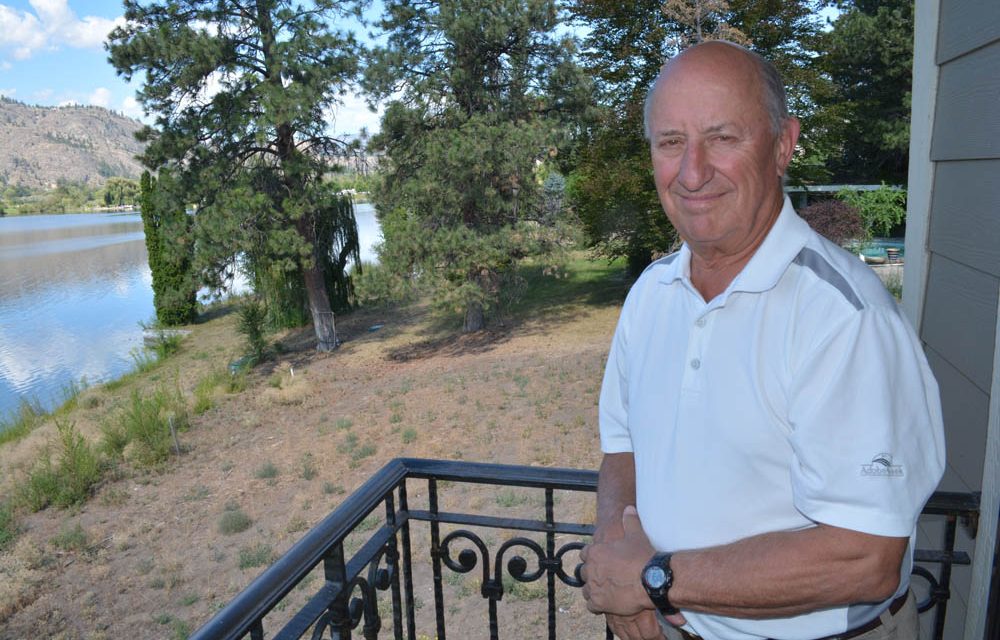
The applicant proposing to build five duplexes on Tucelnuit Lake insists the development will mirror the character of the neighbourhood.
And he’s prepared to put that in writing.
Michael Megale addressed council last week to offer more information on his proposal, which is not being met with enthusiasm by the neighbours.
At a recent public hearing, several residents raised concerns about increased density and the potential impact on the lake environment.
Megale is proposing to build a five-duplex development with a total of 10 living units at 7034 Tucelnuit Drive.
The subject property is currently split into two zones – RS1 and RS3 (residential low density). Both zones allow for multiple dwelling units in the form of single detached dwellings, along with secondary suites and “carriage” houses.
Megale is proposing to amend the zoning to low density duplex (RD1) in order to accommodate his housing plan.
Under the former Official Community Plan (OCP) of 1993, the property was designated as low density residential, but was amended to mixed residential under the current OCP, updated in 2003.
According to Town staff, the RD1 zone is consistent with the “mixed” designation.
The OCP states that density must not exceed 25 units per hectare, and according to the Town’s figures, the duplex proposal falls within that parameter.
Megale acknowledged that some people think his proposal will compromise existing riparian values of the lake.
“Why would I design something that would compromise the development?” he asked.
He stated his intention to put it in writing that his proposal will “keep the same character” of the neighbourhood with “minor variations.”
Councillor Dave Mattes said it’s important to have this letter of undertaking so that Megale adheres to the local architecture.
“We have no idea what this (duplex) will look like other than a couple of squares on paper.”
Megale said a duplex is the least intrusive form of multi-family development.
But Tucelnuit Lake resident Jim Wyse said the five-duplex proposal does not conform to the single family neighbourhood. He also noted the development is too dense for the one-acre site.
Wyse and other local residents also stressed their worry about the development’s impact on riparian values.
The Town received legal advice that it cannot lawfully rezone a property to increase density within a riparian area without an assessment report that determines that a subdivision will not disrupt or harm fish habitat.
Megale had an assessment report completed by Beckingham Environmental Limited. The report stated that if protective measures are implemented, there will be no harmful effects on the lake’s environment.
A provincial database for fisheries lists 14 species of fish in Tucelnuit Lake, including catfish, bass, carp, whitefish, chub, walleye and rainbow trout.
The report states that in order to offset an increase in density on site, a 20-30 per cent portion of the Streamside Protection and Enhancement Area directly adjacent to the lake (15 metres from high water mark) would need to be reclaimed as natural habitat.
According to the report, no vegetation will be impacted, and there will be no encroachment on the streamside protection area.
Local resident Al Hudec agreed the area would need to be restored to original vegetation, but he noted there is no original vegetation on the lot, only cottonwood trees and weeds.
“Mike would have to replant natural riparian vegetation,” Hudec said.
Town planner Christopher Garrish said site restoration can be a condition of the development permit. He noted if proper landscaping does not occur, this could be an enforcement issue with the Town.
The Riparian Areas Regulation calls on local governments to protect riparian areas (fish habitat) during residential, commercial and industrial development.
Megale stressed that his plan is to follow the requirements set out in the environmental report that he commissioned under the regulation.
Another public hearing on the development is planned for October 14.
But resident Marion Boyd hopes there is better notification than what was offered for the September 8 committee of the whole meeting, where Megale made his latest presentation.
She was told by a council member that the meeting was to start at 4 pm, but it started at 3 pm. Therefore, lakeshore residents missed Megale’s presentation.
Boyd said council changed the time and did not notify residents. “How could we have asked questions when we hadn’t heard the presentation?”
“Quite frankly, those of us who made a special effort to come to council chambers were disgusted and dismayed by the way we were treated.”
Lyonel Doherty
Oliver Chronicle