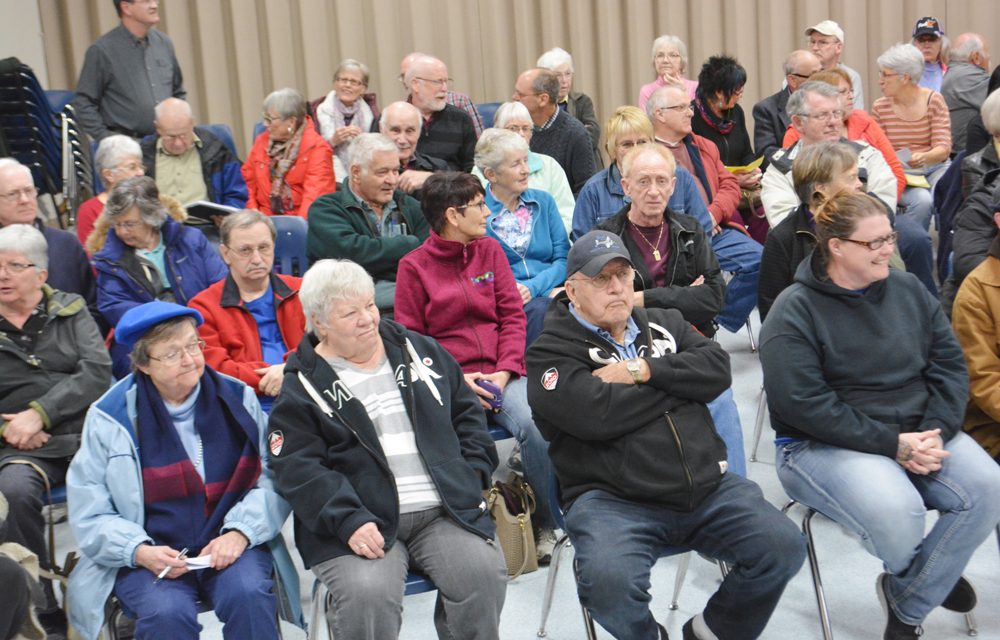

Nearly 200 people attended Monday’s safety forum at the Oliver Community Centre. Photo by Lyonel Doherty
Monday’s safety forum in Oliver delivered a clear message: the RCMP has to communicate better with the public. But at the same time, residents can’t just sit back and watch the show.
Nearly 200 people attended the community centre to hear what the RCMP had to say about crime in Oliver and what is being done about it.
Mayor Ron Hovanes started the meeting by saying that crime is such a “personal thing” that affects everyone. And in Oliver, many have felt its impacts.
According to RCMP statistics, property crime in Oliver jumped from 348 incidents in 2010 to 561 in 2015. There has also been a steady increase in business break-ins.
“It’s unacceptable and it’s a problem,” said RCMP Supt. Kevin Hewco.
The region’s top cop noted that only a small percentage of criminals, known as prolific offenders, is causing the bulk of these property crimes. That’s why the RCMP established the Prolific Offender Management program.
Hewco noted that three prolific offenders responsible for numerous crimes in the South Okanagan have been taken off the street, but he admitted there “will be others” committing similar crimes.
“Our goal is to identify who they are with your help,” Hewco told the audience.
The superintendent stressed several times that crime prevention is not solely the responsibility of the RCMP. Ownership also belongs to the public, he pointed out. This involves residents providing the police with information (anonymously through Crime Stoppers) or volunteering as citizens on patrol.
“We need info and we’re not getting enough of it,” Hewco said.
As for RCMP priorities, the officer said that violent crime against people is their number one focus, followed by property crime, which Oliver has been plagued with.
Hewco said police are “in the face” of prolific offenders all the time with the use of surveillance and other methods. He pointed out these criminals have three options: accept the offer of rehabilitation; continue doing what they are doing (with the police on their tail); or getting on a bus and leaving town.
Hewco said police know when a prolific offender has left town (by the decrease in criminal activity), and they know when an offender is back in town.
“There needs to be a harsher deterrent to this continued activity,” he acknowledged.
Crime Stoppers coordinator Rick Dellebuur said it’s important for people to know what’s going on in their neighbourhood. “It’s important that we look out for each other,” he stressed, adding that making a note of a suspicious vehicle and taking the licence plate number helps the RCMP a great deal.
During question period, Oliver resident Cindy Stewart revealed that her family is being terrorized by a local drug addict.
“We’re doing all we can to protect ourselves. My dad has dementia and he can’t remember not to let her in.”
Stewart said this woman has contravened a court-ordered curfew and is even targeting seniors.
Oliver RCMP Sgt. Blaine Gervais said police would pursue a charge (and conditions) against this lady and recommended that Stewart provide a statement. However, he admitted that police have spoken to the woman “but it has not done any good.”
Resident Diane Gludovatz asked what the authorities want from people to get this addict off the street. “She’s scaring the crap out of everyone.”
Hewco said this individual can be deemed a prolific offender, but noted she obviously needs health care.
Hovanes agreed, but noted the Town’s bylaw enforcement department is investigating the issue of her living in a trailer on a piece of property. He stated the landlord will be fined if this continues.
Resident Glen Krisher lamented the fact there is no deterrence in the justice system today. He noted the police work very hard to bring these criminals to court, but the offenders only get a “slap on the wrist.”
“Where is the deterrence for all of these prolific offenders? There is none!” he exclaimed.
Hewco could only say that judges have challenges too and are bound by the law.
Road 9 resident Allan Patton was a victim of theft and wasn’t too happy with the response from police. He had gas stolen from his tank, but managed to catch the thieves on camera, including a licence plate number. He presented this to the police but wasn’t impressed with the results.
“I didn’t get the feeling that much was done about it. I need to know that something is done (right away) when you (police) receive evidence.”
Gervais acknowledged that more could have been done in this situation and said police will follow up on the licence plate.
Hewco added that police are “maxed out” with priority files and can’t be everywhere at once.
Vaseux Lake resident Ernie Rotheisler was also a target of theft and reported it to the police. But it was a citizen who tipped him off regarding the whereabouts of his stolen property.
Rotheisler said it seems to take a long time to connect with the RCMP, and felt there wasn’t much of a connection in this case.
Gervais said he fully expects his members to get back to people when they call. “If you ever have a problem getting a hold of a member, get a hold of me (directly).”
Another homeowner described a theft from her car and the fact the thief was identified. Working with police, the victim got her stolen goods back but the perpetrator was never arrested, she said.
The homeowner stated that social media is where you find out what’s really happening in the community.
But Hewco said social media should be used with caution because much of what you read on there is not true.
Retired RCMP officer Norm Gaumont commented that the property crime statistics in Oliver are “horrific,” and he agreed that communicating with the local detachment is a problem.
“You can’t get a hold of the officers.”
Gaumont acknowledged the challenges faced by the RCMP, but said when information is given to the police they must act on it quickly, not wait until after the weekend.
Hewco acknowledged that the RCMP can do better. “We’re human . . . we make mistakes.”
Resident Jim Richards said the 9-1-1 dispatch service is a problem, noting a case where emergency responders could not attend to an incident in Triangle Park in Oliver because it has no address.
Mel Walker from Okanagan Falls agreed, saying she called 9-1-1 regarding an assault at the South Okanagan Events Centre, but couldn’t get help because she didn’t know the address.
She also agreed that the public needs to know that the RCMP is following up on calls for service.
Ron Johnson, coordinator of Oliver Crime Watch, said the group definitely needs more help patrolling the community. He noted that volunteers undergo three hours of training and are only obligated to one, four-hour patrol per month.
Last year the group recorded 149 patrols in town, resulting in 327 man-hours and 2,234 kilometres of travel.
For more information call Johnson at 250-498-4364 or email [email protected]
Corporal Mike Field said the crime watch volunteers do a fabulous job and can certainly use the help.
Oliver water councillor Rick Machial said he was informed by the RCMP that members do conduct scheduled night patrols. He stressed that this should be widely publicized so that criminals know that police are patrolling the community after dark.
By Lyonel Doherty