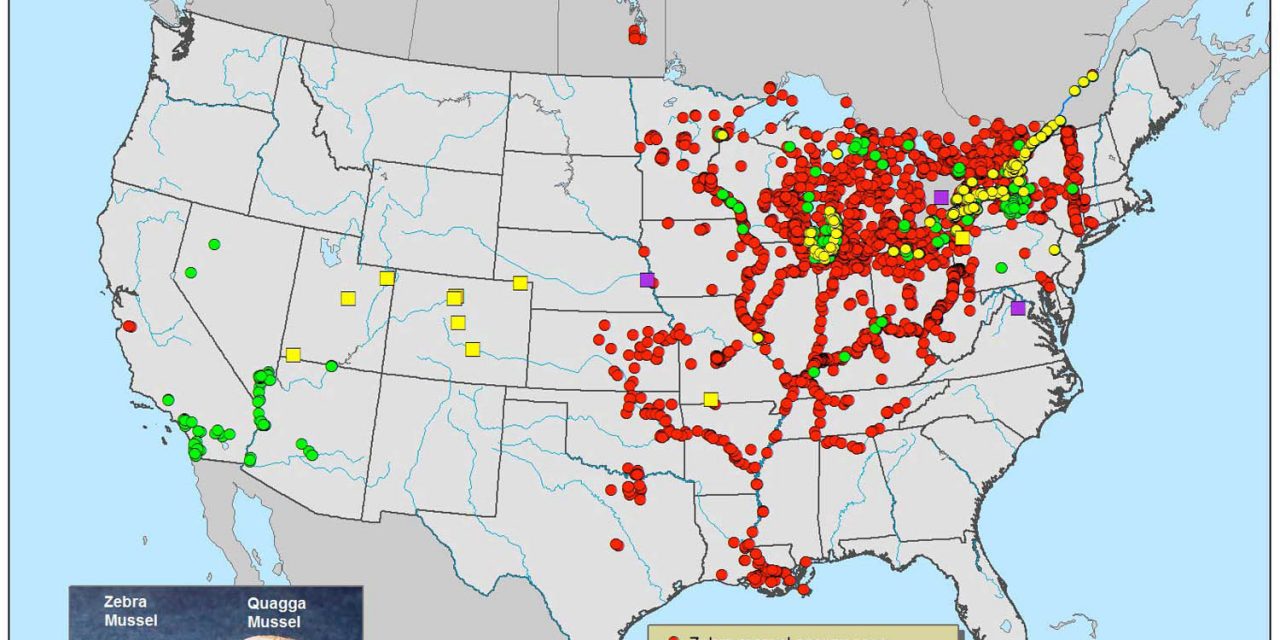
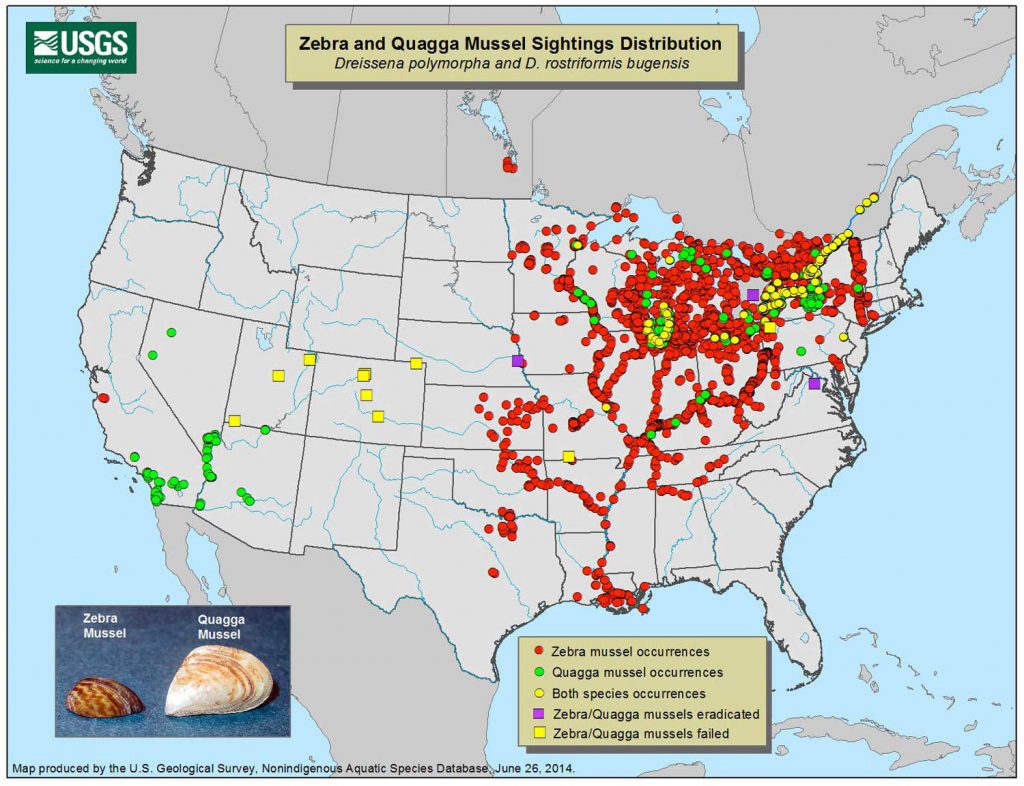
A map of zebra and quagga mussel distribution shows that zebra mussels have reached Manitoba and quaggas have reached the U.S. Southwest. This map was made in 2014 and mussels have now spread further, reaching almost to the Saskatchewan border in Manitoba. (U.S. Geological Survey)
Have you had “the talk”?
While many parents worry about how to have “the talk” with their children about sex, the Okanagan Basin Water Board (OBWB) is encouraging residents to have “the talk” with family and friends about keeping invasive mussels out of Okanagan lakes.
Zebra and quagga mussels may not be very sexy, though they can produce millions of offspring in a single year.
“If you have a brother-in-law on the east coast bringing his boat out for a vacation here in the Okanagan, talk with him,” said Corrine Jackson, OBWB communications director. “If you have a neighbour who is a snowbird who hauls their watercraft with them, or you hear someone talking about buying a jet ski from out of province, have the talk.”
On Wednesday, the OBWB launched an ad campaign on the “Have the talk!” theme to try to spread the word about the devastation a mussel infestation would cause and about the need to clean, drain and dry boats before transporting them.
B.C.’s mussel inspectors are finding that residents of the Okanagan have the highest level of awareness in the province about invasive mussels, said Doug Findlater, OBWB chair.
That’s why the program is aiming to spread the “Don’t Move A Mussel” message beyond the Okanagan, enlisting the support of local residents.
Last year’s inspection numbers found the Okanagan to be the area at highest risk of infestation in the province, said Jackson.
More than a third of high-risk watercraft intercepted were destined for the Okanagan.
Since April 1, the provincial government has been operating a stepped up inspection program, which had inspected nearly 13,000 watercraft as of July 27.
Of these, 439 were found to be coming from high-risk areas, and nine were found to be carrying invasive mussels, all from Ontario.
Another 50 were quarantined to ensure that boats were out of the water for at least 30 days after being used in infested waterways and that any attached mussels were dead.
Violation tickets were issued to 37 people for failing to stop for mandatory inspections.
A 2013 study for the OBWB found that an infestation by zebra or quagga mussels would cost $42 million a year in the Okanagan alone.
The Pacific Northwest Economic Region estimates the cost at U.S. $500 million a year to the Pacific Northwest.
One female mussel can produce more than a million eggs a year.
Zebra and quagga mussels encrust themselves onto water intakes, docks, boats and anything else in the water and they leave razor-sharp shells on beaches making it impossible to go barefoot.
Zebra mussels are found throughout Eastern Canada and the United States and have now spread as far west as Manitoba. Quagga mussels have spread into the U.S. Southwest.
RICHARD McGUIRE
Osoyoos Times