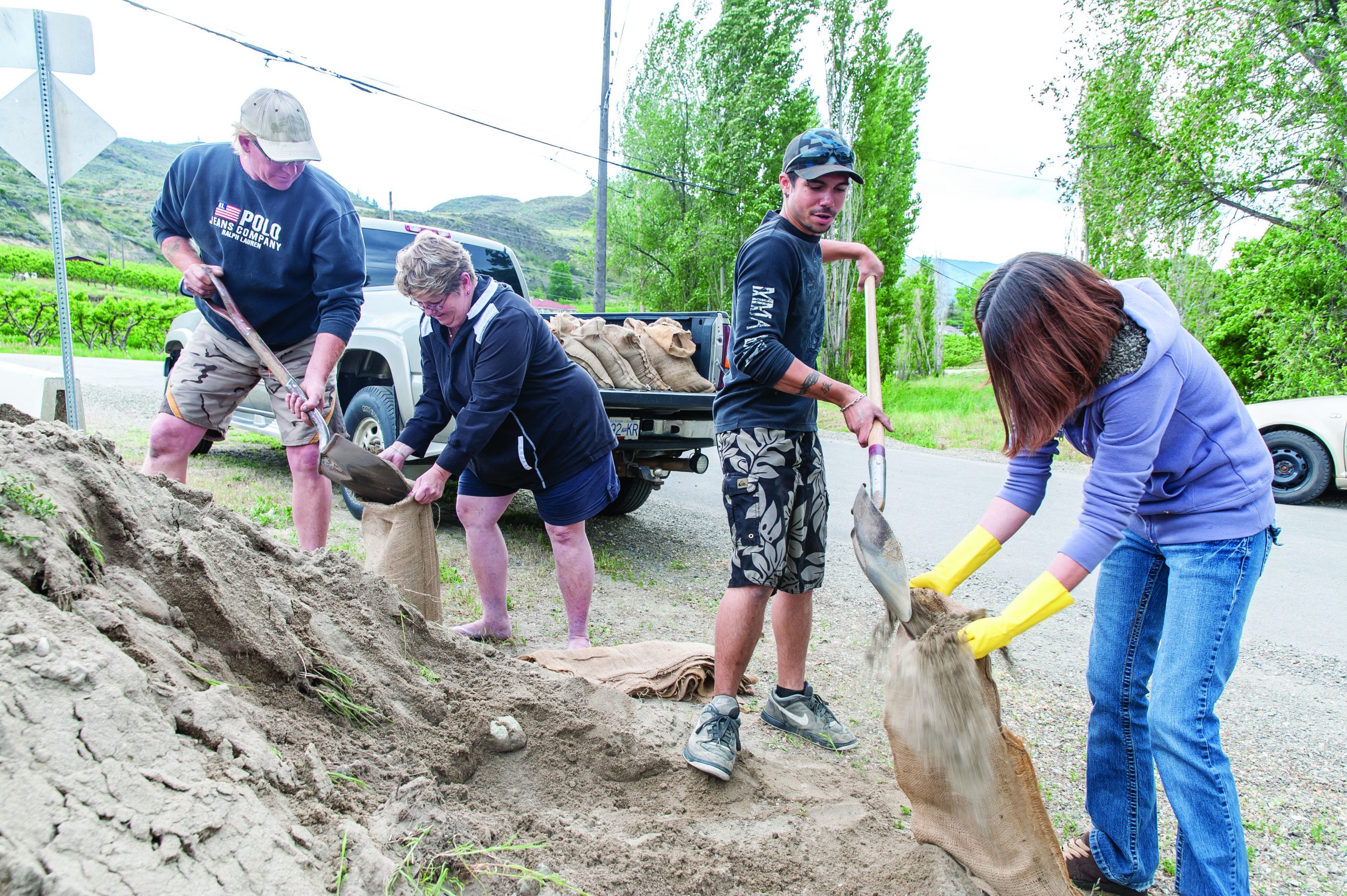
On Monday evening, (from left) Mike Ball, Annette Star, Sasha Strange and Germaine Star were hurriedly filling sandbags at the north end of town as water rose at nearby houses. The flooding is unusually early. Records were broken both for the lake level and volume of water in the Similkameen River for this time of year.
Photo by Richard McGuire.
Local lakefront homeowners are desperately sandbagging as the level of Osoyoos Lake threatens to rise to 914.5 ft., a level that would flood some homes.
The Town of Osoyoos and Regional District of Okanagan-Similkameen (RDOS) are distributing sand and bags for use by residents.
In Osoyoos, bags can be obtained at the public works yard at 11500 – 115 St. and sand is available on Hwy. 3 across from the Dairy Queen and at 91 St. and 87 St. behind Osoyoos Cemetery.
A shipment of 40,000 bags was received at the public works yard at midnight Monday, said Dale Kronebusch, emergency services supervisor with the Regional District of Okanagan-Similkameen (RDOS).
He added that if the situation becomes more tenuous, some pallets of bags may be distributed so that they are closer to the sand.
A third location for residents to pick up sand was added Tuesday at the south end of Osoyoos near 22 Ave. and 85 St., Kronebusch said.
“This is a concerted effort by the Town of Osoyoos, the RDOS and Emergency Management B.C.,” Kronebusch said. “We’re all working together to make sure we’ve got the tools out there to get over this bit of a hump of the spring freshet.”
Kronebusch advised people to be particularly aware of groundwater and water flowing over roads and other infrastructure and especially to watch that water isn’t getting at foundations.
If water reaches foundations, it can get underneath and hollow them out making repairs very difficult.
The high water levels will also impede boats trying to cross under the bridge at Hwy. 3, he said, adding the timing is bad as the long weekend approaches.
On Monday evening, Annette Star, Mike Ball, Germaine Star and Sasha Strange were hurriedly filling sandbags at the north end of town as water rose at nearby houses.
Annette Star said this is the third year in a row she’s had to sandbag, but the threat came earlier this year.
Lake levels rose rapidly last week as temperatures climbed into the mid-30s and water continued rising even as temperatures cooled this week.
The flooding is unusually early. Records were broken both for the lake level and volume of water in the Similkameen River for this time of year.
Temperatures caused rapid snow melt at higher elevations, causing tributaries of the Similkameen to swell as well as water in the Okanagan lakes to rise.
By Thursday, the Similkameen River was backing up at the Zosel Dam in Oroville, preventing water from draining from the lake.
All gates at the dam were raised completely from the water Thursday afternoon, meaning the dam can no longer control rising lake levels.
The Similkameen River joins the Okanogan River just below the Zosel Dam and when the Similkameen’s level is high, water backs up and the dam becomes ineffective.
“The level of the lake right now, it’s all about the Similkameen,” said Al Josephy, with Washington State’s Department of Ecology’s Office of Columbia River.
This year the rise of the lake is several weeks earlier than usual, and the rise is more precipitous, said Josephy.
“It’s quite early,” he said. “Looking back at the historical record, it’s much more common for the Similkameen to not rise a lot until late May and on into June.”
In addition to the dam becoming ineffective as a result of the rising Similkameen River, and impeding outflow from the lake, water is also coming into the lake from upstream at a faster rate.
Osoyoos Lake is fed from the much larger Okanagan Lake, which is controlled at Penticton to make room for snow runoff in the upper watershed. This puts pressure on Osoyoos Lake.
The Zosel Dam is owned by the Washington Department of Ecology, but during the runoff season it can become impossible to dump more water from Osoyoos Lake at the dam.
“When runoff is high throughout the system, dam gates are wide open,” said Josephy. “Even so, there will still be areas of flooding and inconvenience to property owners along the lake and down to the site of the dam itself.”
The state attempts to maintain the lake level between 911.5 and 912 feet from May 1 to Sept. 15, a level mandated by the International Joint Commission (IJC).
“The lake often rises beyond 913 feet and has reached as high as 915 feet, through rarely,” Josephy said.
Early Tuesday, the level of Osoyoos Lake crossed the 914 mark, exceeding the May 14 record of 913.82 ft. set in 1983.
Flow volume and height on the Similkameen broke May 10 records Friday, according to data from the United States Geological Survey (USGS).
The previous May 10 record for daily discharge near Nighthawk measured in cubic feet per second was 16,100 recorded in 1957. Friday it was measured at 16,400.
By Monday, discharge had risen past 20,000 cubic feet per second, but it was well below the May 13 record of 23,100 set in 1949.
Gauge height, also near Nighthawk, broke 1987 records, reaching 12.93 ft. Monday afternoon. On Tuesday, discharge and height on the Similkameen was starting to recede.
Snow is melting at a rapid rate on mountains such as Mount Kobau, but there is still a considerable amount of snow above the 1,800-metre elevation.
On Sunday, the B.C. Ministry of Forests, Lands and Natural Resource Operations (FLNRO) said it was maintaining a high stream flow advisory for the Similkameen River.
“Snowmelt has been rapid over the past week as a result of unseasonably high temperatures,” the May 12 FLNRO bulletin said. “Rivers across the South Interior have been flowing high in response to this snow melt.”
Temperatures for the coming week are forecasted to be much lower with daily highs in Osoyoos reaching around 20 degrees Celsius, according to Environment Canada.
The Osoyoos Times will provide regular updates over the next several days on the flood situation in and around Osoyoos on its website at www.osoyoostimes.com.