By Don Urquhart, Times Chronicle
BC’s current forest management system must transition from volume-based resource extraction to a holistic system of “Land Care” if the province is to overcome immense challenges and secure a sustainable future, according to a new report from the Provincial Forestry Advisory Council (PFAC).
The independent report titled “Conflict to Care: BC’s Forest Future” underscores the colossal failure of the province’s current forest management system saying only a fundamental redesign not incremental reform can fix it. British Columbia stands at a critical crossroads, and status quo is not an option, it said.
The current system is failing to meet a range of needs, it said, including communities, First Nations, businesses and the environment. The report concludes that small, incremental reforms are not enough to address the scale of challenges facing the sector.
“This isn’t about tinkering around the edges or adding more rules,” said Shannon Janzen, co-chair, PFAC in the report titled “Conflict to Care: BC’s Forest Future”. “It’s about rethinking the system as a whole.” This means moving beyond “elusive short-term fixes . . .”
The council’s findings come as BC’s forestry sector grapples with shrinking timber supply, rising costs and volatile market conditions. At the same time, communities and First Nations continue to call for greater certainty, transparency and respect for Indigenous rights and title in land-use decisions.
The report identifies “outdated systems, limited access to trusted public data, and deep structural misalignment” as major drivers of ongoing conflict and instability.
“Decades of layered rules and centralized, top-down decision-making have created a system that lacks the predictability and flexibility needed to respond to today’s ecological, economic, legal and social realities,” the report states.
Past attempts at remedying the issues have simply added complexity and expense without delivering long-term stability, PFAC said.
“We heard frustration across the spectrum,” said co-chair Garry Merkel. “People are being asked to navigate increasingly complicated processes, but they’re seeing very little change on the ground and very little certainty for planning their futures.”
Transitioning forest management
At the centre of PFAC’s recommendations is a shift away from managing forests primarily through timber-harvest targets and toward what it calls “Land Care” — a holistic, regionally grounded, area-based approach to land and forest management.
This offers a “logical and viable path forward,” the report states, noting it incorporates lessons from other Canadian jurisdictions and research to address BC’s complex challenges.
Under this model, decisions would be made closer to the land, with regions developing coordinated plans that reflect local ecological conditions, economic realities and social priorities. PFAC says this would improve transparency and accountability while reducing conflict created by top-down, one-size-fits-all policies.
The report identifies this systematic transition as an opportunity to reset relationships with the land and with people, particularly by supporting place-based approaches that recognize Indigenous rights, title and local knowledge.
“This transition requires courage, steadfast commitment and a willingness to move beyond the short-term focus of election cycles.
“It demands a durable, depoliticized framework grounded in trusted, accessible data, independent oversight and external transition capacity to guide change.
“Central to this success is a renewed partnerships with Indigenous Peoples. We must honour our constitutional obligations not just in words, but by co-designing management pathways that empower First Nations and local communities, while ensuring everyone feels heard,” the report said.
“Stability will not come from preserving the status quo. It will come from changing how the system is built.”
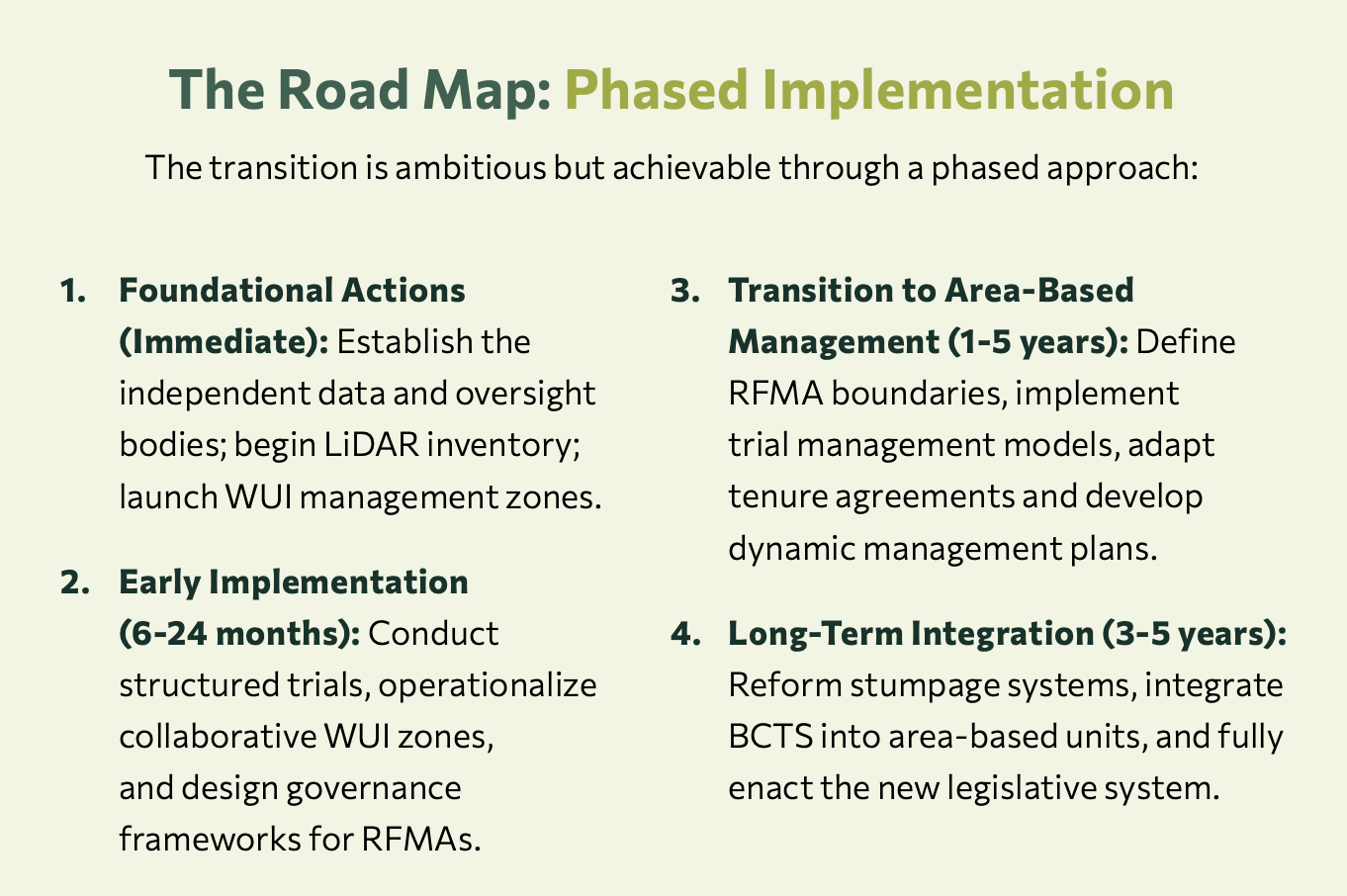
PFAC graphic
PFAC identifies four strategic themes underpinning the transition: improving transparency through trusted data, regionalizing land management, establishing independent oversight, and aligning government programs around shared objectives.
Together, the council says, these changes could be achieved largely by redirecting existing government spending rather than requiring significant new funding.
Transparency through trusted data
A key to the success of this transition is more accessible information to support credible decision-making and reduce conflict. PFAC recommends creating a publicly accessible forest and ecosystem inventory covering all public lands, including parks and protected areas, using LiDAR technology to establish a consistent, high-quality baseline.
To maintain trust, responsibility for managing this data would be transferred to an arm’s-length, expert-driven body independent of government ministries. The report also calls for an independent assessment of high-value old growth forests, aimed at clarifying their current status and identifying conservation pathways while respecting Indigenous decision-making authority.
Regional, area-based planning
A central recommendation is replacing existing administrative units, such as Timber Supply Areas, with Regional Forest Management Areas (RFMAs). Each RFMA would have a single coordinating land manager and be responsible for integrated, long-term planning that reflects local ecological conditions, community priorities and Indigenous rights and title.
Under this model, annual allowable cuts would flow from comprehensive spatial management plans rather than static timber supply reviews, allowing management decisions to respond more effectively to disturbances such as wildfires.
The report also highlights wildfire risk in the wildland–urban interface, recommending the creation of dedicated management zones around at-risk communities, supported by a Community Forest Resilience Fund focused on prevention and risk reduction.
Independent oversight and reconciliation
To ensure continuity across political cycles and reduce what the report describes as “process fatigue,” PFAC proposes establishing an independent forest oversight body to guide and monitor the transition to regional land management.
The council also urges collaboration with First Nations to design new governance structures tailored to regional contexts and consistent with Indigenous laws and responsibilities. Initial implementation, the report suggests, should begin with on-the-ground pilot projects to test and refine area-based management before broader legislative changes are introduced.
Aligning programs with long-term goals
Finally, the report calls for a sharper focus on initiatives that support the broader transition to Land Care. PFAC recommends winding down or repurposing programs that are not aligned with area-based management, starting with BC Timber Sales.
Under the proposed shift, timber pricing would be separated from land management decisions and adjusted to reflect regional realities, with harvesting activities integrated into coordinated regional plans.
“Taken together, these recommendations aim to reduce process fatigue, improve clarity and predictability, and support more stable outcomes for BC’s forests, communities, and all who depend on them,” PFAC said.
To view or download the full report visit here. The Provincial Forestry Advisory Council is an independent advisory body established to provide expert, non-partisan guidance on the future of forest policy in British Columbia. Its members bring experience across Indigenous governance, forest management, economics, ecology, and public administration. For more information, visit pfac.ca.