By Roy Wood, Special to the Times Chronicle
The crackdown on unlicensed short-term rental (STR) properties and the introduction of a regulatory regime is one of several factors leading to a glut in the Osoyoos real estate market and the accompanying drop in prices, says a prominent local realtor.
Eileen McGinn addressed a public hearing earlier this month regarding the town’s pilot STR program. She told town council that several homes in Osoyoos were purchased by out-of-towners with the intent of renting them out for a few years before moving here.
“People … came from Vancouver at 55 years of age and they wanted to buy a home, say up at the golf course. And they were planning to short-term rental it during the summertime, wintertime maybe snowbirds. Those homes are on the market for sale.”
In an interview this week, McGinn told the Times Chronicle that before provincial legislation outlawing STRs, there were close to 300 unregulated units in Osoyoos. “At one time there were 270 STRs. I’ve heard numbers as high as 302,” she said.
The province passed the Short-Term Rental Accommodations Act in late 2013. The town exercised its option to opt into the act in March 2024. The rules became effective in Osoyoos in November.
The town is about to begin a two-to-three-year pilot project that will bring town rules in line with the provincial act. Rules will include a licensing process, safety and parking regulations and a “primary residence” requirement, which will mean owners of STRs must live in the building housing the rental unit.
One critical aspect of the regulations makes it illegal for accommodation platforms, like Airbnb and VRBO, to carry ads for STRs that don’t have a provincial registration number.
Both the provincial and local regimes include hefty fines for violations.
Other elements affecting the real estate market include provincial zoning regulations to encourage multi-family housing, rising taxes and utility charges, the large number of mortgages facing renewal at higher rates, and the general economic uncertainty across North America.
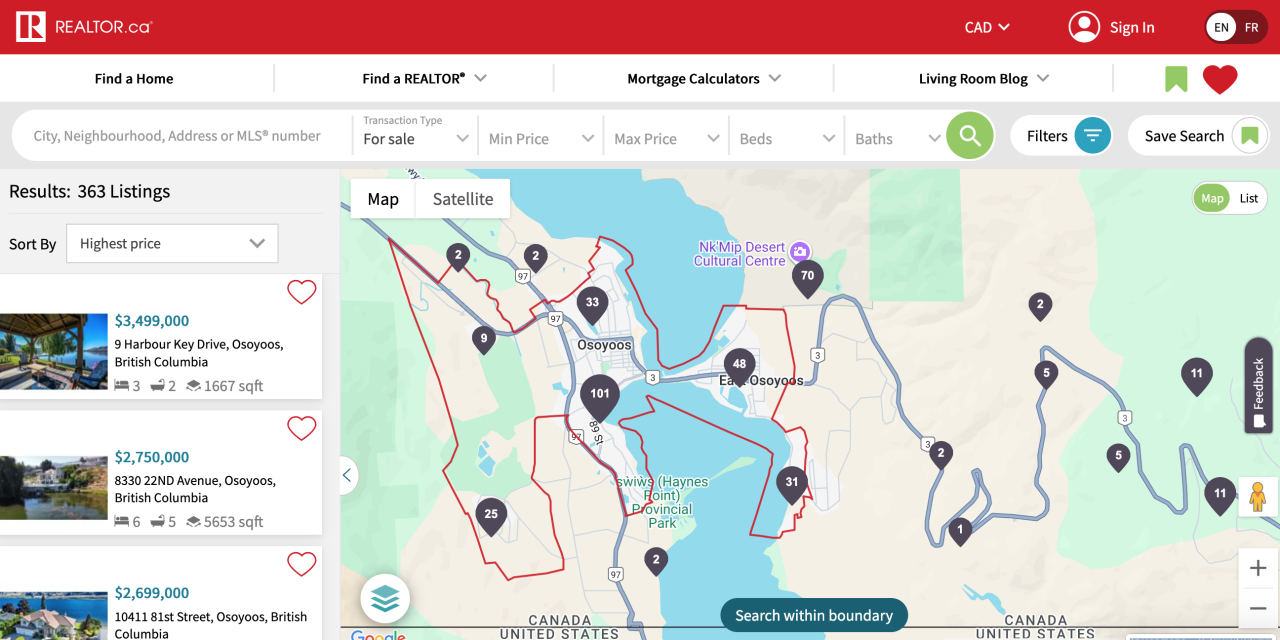
The number of homes on the market is at a remarkable level, said McGinn. There are currently 307 residential listings in the town. “That’s nearly 10 per cent of our market,” she said.
There are some 3,700 houses, condos and townhouses in Osoyoos and in normal times something like 170 of them are for sale, she said.
In the $750,00-to-$900,000 range, for example, McGinn said there are usually fewer than 10 listings. Right now, there are 26. “At the beginning of the season there were 42,” she said, “(So) there have been some sales.”
Most of the sales that are taking place these days are among the lower-priced homes, she said.
As the laws of supply and demand would dictate, prices are coming down.
Quoting from a list of recent sales, McGinn pointed to several that sold substantially below their “assessed value.” For example, one home assessed at $878,000 sold for $785,000; one at $884,000 sold for $707,000; and one assessed at $1.2 million sold for $885,000.
Those numbers show a drop in values, since the “market-based” assessments are based on sales that occurred between July 2023 and July 2024. “Here we are in 2025,” said McGinn. “The market was totally different that year. We were still on an upswing. We’re on a down swing right now.”
McGinn remains optimistic that there will be a resurgence in the market in the spring. “Osoyoos is a smaller community. Prices will always rebound,” she said. “Now is the time to buy if you want (to live in) Osoyoos.