Kwantlen First Nations’ Leah McDowell has a vision. A simple yet powerful one – a sea of orange across the entire country on September 30.
This particular day is Orange Shirt Day – now a federal statutory holiday (although the B.C. government has not followed suit) known as the National Day for Truth and Reconciliation. It is a day aimed at raising awareness about residential schools, victims and the survivors. More than 150,000 children attended these schools between 1883 and 1997.
This year’s marking of Canada’s cultural genocide inflicted on Indigenous peoples has been made all the more poignant by the ongoing discovery of thousands of unmarked graves of children at sites of former residential schools.
This national awakening to the horrors that devastated Indigenous communities and families across generations began earlier this year in late May when Tk’emlúps te Secwépemc Chief Rosanne Casimir announced that 215 children in unmarked graves had been located at the former Kamloops Indian Residential School. This number has since grown to nearly 2,000 as ground-penetrating radar is progressively used at former ‘school’ sites.
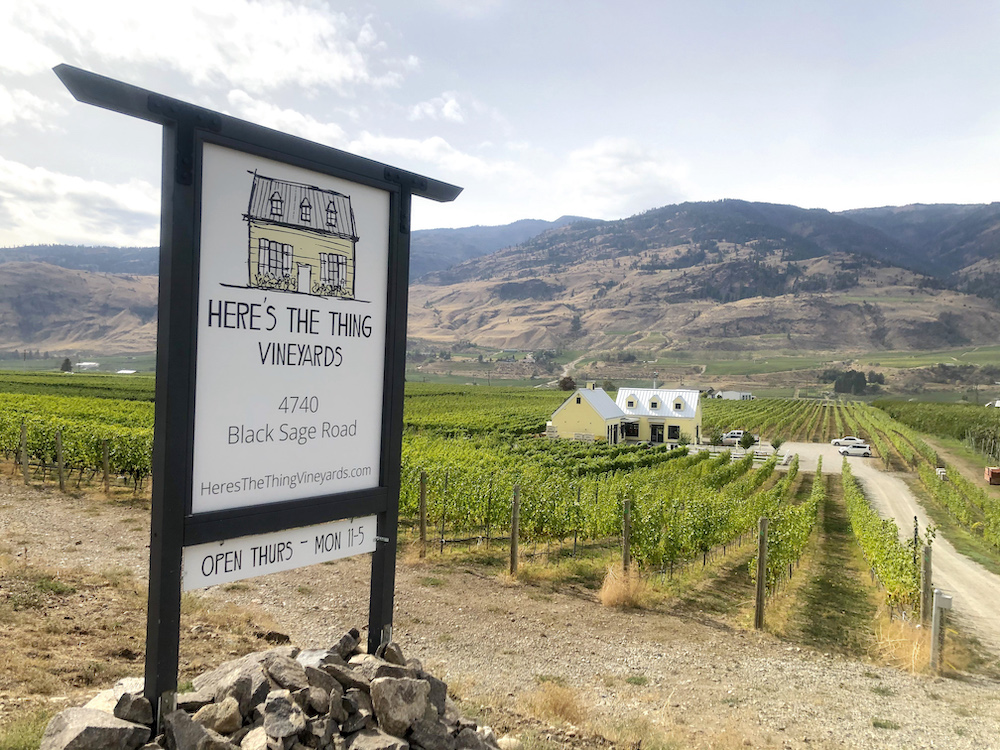
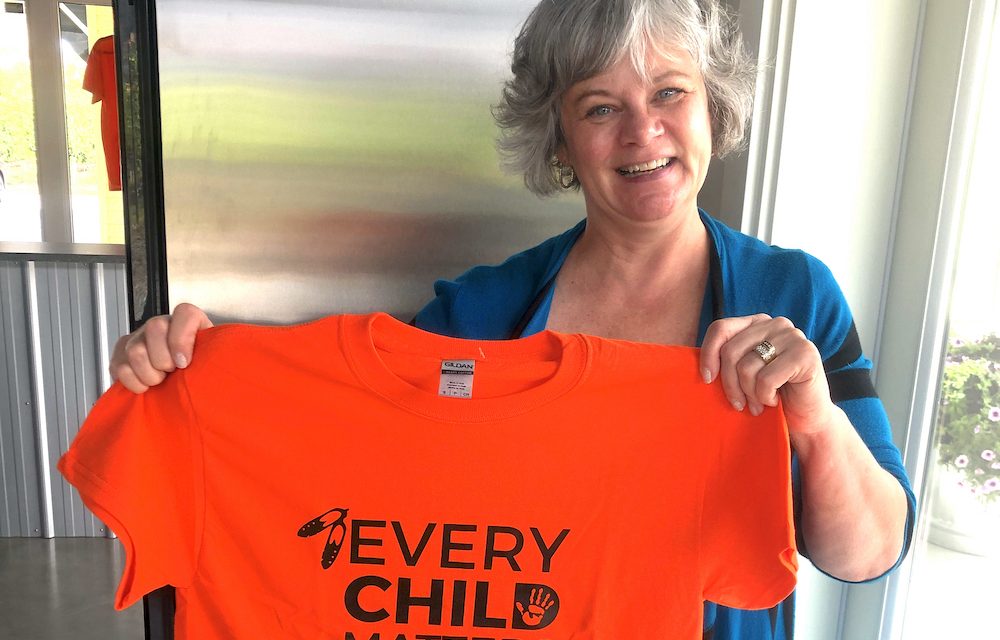
The orange t-shirts are available at Here’s The Thing winery on Black Sage Road and are a result of a partnership between Leah McDowell and Tony Munday of Munday Media & Design. Don Urquhart photo.
Significantly, Casimir used the term ‘located’ and not ‘discovered’ because for the Indigenous population of Canada these graves were known widely by elders. For much of Canada’s non-Indigenous population on the other hand, years of systemic racism and whitewashing of history made this a ‘surprise.’
“I’ve known about residential schools my whole life and I’ve heard the stories from elders in my community but when Kamloops was discovered it was just so shocking, I mean you’d have to have no soul not to be shocked,” McDowell said. “And we know this is only the tip of the iceberg.”
McDowell and her husband Jamie are proprietors of Here’s The Thing winery on Black Sage Road. “I thought to myself, I’m just a small winery owner but is there something that I can do, something tangible.” From there the idea germinated into producing orange T-shirts in partnership with Tony Munday of Munday Media & Design.
She says that while raising some money was part of it, it was also important “just to make a point that we’re thinking about it and it’s front of mind and it’s not just a news cycle, it’s a story that’s going to go on for years.”
The winery purchased the T-shirts and Munday donated the design and printing. The two partners produced 200 of the T-shirts – which was all that was available because orange T-shirts are in high demand for very obvious reasons – which they sell for $25 plus taxes with all proceeds going to the B.C.-based Indian Residential School Survivors Society.
McDowell is pleased with the support they’ve received with less than 50 T-shirts left. They are available only at the winery which is open five days a week from 11 a.m. to 5 p.m. (closed Tuesday and Wednesday).
The Times-Chronicle asked whether she feels Canadians are still focused on the residential school issue, particularly in B.C. where wildfires and then the federal election have refocused media coverage.
“I don’t know that Canadians are focused on residential schools first and foremost on their minds. I think that awareness is growing though and I’m encouraged by that. I’m encouraged by how many regular folks are buying orange T-shirts from us and I think that come September 30 what you’re going to see is a wave of orange all across Canada.”
She is also encouraged by the growing move to include First Nations as part of the curriculum in B.C. schools. But clearly, there is much work to do.
“I think the politicians have failed us there’s no question about it. The last time we were in federal elections Justin Trudeau made a point of making promises to First Nations people and the fact that we are still having the conversation of First Nations people in the north not having clean drinking water, it absolutely infuriates me quite frankly.
“I think our local MP should be held accountable as well in all our communities across Canada,” she said, urging Canadians to put more pressure on Trudeau who won another minority government.
She added that awareness needs to come through not only just Orange Shirt Day, but throughout the year. “The stories are going to continue to come out and I think it’s time for Canadians to be outraged, I really do.”
The worry of course is that the attention of non-Indigenous Canadian society wanes or worse, becomes immune to the horrors as more and more mass gravesites are uncovered. McDowell believes this won’t happen because of the sheer gravity of the injustices.
“When you’re talking about children – some of them infants – being murdered by the Catholic Church and other churches and levels of government and law enforcement, there has to come a reckoning and surely people aren’t callous enough to look away from dead children, Canadian children. That’s my hope, what can I say?”
Will the wounds ever heal?
“I think there’s a possibility for healing, it’s going to take a lot of work on the part of First Nations people and the people in communities, McDowell said.
“I am hoping that the next generations of First Nations people, our youth, have better opportunities than our elders ever had and I hope they have more access to mental health help, and addictions help. Is that reality? I don’t know, that’s something for the federal and provincial governments to answer to. Let’s hold them to account,” she noted.
The inspiration for Orange Shirt Day comes from residential school survivor Phyllis Jack Webstad of the Stswecem’c Xgat’tem First Nation who attended the former St. Joseph Mission (SJM) Residential School near Williams Lake.
At age six, Webstad was given a new orange shirt for the start of school by her grandmother. When she got to school she was stripped of her clothes, including her brand new orange shirt which was never returned.
For Webstad the colour orange has always reminded her of her experiences at residential school and, as she has said, “how my feelings didn’t matter, how no one cared and I felt like I was worth nothing. All of us little children were crying and no one cared.”
The Indian Residential School Survivors Society (IRSSS) provides essential services to residential school survivors, their families, and those dealing with intergenerational traumas.