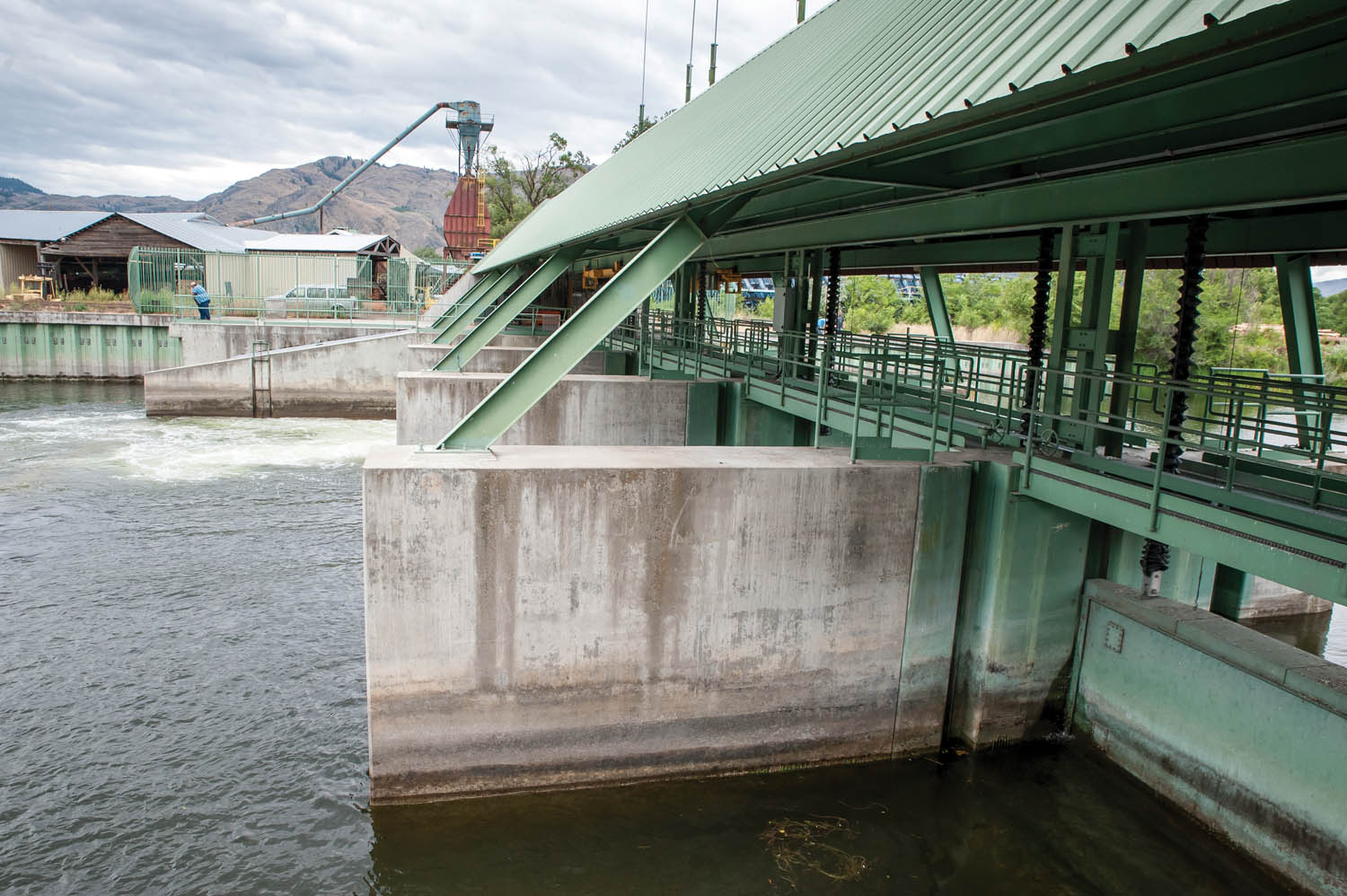
The International Joint Commission has authorized Washington State to increase the water level in Osoyoos Lake at the Zosel Dam in Oroville, WA. (Richard McGuire file photo)
Note: Shortly after this story appeared in the paper, on Wednesday, Aug. 5, the B.C. government announced an increase in the drought rating in the Okanagan to Level 4, or “extremely dry.”
As a record-breaking drought worsens in the South Okanagan, authorities are taking new measures to conserve water.
Last week, the International Joint Commission (IJC) authorized Washington State to allow the level of Osoyoos Lake to rise an additional six inches to store extra water for anticipated need in late summer and fall.
Municipalities throughout the Okanagan Valley have either invoked water rationing or have urged residents to reduce their water consumption by 30 per cent.
Osoyoos was one of the first to take action, implementing a bylaw in June that limits lawn watering to twice a week and prohibits such activities as outdoor car washing with a hose.
Other municipalities have followed. Even Kelowna, traditionally resistant to water conservation measures, has invoked alternate-day watering.
“That’s big news,” said Anna Warwick Sears, executive director of the Okanagan Basin Water Board (OBWB). “It might not seem like a giant sacrifice, odd-even watering days, but at the same time it’s hard to get people to change. It’s certainly a step in the right direction.”
Lake Country has followed Osoyoos in introducing twice weekly watering. Peachland has asked residents to cut back by 30 per cent. Oliver has not imposed any measures, but unlike Osoyoos, Oliver has residential water metering.
Most parts of Southern B.C. are now in a Level 4 drought (extremely dry), the highest level, and Vancouver has completely banned lawn watering with municipal water. The Okanagan, however, is still at Level 3, very dry. Warwick Sears believes this is because of the amount of water still stored in upper elevation reservoirs or artificial dammed lakes, even though natural stream beds are exceptionally dry.
Lower levels of rainfall this spring and summer are only part of the story, says Matt MacDonald, acting warning preparedness meteorologist with Environment Canada.
A bigger factor is the record-breaking warm temperatures that increase demand for water and cause a higher rate of evaporation. Higher temperatures also contributed to an early snowmelt and more of the precipitation over the winter fell as rain and did not accumulate as snowpack.
From May to July, Osoyoos received 78.7 mm of precipitation compared to a normal average of 103.4 mm, he said. July was the driest month, with only 8.2 mm compared to a normal 24.6 mm.
“It was actually close to normal in terms of winter precipitation,” said MacDonald. “But it was much warmer than normal. Last winter was almost record breaking in terms of temperature so the majority of precipitation fell as rain as opposed to snow.”
With the early spring, the warmer temperatures melted the snow in a few weeks and the usual freshet didn’t occur.
The temperatures in recent months, however, are the biggest factor.
In May, the average temperature was 17.2 C, which is two degrees warmer than the norm of 15.2 C. June’s average was 22.8 C, well above the norm of 18.7 C and record breaking on some days. July’s average was 24.7 C compared to the norm of 21.9 C.
While the increase of two or three degrees each month may not sound like much, spread over one month’s time it is quite significant, MacDonald said.
He also points out that the averages factor in both daily lows and highs, so they are well below the temperatures in the hottest parts of the day.
Only one day, June 27, topped the 40-degree threshold at 40.9 C. Several days in July have come close, with the July 9 temperature hitting 39.8 C.
Are the extreme weather conditions and drought a one-off abnormal year or are they a sign of things to come? Is it a sign of long-term climate change or the result of El Niño ocean patterns in the equatorial Pacific?
El Niño has been strengthening, but its biggest impact on B.C. is during the winter months when it is likely to result in a warmer and drier winter, said MacDonald.
“We may see a repeat of what we saw last winter, when the ocean temperatures were very warm and again not as much snow on the mountains,” he said.
This raises the potential for low stream flows and dry conditions next spring.
As for climate change, MacDonald cautions that you can’t pin one individual season on climate change.
“At the same time, I would say I think this is a good hint of what potentially is to come,” he said.
A big factor in this year’s weather, however, is an area of unusually warm ocean temperatures in the Pacific to the southwest of Vancouver Island that meteorologists informally refer to as “the blob.”
When such a large area of ocean is two or three degrees warmer than normal, sitting off the coast, it takes a long time to cool down. That pattern does much to explain the summer weather, MacDonald said.
Osoyoos Mayor Sue McKortoff thinks this year’s hot and dry conditions are a sign of things to come and she’s adapted her personal lifestyle to use less water.
“I honestly think that this is going to be the norm,” she said. “I think we’re going to have to get used to making do with less.”
There is no current discussion at council about reducing watering days from the present two days a week, she said, but it’s an option council could consider. Such a change takes time because it requires further notification of the public.
The measures taken so far have reduced water consumption slightly, McKortoff said. However, she acknowledges that some people take the measures more seriously than others. Some are increasing their watering times on days when they are allowed and others are watering illegally outside of permitted times.
“We do have bylaw officers that are working on this and we’ve actually put some extra money into our watering bylaw officers,” McKortoff said. “We have pictures of people watering for 12 hours at campgrounds and motels and they will say to you, ‘that’s because this is our business.’ We understand, but we all have to do our bit. If everybody cuts down a little bit, then I think it will be helpful. It’s like garbage and recycling. It took forever to get people used to that change. I think it’s much more about education, about getting people talking about water and being aware of it.”
McKortoff suggests that people should wait until they have a full load to do laundry or use a dishwasher. They should also not let the tap run when they brush teeth, and they should consider reusing waste water, from a kettle, for example, to water plants.
“I take three-minute showers,” she said. “I heard somebody on the news the other day saying they take their dishes into the shower with them. I don’t go that far.”
In a recent Canadian Press news story, McKortoff also said she doesn’t shower every day “unless I need to of course.”
She chuckles and said her children were “mortified” when they read this.
Warwick Sears of the OBWB, however, says that reducing indoor water consumption makes less of a difference than controlling outdoor use.
“What’s going to make the difference is don’t water your lawn so much, don’t wash your car on the street and if you have irrigation, make sure that it is set up properly so that you are not watering your sidewalk,” she said. “We know from all the work that we’ve done that 24 per cent of the water that we use in the Okanagan is just on residential outdoor landscaping, so we think that this is a non-economic use. It’s purely aesthetic. It’s reasonable that people in the Okanagan don’t have emerald green lawns in the middle of a drought of historic proportions.”
Al Josephy of Washington State’s Department of Ecology oversees the operation of the Zosel Dam in Oroville, WA, which regulates the level of Osoyoos Lake.
He said the IJC’s decision last week will allow Osoyoos Lake to be raised or lowered by an additional six inches from its normal rule curve.
This means the water level could be raised to 912.5 feet in order to retain water to meet demand in the late summer and fall.
While the low flow in the Similkameen River met the criteria to declare a drought year months ago, the necessary criteria have not yet been met at Okanagan Lake.
Instead, the International Osoyoos Lake Board of Control recommended that the IJC should allow a temporary variation under Condition 10 of the supplementary order of approval for the operation of Zosel Dam.
Josephy said the speed at which the lake can be raised will depend on releases of water from Okanagan Lake at Penticton, any rainfall and the ability to hold back water at Zosel Dam without starving the Okanogan River of water below the dam.
The variation is allowed up to Nov. 1, but the lake level is normally drawn down starting on Sept. 15, he said.
It’s possible the drought variation could be ended sooner if there is a succession of rainy days, said Josephy.
“We’ve all got our fingers crossed,” he said.
RICHARD McGUIRE
Osoyoos Times
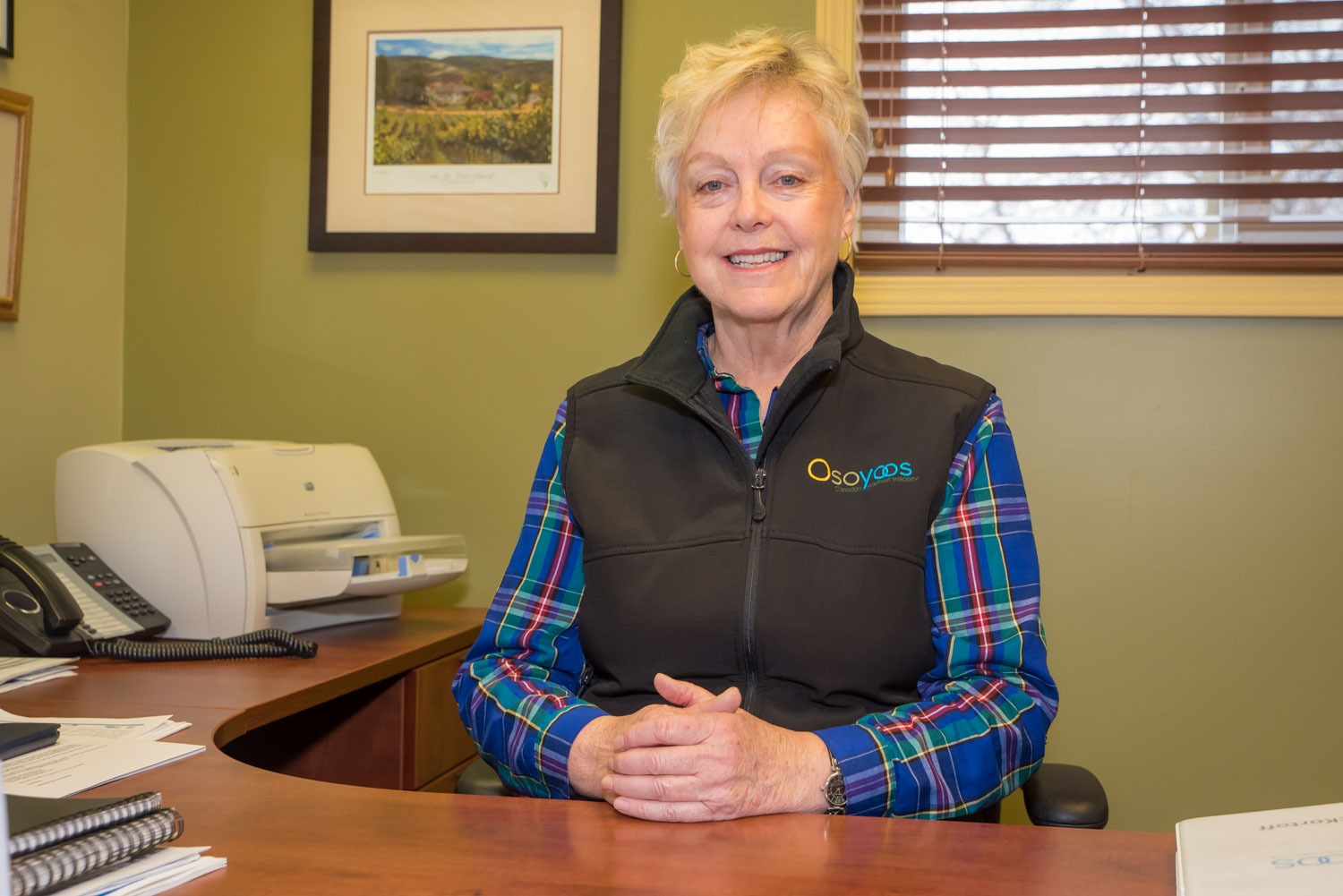
“I take three-minute showers. I heard somebody on the news the other day saying they take their dishes into the shower with them. I don’t go that far.” – Sue McKortoff, mayor, Town of Osoyoos. (Richard McGuire file photo)