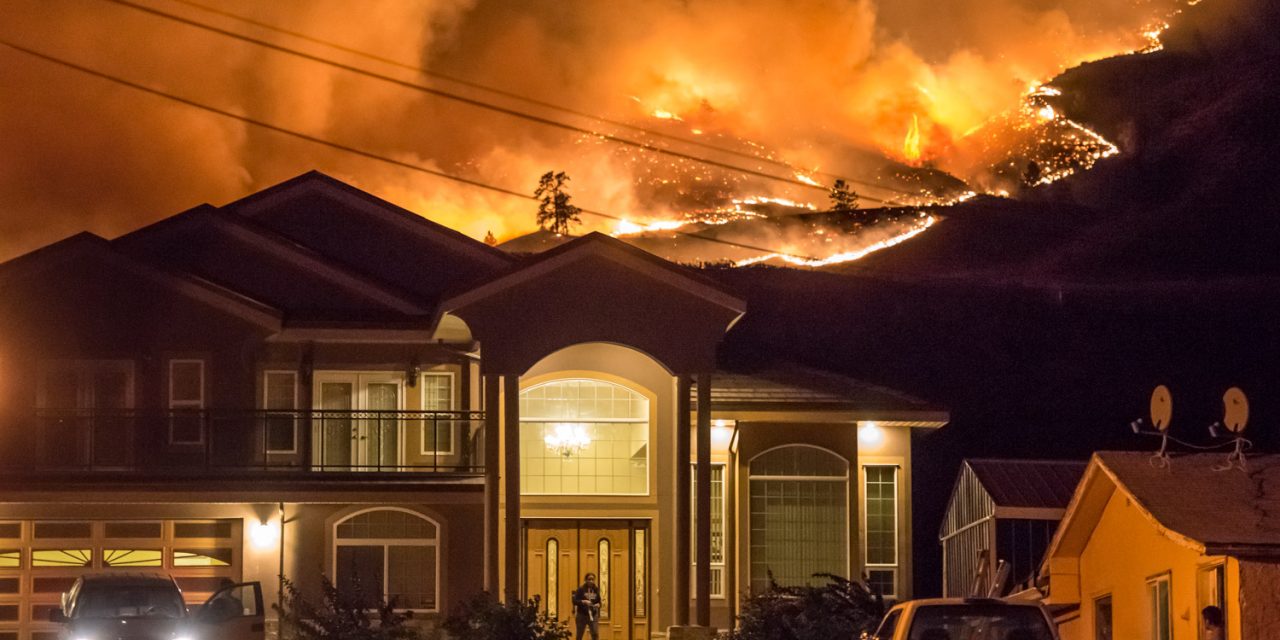
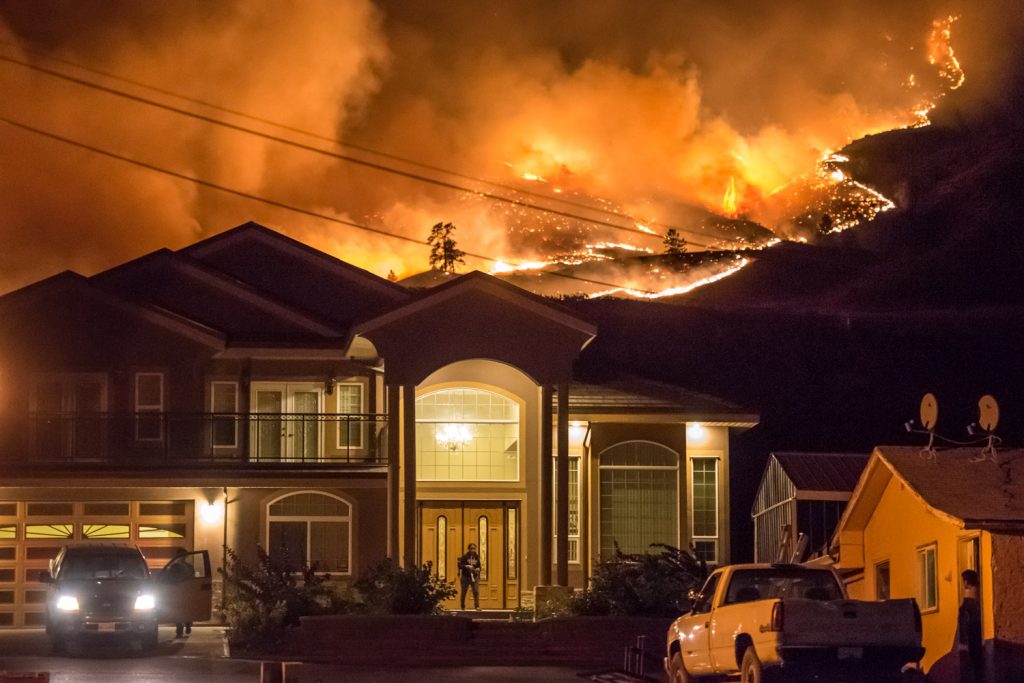
People prepare to evacuate homes along Highway 97 as the Testalinden fire rapidly approached just before 10 p.m. on the Friday night. Although the fire burned close to some of the homes and businesses in this area, it was stopped short before it did any serious damage to them. (Richard McGuire file photo)
The two wildfires that threatened Oliver and Osoyoos last summer are still a stark reminder of how helpless a town can be in the clutches of Mother Nature.
The one-year anniversary of Firestorm 2015 passed last week and people can’t forget how close the fires came to swallowing up the rural communities.
The Wilson Mountain and Testalinden Creek fires began their rampage 12 months ago.
Both blazes threatened many homes and prompted the evacuation of numerous residents.
Eighty-three-year-old Wally Yahnke barely had time to escape the inferno that engulfed his property on Wilson Mountain Road. The fire destroyed his unique home that he built against a rock.
J.C. Oliveira stood on the roof of his house on Spartan Street with a water hose and cooled down the shingles so they wouldn’t catch fire. His wife and children were waiting anxiously across the street in preparation to leave at any moment.
But not without their J.C. Luckily, the fire didn’t reach the homes in that neighbourhood.
Bruce Fuller from Rustico Farm and Cellars was too close for comfort in the Testalinden Creek fire that nearly took out his winery on Road 16.
“I’m not an overly religious person, but I tell you, someone was watching over us … I thanked him in the morning.”
Fuller said he now has renewed respect for fire and the men and women who put it out.
Even after a year has gone by, Fuller thinks about the wildfire every day.
“I look over at the mountain and it’s very pretty (green) now.”
It’s amazing how many people visit the winery from across Canada and the U.S. and tell him they saw the news coverage, he said.
Some people were even in tears during their visit. “It’s something people talk about all the time.”
Fuller admitted he wasn’t very emotional on the night of August 14. That’s because he was too busy juggling everything as the fire crept toward his property.
The only structure he lost was a horse barn and a big elm tree beside it, despite the fact he had a garden hose in his hand.
“I was spraying the barn but the heat was so intense it sucked the oxygen out of your lungs . . . like a vacuum cleaner.”
When that started happening, his friends helped him get out of there and they ended up sitting in a truck drinking a bottle of wine.
“The RCMP asked me to leave, but I did not. I wanted to stay (and put out the fire).”
Fuller was worried about the sod roof on his log home, but there were sprinklers on top to help prevent embers from igniting it.
Luckily there was no damage to the vineyard.
After the fire he handed out smoke masks to visitors, who looked like “little bandits” walking around.
Oliver Fire Chief Dan Skaros said last year’s event was the biggest grass fire that the department has ever battled.
The highlight for him was seeing everyone work together towards a common goal – put that fire out and help those in need.
When asked what good came of the fire, Skaros took a long pause but couldn’t really pinpoint anything. “It got rid of some of the underbrush,” he noted.
The fire chief did agree that the event was a valuable learning experience.
“Don’t take anything for granted, and don’t count on the wind going north because it can change south fast . . . expect the unexpected.”
Skaros pointed out that last summer’s ordeal strengthened the bond among firefighters, who have to continually trust each other in emergencies.
The chief strongly promotes the FireSmart program and reminds homeowners to keep their yards clean of debris and other combustibles, such as pine needles and tumbleweeds.
“It’s not a five-year thing, it’s a yearly thing . . . it’s educating yourself, not just the community.”
Skaros said although the campfire ban in town is unpopular with some people, it has certainly helped deal with the fire hazard this year.
Looking back at the fires, Oliver Mayor Ron Hovanes finds himself appreciating the cooler temperatures this summer.
“Last year I found myself many times in a conversation about how the conditions in Oliver were ripe for a fire. You could feel it in the air most every day.”
After the fire struck, the mayor, like many others, found sleep to be elusive. His thoughts were filled with choking smoke, residents on rooftops, hardworking firefighters, children sleeping in the community centre, and fire in the hills as far as you could see.
“A big takeaway for me was recognizing how big a risk an interface fire can be to Oliver,” Hovanes said. “Knowing that our community is surrounded by agricultural lands and a desert landscape I thought that we were somewhat protected. We were not.”
Going forward, Oliver has begun the process of becoming a FireSmart community, the mayor said.
“We are also in the process of examining our emergency preparedness and will take steps to ensure that we have the properly trained personnel to deal with any future incidents.”
One lasting thought that Hovanes had was seeing the community come together during the threat.
“You realize how close and common our relationships are. We are all neighbours, family, colleagues, friends . . . everyone is affected.”
Osoyoos Mayor Sue McKortoff said the fire extended to Kilpoola where residents had to be evacuated.
“What amazed me was the speed that all the fire, police, ESS teams got ready and fought these fires, the mayor said. “Fortis had replaced a pole on Highway 3 by the time I toured there with the fire chief the next morning. This was a test of how well these professionals worked together.”
McKortoff said she’s glad that it hasn’t been a super dry season this year.
“But I think we are prepared to deal with this again if necessary.”
Dale Kronebusch, emergency services supervisor for the regional district, recalled many highlights (and lowlights) of last summer’s wildfires. One highlight for him was seeing firefighters regain exiting ability after the fire’s travel blocked their safe exit routes during tactical evacuations.
“There could have been more property damage than there was if it wasn’t for the skill of the structural and wildland firefighters.”
The most memorable moment for Kronebusch was watching the wind shift to a northerly direction, which filled the skies with smoke from the fires in the U.S., grounding all airtime operations here.
For him, the most valuable learning experience was communication, saying it is the key to working together towards a common goal.
When asked how to best prevent a similar wildfire from happening again, Kronebusch said you can start by utilizing the FireSmart model – lessening the forest fuels on the perimeter of your community and transportation corridors.
Janette Van Vianen, local emergency program coordinator, attends two readiness seminars a year through Emergency Management BC. This provides her with up-to-date information regarding possible large-scale emergencies such as floods or fires.
“We also held a tabletop exercise last year that involved a chemical spill that required evacuations across the border.”
Van Vianen said they are prepared for any type of emergency and have the contacts for any type of resources they need.
Patty Otteson, reception centre manager in Oliver and Osoyoos, said they assisted more than 250 people in Oliver and approximately 50 in Osoyoos, including some evacuees from Rock Creek.
The most memorable moment for her and the volunteers was seeing the looks on the evacuees’ faces when they were told they would receive shelter, food and clothing over a 72-hour period.
“These people were all extremely grateful and happy to see us. I believe we provided them comfort in an extremely scary situation.”
Otteson said the experience taught her that a lot of goodness could come from people in a crisis.
“It also taught me there is strength in numbers. The entire community and neighbouring communities came together to help in so many different, selfless ways (donating their time, food, water, clothing, blankets, transportation, etc.). The list was endless for what people would do to help out.”
Otteson said she sincerely hopes a fire of this magnitude never happens again.
“It reminded me of how important the role of ESS (Emergency Support Services) is and how someone’s life can totally change in a split second.”
She was asked what good came of the crisis.
“This event restored my faith in humanity. It brought people in this community closer together and closer with the people in neighbouring communities who assisted in various capacities.”
The Rock Creek fire east of Osoyoos was a monster that nobody could control as it burned everything in its path, including at least 30 homes.
Today, residents continue to rebuild their lives in that community. In fact, the Oliver Fire Department helped by raising money for a special fire suppression truck for Rock Creek.
The wildfires in Oliver prompted a visit by B.C. Premier Christy Clark, who personally thanked members of the Oliver Fire Department and those who worked in the emergency services centre.
Clark condemned the operator of a drone that grounded fire suppression aircraft in the area. Since then, the government has introduced new penalties for people with drones that interfere with firefighting efforts.
Aerial drone operators could be fined $100,000 and face jail time for up to one year.
According to reports, lightning caused the Testalinden Creek blaze, which burned more than 3,700 hectares. The cause of the Wilson Mountain fire, which burned more than 300 hectares, was not confirmed.
Max Birkner, fire information officer for the BC Wildfire Service, said there have been approximately 140 fires in the region since the fire season began this year. About 70 of those fires were caused by humans, he pointed out.
“We would like to highlight that human- caused fires divert resources from lightning-caused wildfires.”
Birkner said people need to be aware of their actions in the backcountry. For example, ATV operators and dirt bike riders should stay on designated trails and not park their machines in high grass. That’s because hot manifolds and exhaust pipes can easily start a fire in dry areas, he said.
Birkner noted that fireworks and Tiki torches are prohibited this time of year, and throwing lit cigarettes out of vehicles is illegal.
New on the prohibition list is binary exploding targets used for target shooting.
While campfires are permitted, they can’t be any larger than half a metre high and half a metre wide. However, Birkner said people who live in municipalities must check with the fire department before lighting campfires.
Despite the significant hazard of abandoning campfires, there were 38 abandoned campfires in the region on the B.C. Day long weekend, Birkner reported.
Before leaving a campfire, be sure to stir the ashes and ensure they are cool to the touch, he advised.
LYONEL DOHERTY
Special to the Times
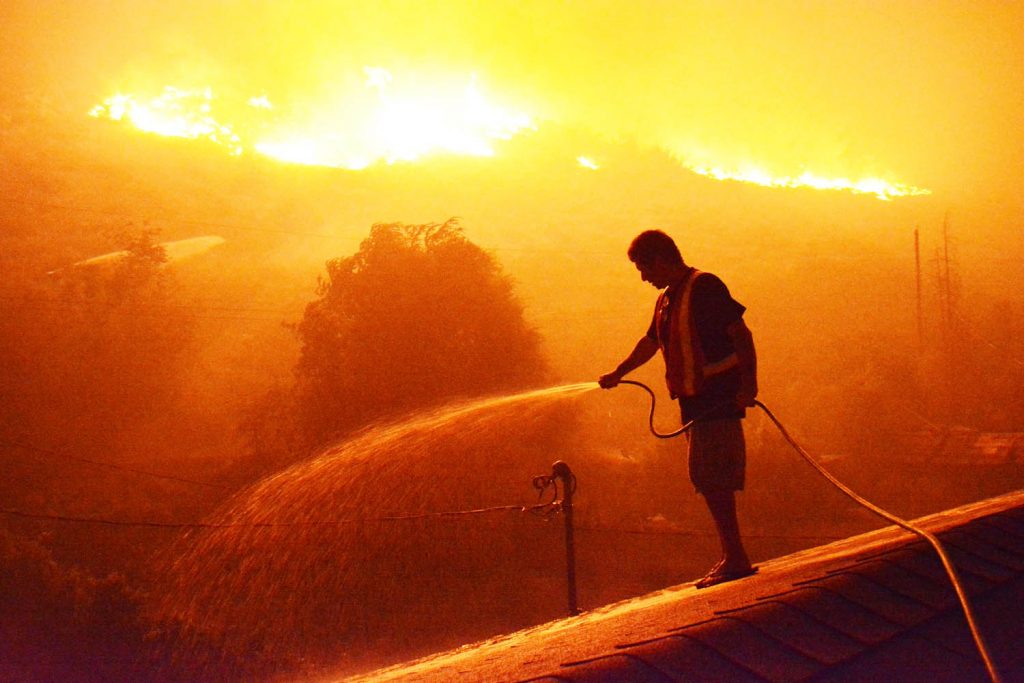
Some residents like J.C. Oliveira didn’t want to leave their homes unprotected on Spartan Street in Oliver, where the Wilson Mountain fire came dangerously close on Aug. 14, 2015. (Lyonel Doherty photo)