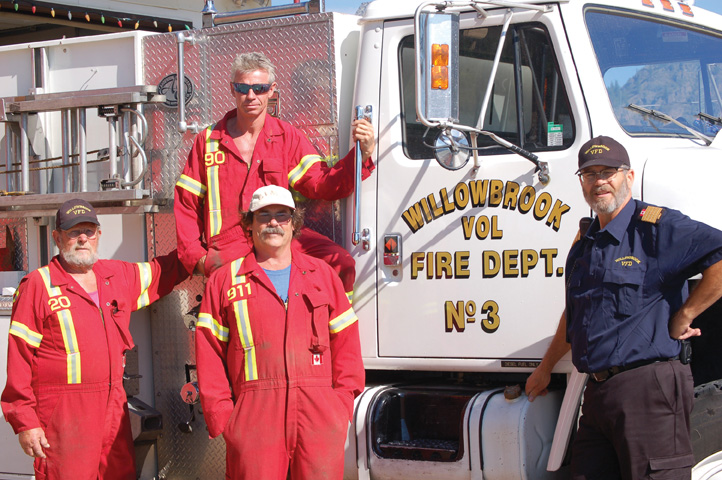

Willowbrook Fire Chief Brad Fossett believes a standard pay policy will help recruit younger members to the department.
File photo
The regional district is looking at a proposal that would standardize wages within volunteer fire departments – a move that could have tax implications in several communities.
Regional emergency services supervisor Dale Kronebusch introduced the plan to board directors as part of budget discussions. He said the intent is to standardize rates of pay throughout regional fire departments including Willowbrook (whose members don’t get paid), Okanagan Falls, Keremeos, Anarchist Mountain and Kaleden.
The board plans to investigate a “tiered” system for fire department remuneration based on call volume. Tier 1 is 100-plus calls, tier 2 is 26 to 99 calls, and tier 3 is zero to 25 calls per year.
The Oliver Fire Department responded to 201 calls in 2012, compared to Okanagan Falls with 220. Osoyoos had 154 and Keremeos had 127. Willowbrook Fire Department responded to 15 calls in 2012, while Tulameen had four calls in 2012. Anarchist Mountain responded to 17 calls in 2012.
Current stipends for fire chiefs range from $8,100 in Princeton to $15,000 in Osoyoos. Under the new proposal, tier 1 fire chiefs would get a stipend of $15,000, while tier 2 chiefs would get $12,000, and tier 3 chiefs $8,000. Officers would also get raises under the plan.
The proposed financial impact on communities varies. For example, the average residential impact in Willowbrook would be $233, while in Okanagan Falls, residents would pay an extra $8. If adopted, the proposal would cost approximately $150,000 to implement.
Brad Fossett, chief of the Willowbrook Fire Department, said it is difficult to ask someone to give up work and family time to risk life and limb for their community without some form of remuneration.
“The longtime members of Willowbrook Fire Department have worked tirelessly for 25 years to build an organization that is now capable and well equipped. I believe that if we hope to enlist younger members in today’s economy we need to have a standard pay policy.”
Andrew Stuckey, communications director for the regional district, said they value the service firefighters deliver in their communities and believe they should be compensated at a level consistent with industry standard.
“The regional district believes standardization of operational and safety guidelines, training and remuneration plays a big role in ensuring sustainable operations at each of the regional district’s seven volunteer fire departments,” Stuckey said.
(These seven departments do not include municipal departments in Summerland, Osoyoos, Oliver, Princeton or Keremeos.)
Stuckey said the regional district is proposing to introduce a phased approach to the remuneration structure. The board will strike a committee to further review the proposal and report back this spring.
Area C director Allan Patton said there is a huge disparity among fire departments, and this inequity must be addressed.
Patton said he was shocked to learn that Willowbrook and Tulameen firefighters don’t get paid for the work they do.
The director noted that many Willowbrook firefighters are wary of potential tax increases and like the idea of being volunteers. But the inequity has to be fixed, he reiterated.
The new proposal could reportedly see volunteer firefighters getting $20 an hour for call-outs and training.
Bob Haddow, chief of the Okanagan Falls Volunteer Fire Department, told the Penticton Western News that he would rather see additional money spent on equipment upgrading as opposed to wage increases.
Lyonel Doherty
Oliver Chronicle