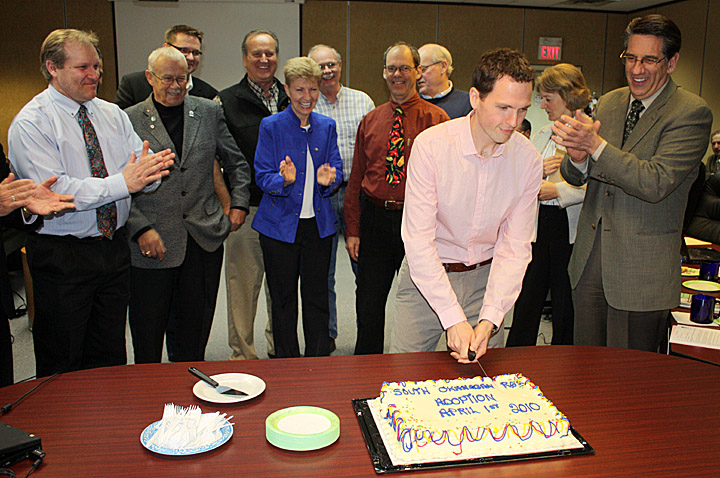
Regional District Okanagan-Similkameen staff and board members celebrate with cake after the board adopted the Regional Growth Strategy on April 1. Photo by Paul Everest - Click on picture for larger image
OSOYOOS TIMES-April 7, 2010
By Paul Everest – Osoyoos Times
After six years of tweaking, the Regional District Okanagan-Similkameen (RDOS) Regional Growth Strategy has received final approval.
RDOS board members and staff applauded when the lengthy document was adopted at the April 1 board meeting and those present were provided with a piece of cake to mark the occasion.
The strategy is described as a long-term planning tool to deal with growth management issues in the southern part of the Okanagan Valley, including the Osoyoos area, over the next 20 years.
According to a definition found on the RDOS website that incorporates guidelines from the Local Government Act, the strategy “asks participating local governments to look at their future holistically, aiming to ‘promote human settlement that is socially, economically and environmentally healthy and that makes efficient use of public facilities and services, land and other resources.’
“The RGS is not a land use plan, like a zoning bylaw. Rather, the RGS sets direction in an overarching policy framework that will be linked to local government Official Community Plans (OCP). In this way, the RGS not only guides growth over the long term, but also provides a framework for agreements on such issues as air and water quality, and major public infrastructure, between the various levels of government as well as between government and non-governmental organizations and citizen groups.”
Some of the guiding principles behind the strategy as set out by the Local Government Act include avoiding urban sprawl, creating settlement patterns that limits automobile use while encouraging walking and public transit, protecting environmentally sensitive areas, preventing air, land and water pollution and providing affordable housing.
The strategy has been in development since 2004 and received first and second readings in June of 2007 before going out to the public for feedback.
It was amended twice in October of 2008 and October of 2009 in response to concerns brought forward by local governments and the public, including issues surrounding growth areas.
In the fall of 2009, the Town of Osoyoos told the RDOS it wanted the strategy tweaked to limit the number of growth areas in the region and nine requests made by Osoyoos town council relating to primary growth areas were incorporated into a revised version of the strategy.
Council gave its approval to the strategy on Feb. 1 and, after all affected governments confirmed their acceptance of the document, the RDOS board gave the strategy third reading on March 18.
Mark Pendergraft, rural director for Area A, said the strategy is a “needed document.”
“As fast as the area is growing we need guiding principles on where we grow and how.”
The strategy will be beneficial for Area A, he said, as it will provide direction for where growth will go.
It won’t prevent small subdivisions while larger development projects, such as the Regal Ridge project on Anarchist Mountain or the now-defunct Willow Beach Resort, would have to go through a stringent approval process, Pendergraft said.
One of the parts of the strategy that pleases Pendergraft is its focus on water needs in the region.
He said the strategy suggests that a region-wide policy is needed for managing water requirements and uses, something that could benefit the area in the face of future water shortages.
[email protected]