The provincial government has teamed up with Okanagan fruit growers – and farmers across this region and province – with new programs with the goal to ensure the short-term and long-term viability of the tree fruit industry in this region.
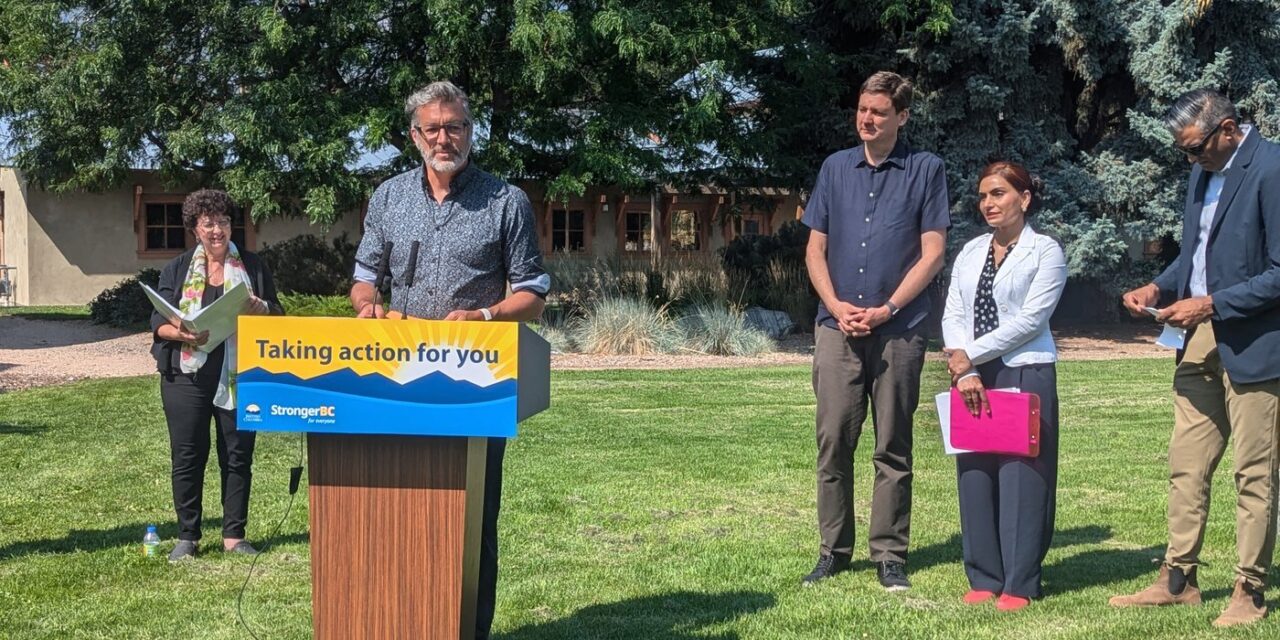
Premier David Eby, along with Agricultural Minister Pam Alexis and Roly Russell, the MLA for Boundary-Similkameen were all on hand for a major multi-year, multi-program announcement in Penticton Tuesday that will assist Okanagan fruit and vegetable growers and farmers across the province who have been ravaged by natural disasters and other difficult circumstances for several consecutive years.
Two weeks ago, the B.C. Fruit Trees Co-operative announced it was shutting down after 80 years in business, leaving hundreds of fruit and vegetable growers without a place to pack, store and move their products.
Eby said these initiatives moved forward after a recent meeting with the federal government and agricultural ministers from across Canada, who were unanimous in calling for reform to federal programs.
Eby said he personally asked Prime Minister Justin Trudeau for much-needed help. “I brought up with the Prime Minister to ask for some very specific things in this urgent moment, as well as an ongoing commitment to work with us,” he said. “Just like they would work with other farmers in other provinces facing a crisis like this. We deserve the same treatment.”
The crops are different in B.C. and the circumstances are different from other provinces, but there’s a need for the federal government to step up and assist, he said.
Eby also asked Trudeau to initiate a two-year stay on advanced loans that farmers may have received. “Farmers can not afford to make those payments right now,” Eby said. “With two years, they’ll be able to plan and prepare to start to repaying those federal government has made to them.
His government is initiating a provincial “replant program” and has asked the federal government to match that funding, which will greatly benefit so many farmers in this region who are hurting so badly, said Eby.
He’s also asked for subsidy frameworks taking place in Washington State, where the federal and state governments are heavily subsidizing their farmers.
“Our farmers are expected to compete on what’s been called a level playing field … when it’s clearly not a level playing field,” he said. “One group of farmers is being subsidized and one isn’t. If there’s a level playing field, our farmers can compete with the best in the world.”
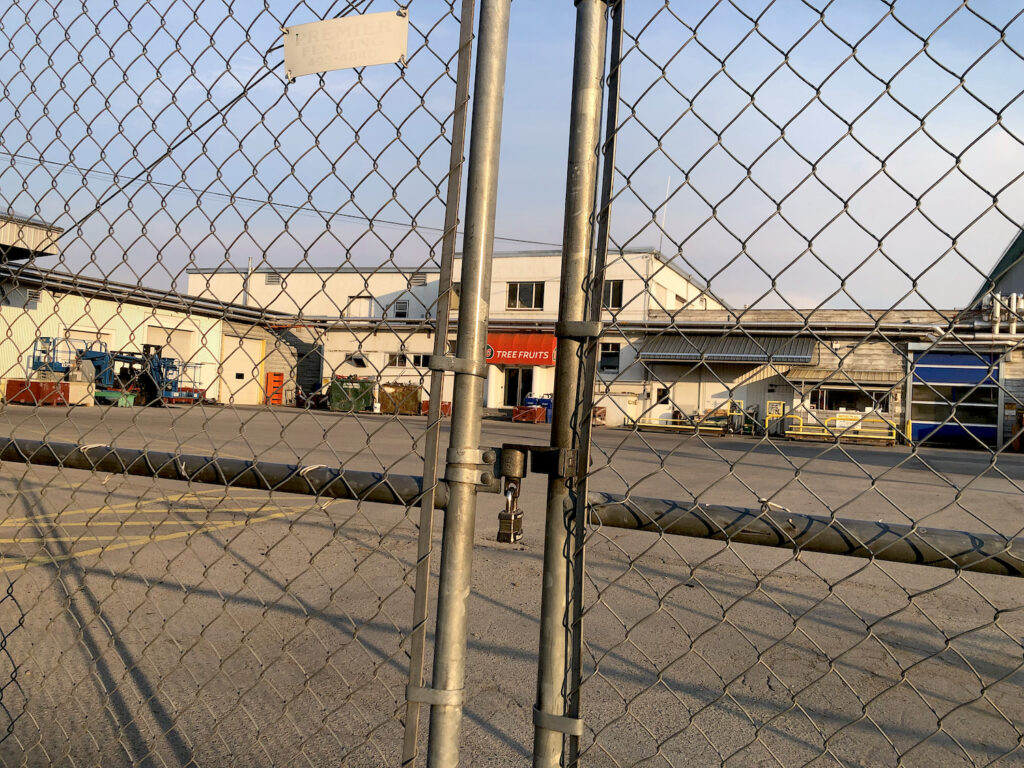
The BC Tree Fruits processing facility in Oliver sits idle behind padlocked gates. Don Urquhart photo
The provincial government is taking immediate steps to help B.C. farmers and will be making more announcements in the near future, he said.
“Our commitment is to continue to work with farmers and the key associations to ensure that these programs that we have announced are easy to access, that they make sense, they work in a coordinated way, but also to make sure they’re responsive to the evolving challenges faced by farmers.”
The provincial “agri-stability program” will be improved with the compensation level increasing from 80 to 90 per cent, as well as doubling the cap for the 2024 growing season, said Eby.
“Our estimates are that this will amount to about a $15 million direct payment to farmers to support them with their immediate costs and compensation claims related to loss of crops,” he said. “We are putting in place an additional $5 million tree fruit climate resiliency program, which centres around technologies that are needed to prevent crop loss due to climate events.”
This would include crop covers, fans and other devices needed to protect crops from extreme weather events, he said.
This program will be replenished annually so farmers can plan on a multi-year basis, rather than a single season.
There will be an exemption to the tree fruit sector so that crops this year can be picked, processed and stored to minimize losses related to the closure of the co-op, he said.
The tree fruit co-op sought bankruptcy protection on Tuesday. “We will do whatever we can to identify opportunities to intervene to do whatever we can to make available the services that the co-op used to provide,” Eby said. “And to keep a close eye on the assets of the co-op to see if there’s an opportunity for us to work together to find a path to ensure that the assets are not lost.”
The impact of climate change, wildfires and other natural disasters has had a devastating impact on family farms across this region and the province, he said.
“Our commitment is to farmers of all sizes,” he said. “Whether large markets that go to export markets or small farmers that grow for local fruit stands, we’re going to stand with you and ensure we’ve got your back here and continue to work with you to address the crisis you are facing.’
Alexis said there’s no doubt B.C. farmers over the past several years have faced many challenges. “And the way we’ve responded to each of them is by working together.”
The winter frost that damaged so many crops, followed by the closure of the co-op have only added to the growing pressures felt by farmers, she said.
“From the beginning, we’ve been listening to the wide range of perspectives different growers have on long-term solutions,” she said. “The constant them we’ve heard is that growers need help with their bottom line now.”
The agri-stability fund will assist farmers when they experience serious declines in production, she said.
“Most growers are already registered for this program and they will automatically receive higher payments,” she said.
Growers can also receive advanced payment so 75 per cent of their anticipated final claim in as little as 15 business days, she said.
This program applies not only to tree fruit growers, but also grain, livestock and other producers, she said. Farmers can apply for supports for the 2024 season until April of 2025.
The provincial programs will provide $75 million to tree fruit growers this year, which is in addition to the $160 million insurance and agri-stability funding paid in the last four years, Alexis said. The province has also worked with private packers and other stakeholders to ensure tree fruit growers can get this year’s harvest completed.
Over 60,000 bins of fruit will be shipped to other packing houses.
This story first appeared in the Penticton Herald.