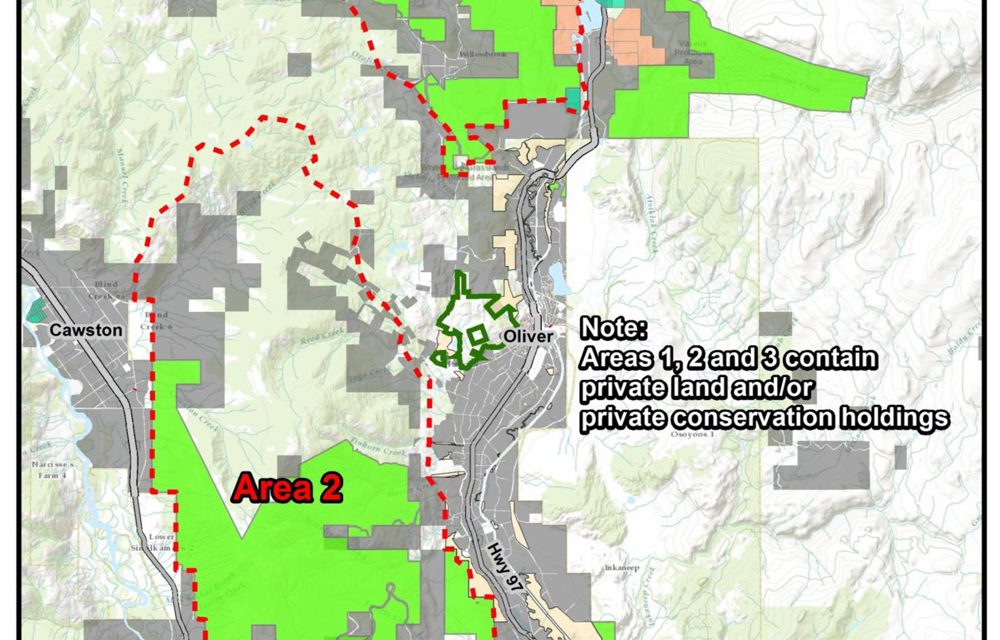

This map in the provincial government’s “intentions paper” shows the three areas being considered for protection and current land uses. Areas 1 and 3 are being considered for national park reserve status, while Area 2 would become a provincial conservancy. The province has underlined that this is conditional on respecting existing tenures and allowing land acquisitions only on a willing-seller, willing-buyer basis — conditions the federal government has previously accepted.
The provincial government has re-opened the door to a possible national park reserve in extensive areas of the South Okanagan-Lower Similkameen.
The announcement comes more than four years after the province pulled its support for a national park reserve.
The government is inviting public comment on an “intentions paper,” which sets broad brushstrokes for how environmentally sensitive areas can be protected, while continuing to allow existing users and also engaging First Nations in shared management.
Consultation on the paper will last for 60 days with the deadline for comments set at Oct. 12, 2015.
Although the total area considered for national park reserve status is smaller than that under consideration in a federal-provincial feasibility study completed early in 2011, it includes some areas that were not in the earlier study.
It would also offer enhanced provincial protection for areas excluded from the national park reserve by making them a conservancy under B.C.’s Park Act. A conservancy provides less protection than a national park or a provincial ecological reserve.
The provincial government’s announcement is a major shift in direction since it secretly withdrew support for a national park reserve early in 2011. It follows upon consultations with supporters and opponents of a national park that began late last year.
The intentions paper establishes three geographic concept areas.
Area 1 south of Highway 3, which includes some of the most environmentally sensitive land and the highest biodiversity in the region, would be considered for a national park reserve.
Area 2, to the north of Highway 3, west of Oliver and east of Cawston, would be established as a provincial conservancy. This area includes Mount Kobau, and is currently the most intensively used for ranching and recreational purposes.
“A conservancy designation has the necessary flexibility to ensure existing uses can continue while environmental and First Nation cultural values are protected,” the government says in its intentions paper.
Area 3, which lies west of Vaseux Lake between the former McIntyre Bluff and Okanagan Falls and would extend beyond White Lake, would be considered for a national park reserve.
“There are presently a number of federal land holdings in the Vaseux Lake area which are managed by the Canadian Wildlife Service,” the intentions paper observes. “While the protections afforded by a provincial conservancy designation and national park reserve status would both be sufficient to protect the unique features of Area 3, it is the presence of the federal holdings, along with the desire for additional tourism marketing potential, which implies supporting designation as a national park reserve.”
Despite previous statements by MLA Linda Larson that ranching is more important than tourism, the intentions paper makes clear that promotion of tourism is one of five key principles the province wishes to promote.
The paper also appears to imply that national park reserve status would bring tourism marketing benefits to the region.
“The area has outstanding beauty that residents and visitors will experience,” the paper says. “New protected area establishment will come with support to encourage prospective visitors to consider the recreation opportunities that the South Okanagan has to offer.”
The paper also suggests the area could emphasize cultural tourism opportunities for the Okanagan Nation.
Although documents recently obtained from Parks Canada make it clear that the federal government planned to respect existing grazing rights and only purchase private lands on a willing-buyer, willing-seller basis, the province underlined this commitment.
As a precondition to accepting national park reserve status, “the province will ensure that all existing tenures continue unimpeded,” the paper says.
The province said its land framework proposal was arrived at as a result of consultations with stakeholders, community interests and the Okanagan Nation.
It sets out five key principals:
- Additional protection measures will benefit the area. Despite existing protections by different levels of government and private land holders, “this area does not have the co-ordinated protection needed to address the uniqueness and richness of the ecosystems and the large number of species at risk that are present.”
- Management shared with First Nations must be explored and should involve the planning and ongoing management to incorporate traditional ecological knowledge and cultural use.
- Existing land uses are recognized and protection measures will result in a broad array of recreation opportunities, “even if some uses must be allocated to certain areas through access management.”
- Privately owned lands must be respected and future land acquisitions must only be on a willing-seller, willing-buyer basis as land availability and budgets allow.
- Tourism, including cultural tourism, will be actively promoted.
The proposed areas for a national park reserve go far beyond a proposal made by MLA Larson earlier this year to have the Osoyoos Desert Centre made into Canada’s smallest national park.
Nonetheless, the Desert Centre is included in Area 1. It was not previously part of the park concept area.
This area “is home to unique features such as the Pocket Desert, showcased by the Osoyoos Desert Centre,” the paper says.
After the 60-day consultation period, BC Parks will compile and review feedback received and this will be posted as a consultation report. The report will be accompanied by final land designation recommendations.
The land framework proposal will then be further refined and submitted to the provincial government for review and approval. If approved, legislation to implement elements of the framework would be prepared and considered in 2016.
While the paper implies that discussions with the federal government on national park reserve status would be resumed, the paper says that if this federal status is not possible, the province would seek to protect areas 1 and 3 as provincial conservancies.
Special by Richard McGuire