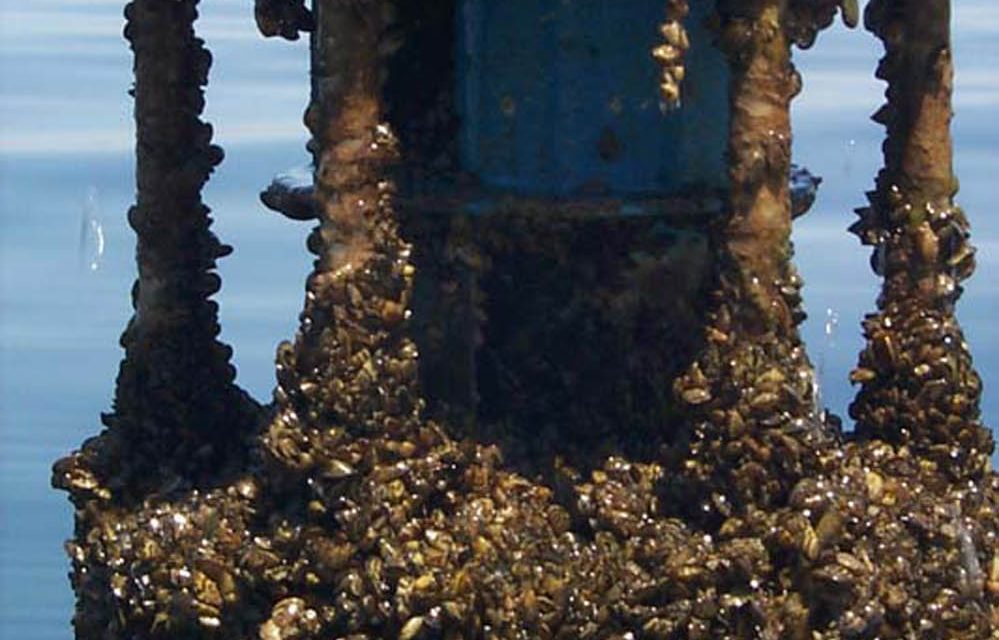
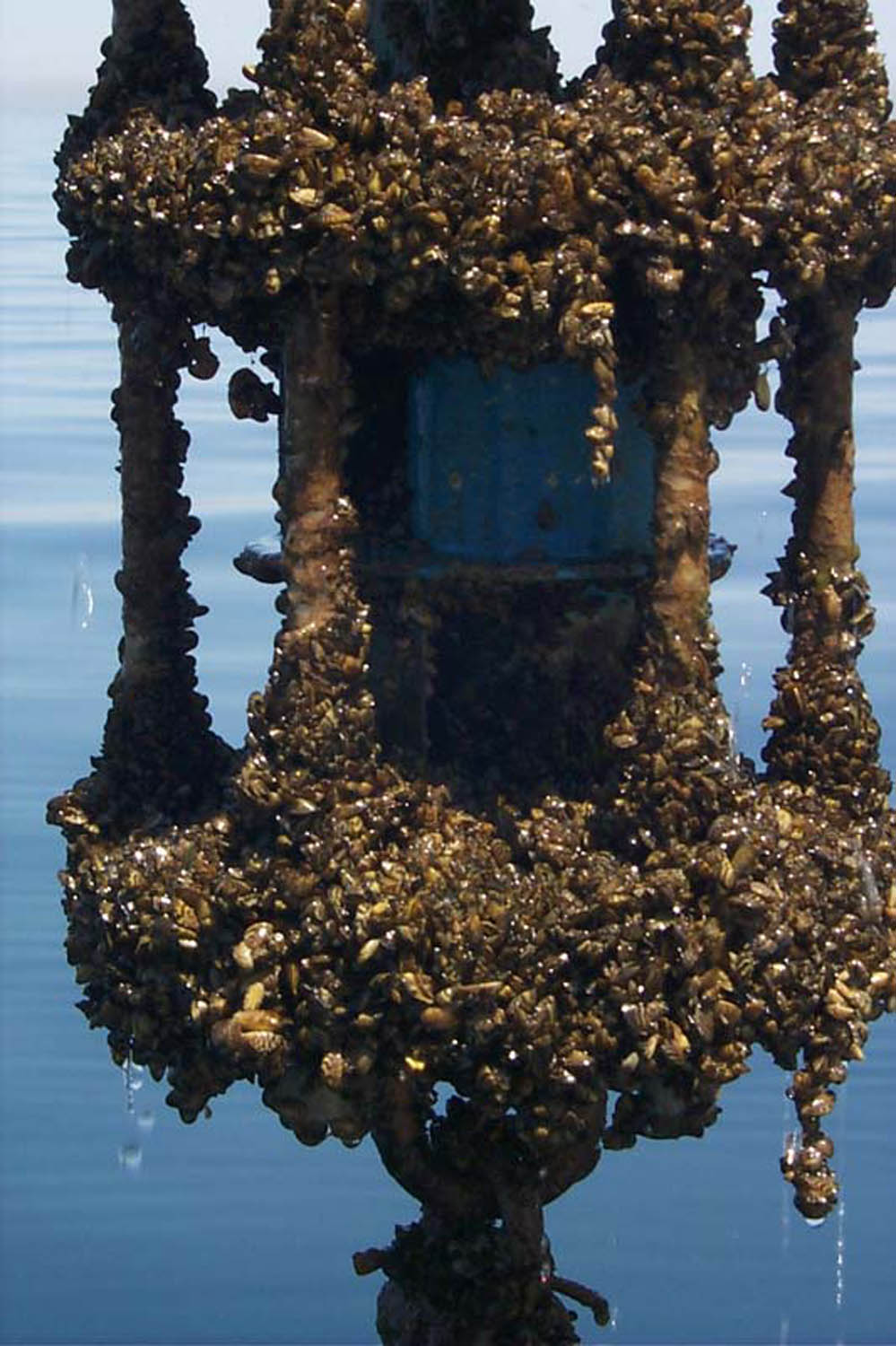
Zebra mussels encrust a current meter retrieved from Lake Michigan. Mussels cover every imaginable surface in the water once they infest a waterway. They are spread by careless boaters, but Canada lacks federal regulations needed to stop them at the border. (U.S. National Oceanic and Atmospheric Administration)
As senior governments drag their feet on addressing the threat to Okanagan lakes of invasive mussels, the Okanagan Basin Water Board (OBWB) is getting frustrated and wants answers.
The OBWB is requesting a meeting with B.C. Environment Minister Mary Polak to explain the province’s delay in responding.
Alberta has recently placed inspection stations at four major roadways into the province prompting the OBWB to ask why British Columbia isn’t doing the same.
The OBWB wrote to Premier Christy Clark in April raising the need for inspection stations. A form letter reply sent by Polak on June 30 failed to make any reference to inspection stations and put much of the onus for action against invasive species on the federal government.
“The Province of B.C. appreciates that the City of Nelson is taking the threat of invasive quagga and zebra mussels seriously,” the letter signed by Polak said, failing to replace the reference to “Nelson” with the OBWB.
Zebra and quagga mussels currently infest waterways in eastern North America and they’ve made inroads into the southwest United States. OBWB estimates the cost of an infestation in the Okanagan at about $43 million per year.
Polak, however, claims the cost to the entire province would be $28 million a year “as a conservative estimate,” while Alberta estimates the cost to that province at $75 million annually.
The mussels encrust themselves on water intakes, docks and bridges, leave sharp shells on beaches and they consume nutrients in the water, killing off other aquatic species.
Recreational boaters who fail to clean their boats adequately when moving them from an infested lake to an uninfested one typically spread zebra and quagga mussels.
Action by the provincial government is not dependent on the federal government acting, said Doug Findlater, OBWB chair in a news release titled “Why so slow to act on mussels?”
“Alberta didn’t wait for the federal legislation,” said Findlater. “They moved quickly to protect their lakes and we should be doing the same. They get it – it’s a serious threat and they’ve invested money in helping to protect themselves. B.C. needs to do the same.”
An Alberta government spokesperson said there are four inspection stations to check boats coming into the province.
One is near Vermilion on the Yellowhead Highway and another is near Dunmore on the Trans Canada Highway, both close to the Saskatchewan border. Two others are at the Coutts crossing to Montana and near Burmis on the Crowsnest Highway from B.C.
“Alberta Tourism, Parks and Recreation is also performing roaming inspections at various Alberta provincial parks this summer,” said Carrie Sancartier, public affairs officer with Alberta Environment and Sustainable Resource Development.
Alberta’s inspections started during the summer of 2013 and continued this year, running from June through to September, she said.
“We can also do inspections any time of the year on boats that come back to Alberta outside the operating hours of the inspection stations,” Sancartier said.
The program is funded by Alberta’s general revenue although some American states have a user-pay sticker system.
Alberta has also teamed up with Montana to use trained sniffer dogs to find mussels attached to boats. The dogs will be working on both sides of the border.
Anna Warwick Sears, OBWB executive director, said board members want a chance to impress upon the provincial government that this is a serious issue that is not going to go away.
“There is a certain amount of frustration because it is so clear to everyone who’s working and living in the Okanagan that something needs to be done,” she said. “We’re not seeing any inspection stations happening at the provincial level and it’s hard to understand from the local government perspective why nothing has been done yet. Even the (province’s) response plan that has been in the works for over a year is not completed. It just seems like the risk is so high and the repercussions are going to be so massive.”
OBWB is also anxious for the federal government to bring in new regulations under the Fisheries Act to address invasive species such as zebra and quagga mussels.
Such federal legislation would allow border officials to inspect boats coming into Canada from the United States.
Consultations on these regulations concluded in April 2013, but they still haven’t been implemented.
Frank Stanek, a spokesperson for the federal Deptment of Fisheries and Oceans said: “It is anticipated that the department will bring forward this regulatory proposal in 2014 and that there will be an opportunity for the public to comment when it is published in the Canada Gazette, Part 1.”
Warwick Sears doesn’t accept the provincial government’s suggestion that action is contingent on the federal government.
Findlater said he’s also disappointed that the province didn’t address the issue of inspection stations in Polak’s letter and that the province is waiting for action by the federal government. He stops short, however, of using the word “frustration.”
“I’m concerned about the slow pace of getting at this,” he said. “We do think it’s attracted their attention, but they need to realize that there is some urgency to this.”
Osoyoos Mayor Stu Wells, who chaired the OBWB before Findlater, said he is frustrated by the slowness of senior governments to act.
“It’s crucial that we act fast,” said Wells. “When you consider that this wonderful salmon run we’re having in Osoyoos Lake is actually threatened by our inaction – if we had zebra/quagga in this lake, we wouldn’t have the salmon run here.”
Wells agrees that Alberta’s actions show that this province can move forward with inspection stations without waiting on the federal government.
“They have instituted an inspection program and here we are in British Columbia with some of the most pristine waters in North America and we haven’t,” said Wells.
Recently the OBWB added a page to its website allowing local residents to send letters to senior governments calling on them to address the mussel threat.
As of July 29, 212 letters had been sent, said Corinne Jackson, communications director, in her July 30 report to the board.
People can go to www.DontMoveAMussel.ca and click on “Speak Out.”
RICHARD McGUIRE
Osoyoos Times