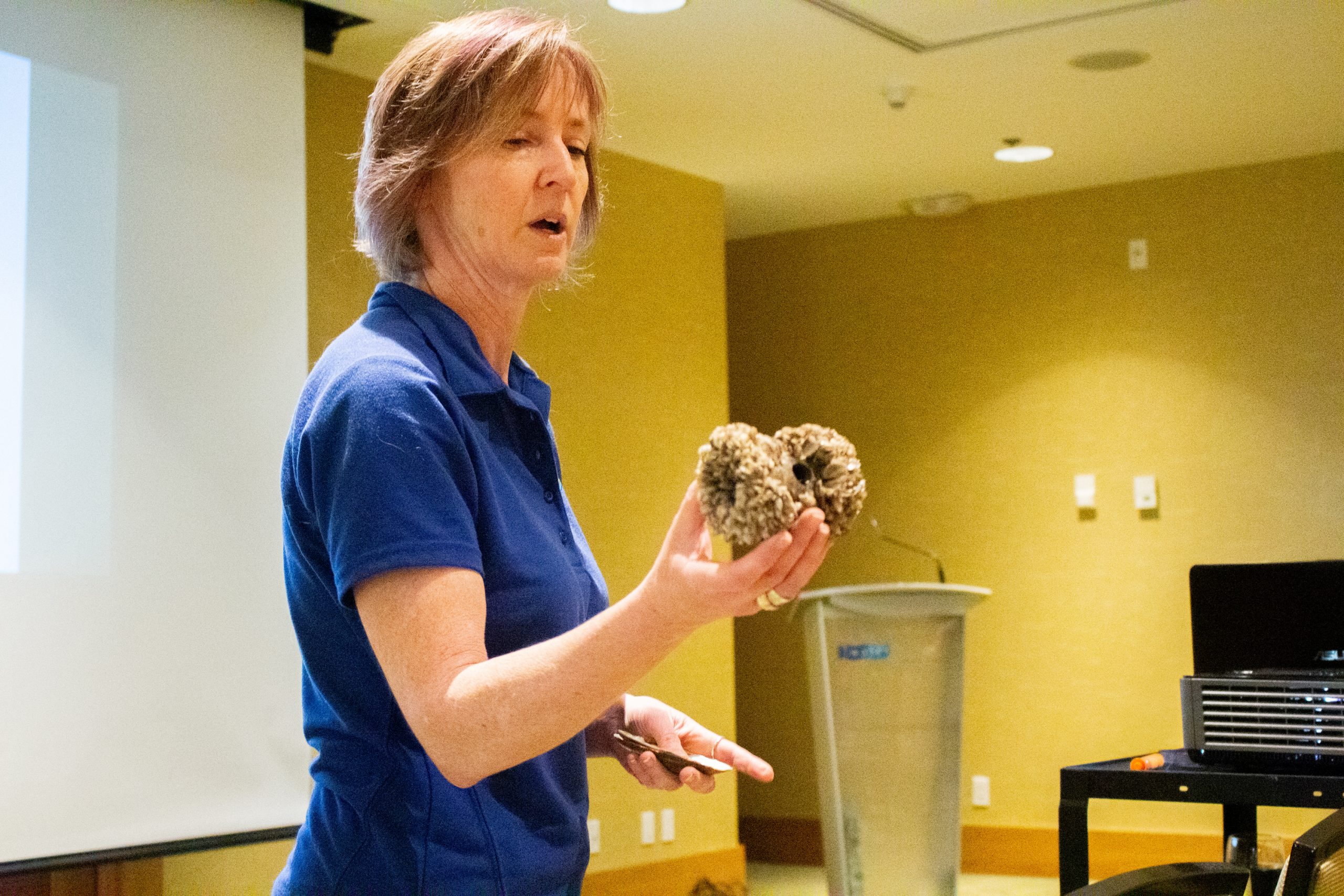
Lisa Scott, executive director of Okanagan and Similkameen Invasive Species Society (OASISS) hold a piece of a boat covered with invasive mussels during her talk at the Osoyoos Lake Water Quality Society’s AGM on May 8. (Dale Boyd / Osoyoos Times)
By Dale Boyd
Osoyoos Times
A long-time advocate in the fight against invasive mussels in the Okanagan has seen a lot of progress, but the risk of the species flooding Okanagan beaches and waterways remains ever present.
“It will change the Okanagan forever,” said Lisa Scott, executive director of Okanagan and Similkameen Invasive Species Society (OASISS).
“It,” meaning invasive zebra and quagga mussels, which have already wreaked havoc on the Great Lakes and other waterways in North America. Over ten years the areas surrounding the Great Lakes have spent $5 billion simply to manage the invasive species. Aside from coating beaches with the mussels sharp shells, an invasion into B.C., which so far remains mussel free, could have devastating impacts on infrastructure, property values and even salmon habitats.
“It’s not just tourism, they estimate the cost to the region at a half-billion dollars per year for the rest of our lives, that’s not to get rid of it, that’s to manage it,” Scott said.
• Read more: Council votes to join water board in fighting milfoil control prohibitions
Scott was the guest speaker at the Osoyoos Lake Water Quality Society’s annual general meeting on May 8, where she spoke about the progress made in the fight against invasive mussels and fielded questions about the future of the issue.
A total of 12 mussel inspection stations bordered B.C. last year, with only one station in Golden operating 24 hours a day. Through those efforts 25 mussle-fouled boats were discovered on B.C. borders last year. With two mussel-sniffing dogs, signage and awareness campaigns helping the “Don’t Move a Mussel” effort more people are aware of the issue than ever before. Out of 1,000 boaters surveyed last year, 90 per cent had heard of aquatic invasive species.
“We’ve had quite a change over the years because when we first started taking the measurement back in 2015, less than half the people, 45 per cent of people, had heard of aquatic invasive species,” Scott said. “Now over the last two years 90 per cent of boaters surveyed were aware of aquatic invasive species. So that’s great, but it still means ten per cent still haven’t heard the message and remember, it only takes one boat.”
Limits on financial contributions, including OASISS not receiving Canada Summer Jobs funding this year to hire students, is one shortfall advocates face, as well as inaction on legislation.
“We need the law to change, we need any boater from out of province to not be able to launch in B.C. waters until they have been inspected and talked to someone,” Scott said. “We need to get that legislation changed.”
Invaders: endgame
While awareness and prevention efforts are the front lines of defence against invasive mussels, at this point, Scott is treating a mussel invasion in B.C. as an inevitability. So what can be done if mussels start lining B.C. shores and boats? At this point, not much.
Efforts are being made by researchers and scientists on chemical or biological ways to eliminate the mussels from already infected waterways, however, doing so without harming the remaining ecosystem is not so easy. One chemical, Zequanox, has had success in eradicating mussels but is used in closed systems.
“There are lakes, if you have control of a system and you can actually fully drain an area it will desiccate or dry out the mussels. In a natural system, nothing yet, but there is a lot of research going on,” Scott said.
Some researchers looked at liquid potash to prevent mussels in harbors from entering Lake Winnipeg.
“Liquid potash is used in natural systems but it doesn’t discriminate, it will kill everything,” Scott said.
She will be attending an international conference on the issue in Montreal where she hopes to learn more about the cutting edge,
“The person who invented Zequanox is very wealthy, and the person who finds something that is going to be equally good in a natural system will be a billionaire,” Scott said.