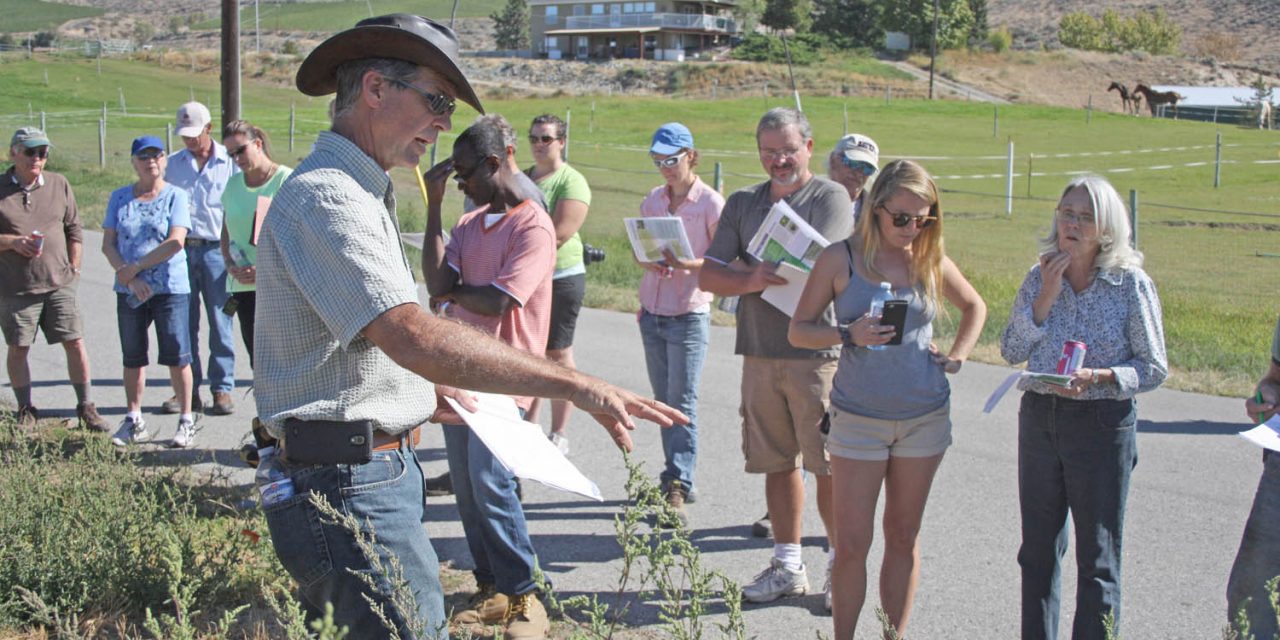
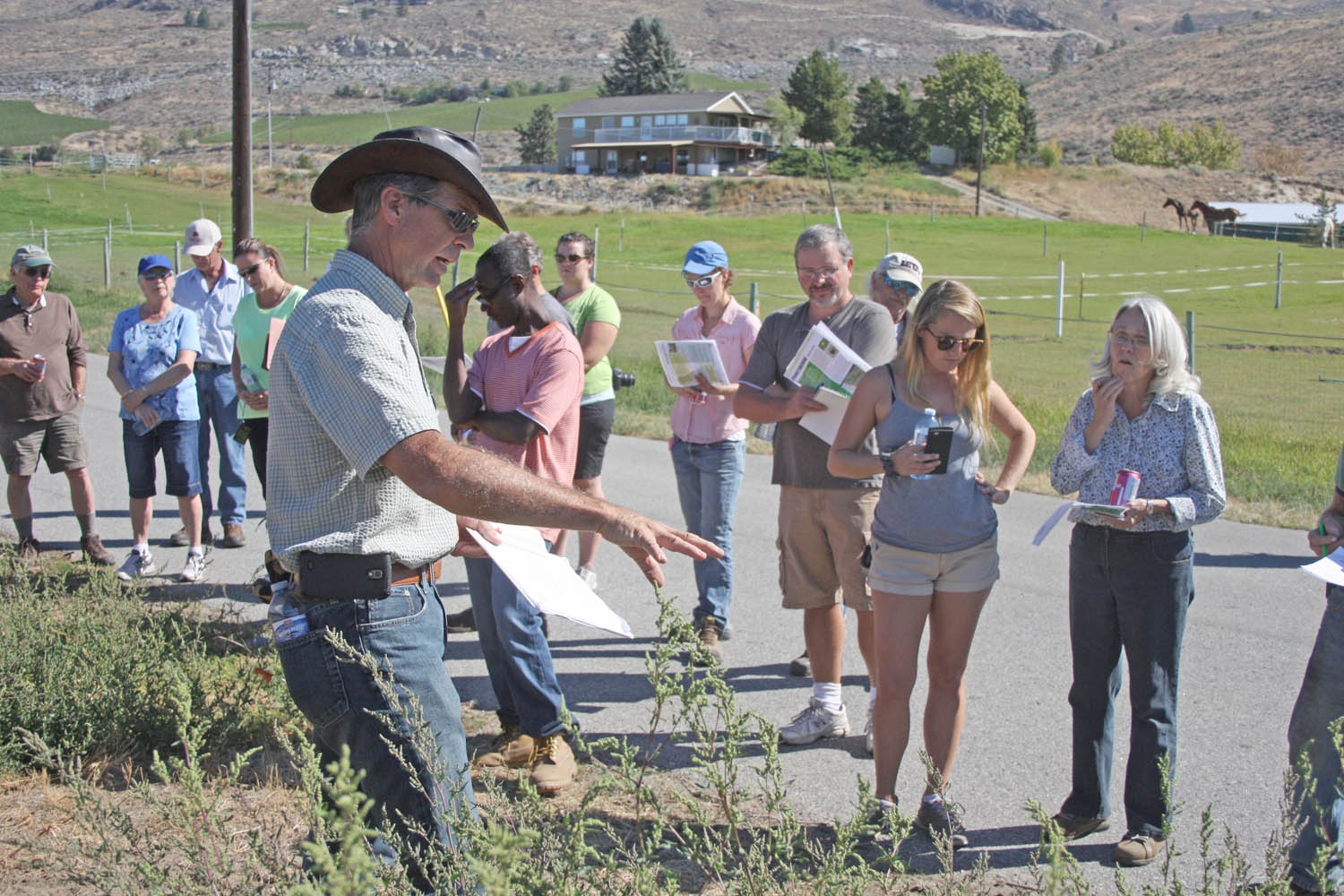
Researcher Ken Sapsford led an informative three-hour workshop in Osoyoos about the problems associated with puncturevine, an invasive weed that is causing serious problems locally for orchardists, farmers and landowners. More than 30 people attended the workshop. (Keith Lacey photo)
A pilot research project designed to tackle the problems associated with the insidious growth of an invasive weed species in and around Osoyoos is showing promising results.
Puncturevine first started showing up in the Osoyoos area and across the Okanagan Valley – the only place where weather conditions allow it to survive in Canada – about 15 years ago.
Because the rapidly growing weed continues to cause so many headaches for orchardists, farmers and regular citizens, the Okanagan and Similkameen Invasive Species Society (OASISS) held an information workshop last Thursday in Osoyoos.
More than 30 area orchardists, farmers and citizens attended the informative workshop.
The workshop and information session was held on the property of Michael Mauz, the owner of Cedar Creek Estate Winery vineyards on the East Bench of Osoyoos.
Mauz agreed to allow Ken Sapsford, one of the country’s leading agricultural researchers recently hired by OASISS, to conduct scientific trials on his property to try and find a cure or control for the continued spread of puncturevine across the region.
Puncturevine is an invasive weed that forms dense mats along roadsides, vacant lots, beaches and unpaved parking sites and can reach up to 10 feet in length.
Hairy leaves that are divided into six to eight leaflets cover the stems. Tiny, yellow flowers first appear in late spring or early summer and spiny seedpods emerge a few weeks later. Each seedpod consists of five sections that, at maturity, break into tack-like structures with sharp spines.
These sharply pointed seedpods can stick into bare feet and hands, causing severe pain, and can also flatten bicycle tires, which has become a serious problem in this town and across the region, said Lisa Scott, co-ordinator for OASISS since the organization was founded almost 20 years go.
Puncturevine grows exclusively in Canada in southern B.C. from Osoyoos to north of Vernon and throughout the Similkameen Valley, said Scott.
The problems associated with the invasive species are so severe that two full-time OASSIS staff work full time from early spring to late fall doing nothing but attending trouble spots and removing puncturevine by hand, she said.
“This stuff is incredibly challenging to work with,” she said.
It’s believed puncturevine arrived in the Okanagan from Europe as seedpods got caught up in the wool of sheep being transported to this area, said Scott.
The best method of controlling puncturevine is to prevent establishment by destroying the first plants found in an area before seeds begin to form, said Scott.
Young puncturevine plants are easily controlled by hoeing, shallow tillage or by carefully hand-pulling plants, she said.
If seedpods have not yet developed or haven’t matured (small and green), the plants can be composted. If plants have already matured and the seedpods have ripened, plants should be carefully pulled and bagged and taken to the local landfill, where they will be buried and won’t resurface, she said.
One of the greatest challenges puncturevine poses is its innate ability to germinate throughout the summer months, she said.
“One treatment at the beginning of the summer is not enough,” she said.
Landowners must be vigilant and check sites prone to puncturevine growth at least once every three weeks, starting in June and continuing until September, she said.
“New plants need to be continually destroyed to ensure seeds do not form,” she said.
It’s also important for landowners to be able to recognize puncturevine at an early stage of growth as this is when it can be most easily controlled, as opposed to when the plants are large and seedpods have matured, she said.
Like most other weeds, puncturevine prefers to grow in areas that are not disturbed and landowners can help themselves by not providing an opportunity for the weed to grow, as well as by patrolling their property in the summer and controlling any puncturevine they discover, she said.
Unfortunately, seedpods are easily transportable on shoes, boots and vehicle tires and this means the ugly weed at the side of the road often can end up spreading over huge tracts of area on a single orchard or piece of property, she said.
The tips of the spine have a “mild toxin” which can make many people feel ill and are sharp enough to easily cut through a bike tire tube, she said.
Because puncturevine has caused so many problems on his property, Maux agreed to allow OASISS to conduct scientific research on puncturevine this summer.
“It has become a huge issue for us,” he said. “It’s everywhere … our workers don’t like it, our neighbours don’t like it and I certainly don’t like it.”
In late May, Sapsford sectioned off more than two dozen small pieces of land covered in puncturevine on the roadside near Maux’s vineyard.
For the past four months, he has used various chemicals and products available on the market to try and find effective methods to control the growth and spread of puncturevine.
Part of his experiment included applying chemicals before puncturevine seedpods blossomed (pre-emergent trials ) and using the same chemicals once the weed had sprouted (post-emergent).
Two products that have shown the most promise when applied during pre-emergent trials are chemical compounds known commercially as Chateau and Sandia, said Sapsford.
Simply doing nothing and hoping puncturevine disappears “simply isn’t an option,” he said. “Left untreated, this one plot grew up to 592 plants per square metre.”
OASISS is confident they will be able to acquire sufficient funding from the provincial government and corporate sponsors to allow Sapsford to continue his research at Maux’s property in 2016 and 2017, said Scott.
Scott urged property owners with puncturevine problems to use mapping to determine where the weed is growing and to take action to control its spread every spring.
“Prevention is the key when it comes to controlling invasive species.”
KEITH LACEY
Osoyoos Times