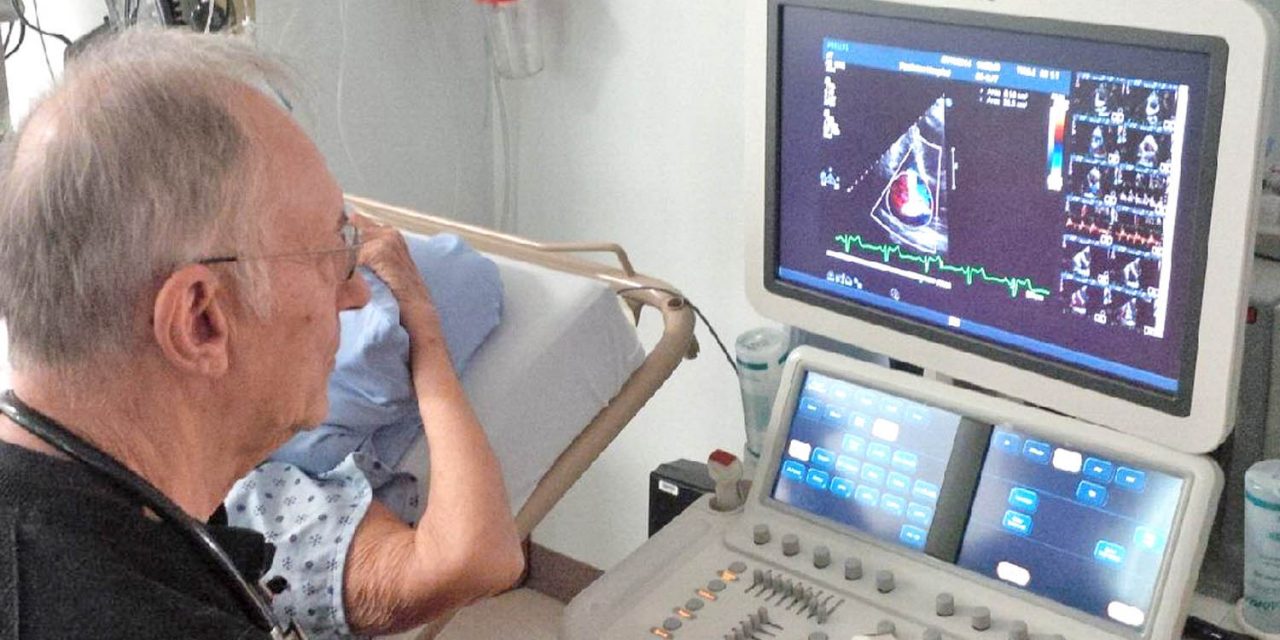
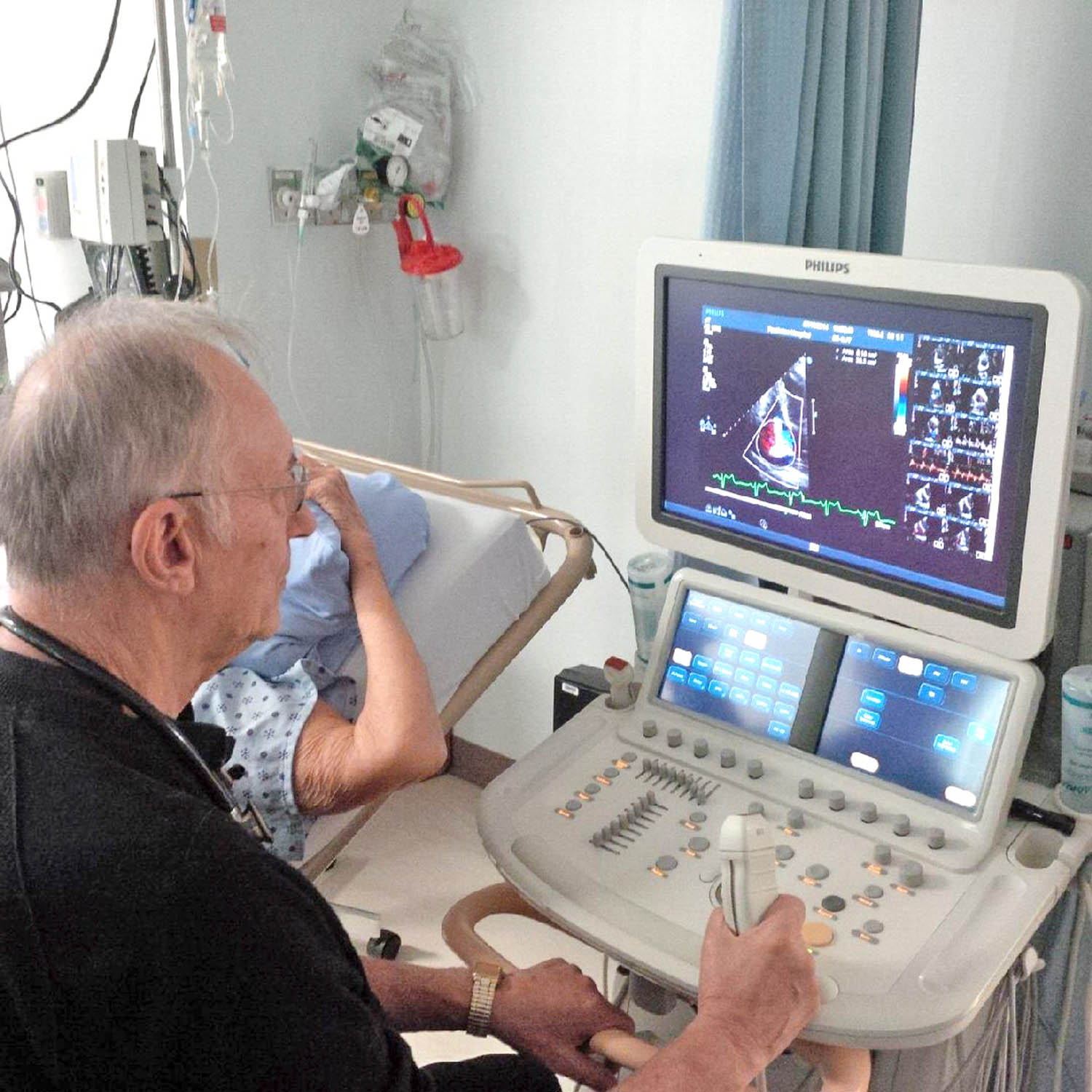
Dr. Thomas Ashton from Penticton Regional Hospital headed up the medical team that developed a new “contrast agent” used during echocardiograms – or electronic testing of heart function. Contrast agent is injected into veins near the heart prior to patients undergoing echocardiograms and allows physicians to get a much more accurate diagnosis relating to heart function, said Ashton. (Photo supplied)
A pilot project developed at Penticton Regional Hospital (PRH) is going to help save the lives of many patients across British Columbia, including cardiac patients in Osoyoos and the rest of the South Okanagan, says the heart specialist who headed up the project.
Dr. Thomas Ashton, who has been a cardiologist for more than 40 years at PRH, headed up the medical team that developed a new “contrast agent” used during echocardiograms – or electronic testing of heart function.
Echocardiograms look at the size, shape and construction of the heart and are the most common diagnostic tool used in cardiology over the past 40 years, said Ashton.
Contrast agent is a fluorocarbon compound that is injected into veins near the heart prior to patients undergoing echocardiograms.
The contrast agent allows physicians to get a much more accurate diagnosis relating to heart function, said Ashton.
“Using this contrast agent has proven safe and very effective,” said Ashton.
The use of this particular form of contrast agent has been used at the world-renowned Mayo Clinic for the past nine years and adopted almost four years ago by the Ontario Hospital Insurance Plan (OHIP), said Ashton.
Thanks to support from the South Okanagan Medical Foundation and administration at PRH, Ashton has been heading up the pilot project to use contrast agents during echocardiograms for two years.
After months of testing, British Columbia’s Ministry of Health formally approved the pilot project and has been providing full funding for all patients in the province undergoing echocardiograms since the end of June.
All B.C. residents who pay fees to the province’s Medical Services Plan (MSP) can now access echocardiograms using the contrast agent free of charge, which is great news for physicians and patients across the province, said Ashton.
Penticton Regional Hospital conducts more than 3,000 echocardiograms annually and two to 10 per cent were “sub-optimal”, but being able to use contrast agent with every test will eliminate that small margin for error.
“We’ve been able to do clinical trials for the past two years and determined that by using this contrast agent, we can enhance diagnostic testing on 100 per cent of the heart patients we treat,” he said.
Echocardiograms have been used for decades as an effective diagnostic tool allowing cardiologists to look at patients with heart problems, but there were certain heart abnormalities that were not detected, said Ashton.
The use of the contrast agent has proven incredibly effective in diagnosing even the smallest abnormality and will help save lives as a result, he said.
“I recently treated a patient from the South Okanagan who had an echocardiogram and we didn’t detect anything out of the ordinary,” he said. “Then we did another test and used the contrast agent and we were able to immediately recognize that she had a genetic abnormality.
“This additional testing allows us, as doctors, to make a proper diagnosis every time and that is going to make a tremendous difference to residents across the South Okanagan and across the province. We’re exceptionally pleased with the results of our pilot project and the fact patients across the province can now get this new testing and have it covered under their medical insurance.”
The pilot project will also save money and allow the system used to treat heart patients to function more properly, said Ashton.
Any indication of heart malfunction in the past would often lead to patients at PRH having to travel to Kelowna for a further angiogram, but that will no longer be necessary, he said.
Several physicians from Ontario who were involved in clinical trials in that province on a similar program provided support and information to his medical team in Penticton and they are all very thankful for their assistance, said Ashton.
Medical professionals from the Northern Alberta Institute of Technology and South Alberta Institute of Technology were also involved in the pilot project, he said.
The local medical foundation also deserves a great deal of credit for providing world-class diagnostic equipment at PRH over the past several years, which allowed the local team to get approval to work on the pilot project, he said.
The contrast agent costs $110 per vial, but can be used to treat numerous patients, he said.
“The testing is expensive and that’s why it was so important we get this project approved and fully funded by MSP,” he said.
“We can do the test and have a thorough and accurate diagnosis the same day.”
The fact a small medical team from a small hospital like PRH could conduct a pilot project and clinical trials that will benefit tens of thousands of B.C. residents annually is one of the highlights of his 40 years in medicine, said Ashton.
“In terms of helping my patients, this project would be near the top of my list of accomplishments,” he said.
His hope is that other medical professionals in other provinces can access the information gathered by the team at PRH and hopefully have this kind of testing accepted and funded in the coming years, he said.
KEITH LACEY
Osoyoos Times