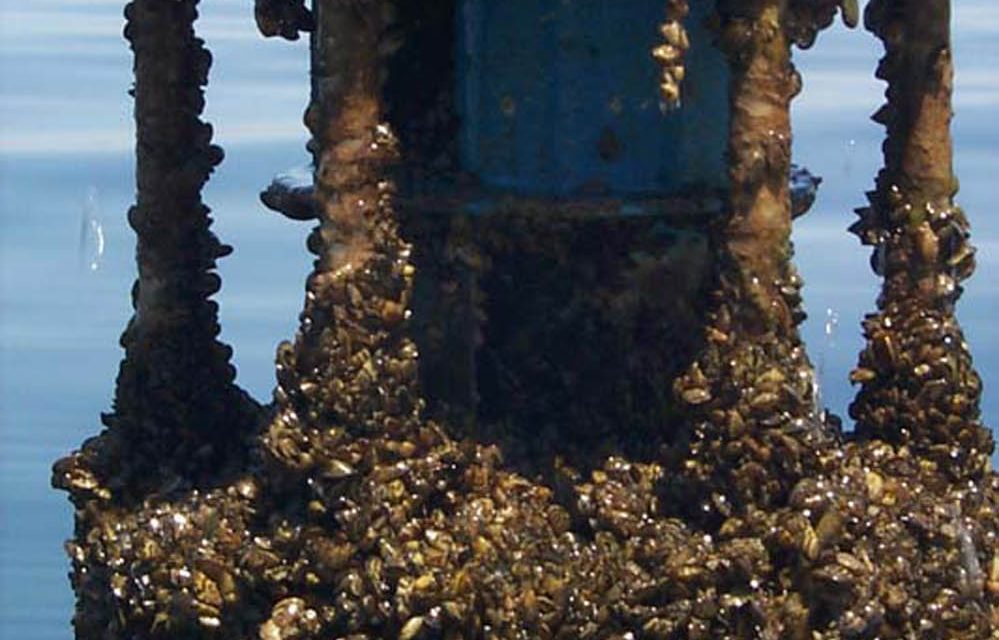
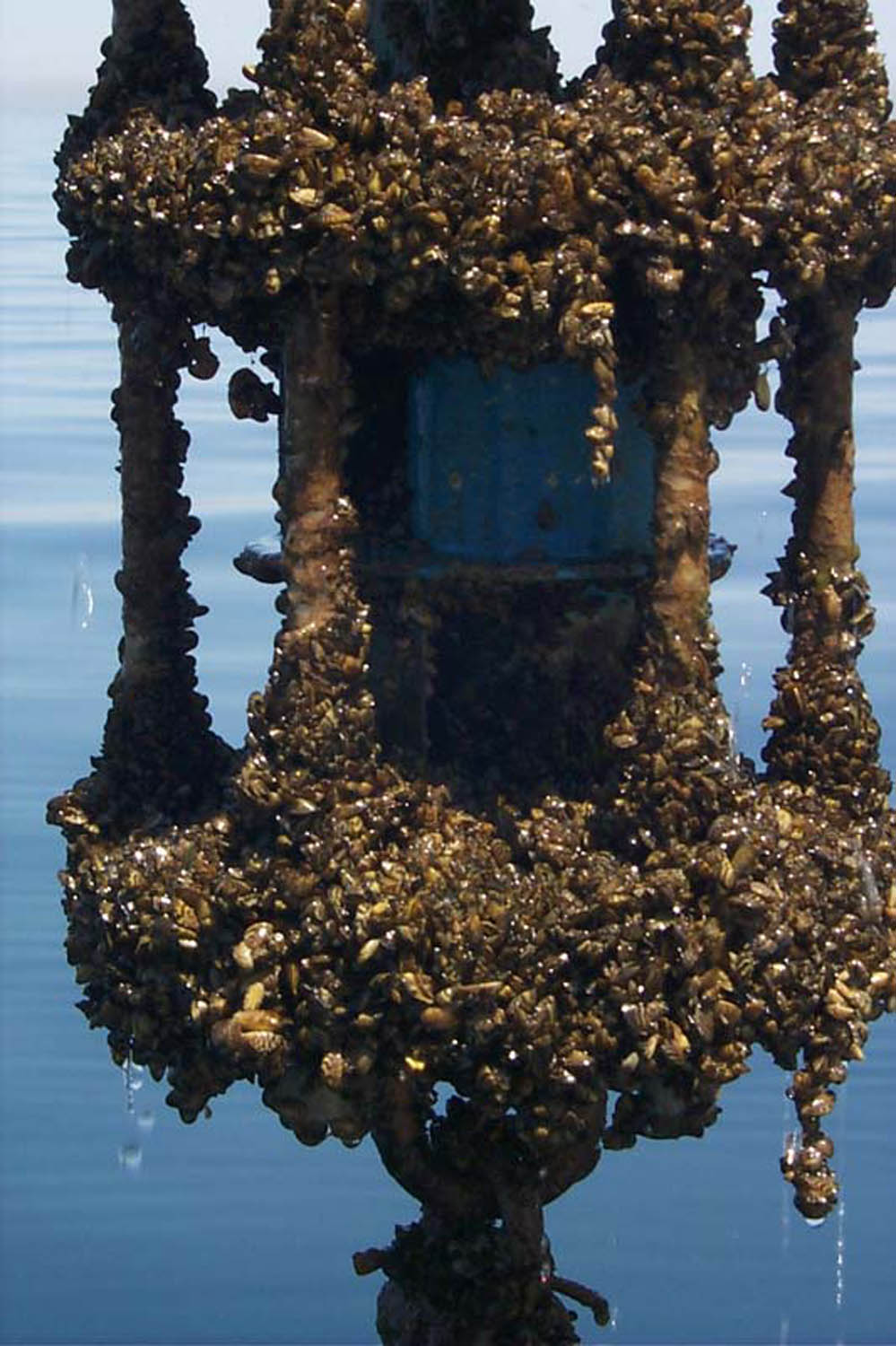
Zebra mussels encrust a current meter retrieved from Lake Michigan. Mussels cover every imaginable surface in the water once they infest a waterway. They are spread by recreational boaters who fail to properly clean, drain and dry their boats after using them in infested waters. Zebra mussels have spread to Manitoba and quagga mussels have reached a number of waterways in the Southwest United States. (U.S. National Oceanic and Atmospheric Administration)
The decision to base a permanent inspection and decontamination station for invasive mussels in Penticton rather than Osoyoos is not a concern for the Okanagan Basin Water Board (OBWB).
James Littley, OBWB operations and grants manager, said he has other questions about how the stepped up program announced recently by the provincial government will operate, but the location of the station isn’t one of them.
Littley made the comments after members of Osoyoos town council expressed concerns at their April 4 meeting about the location of the station.
Littley said the province has established more permanent inspection stations along the provincial border with Alberta, but they are working with the Canada Border Services Agency (CBSA) on the Canada-U.S. border.
Invasive zebra and quagga mussels have been spread to many parts of North America by transporting of recreational boats that aren’t properly cleaned, drained and dried after leaving infested waters.
The OBWB estimates the cost of mitigating their damage if they got into the Okanagan lakes would be $43 million a year.
In recent years, the province has trained CBSA staff at the Osoyoos border crossing to do inspections when boats cross, Littley said.
“They’ll go through a protocol asking them questions to establish if it’s a high-risk boat or not,” said Littley.
The driver with a boat can then be ordered to report to the provincial station wherever it is set up that day, he said.
“So it’s not that the federal border isn’t being covered,” he said. “It’s just that it’s a federal responsibility and they are the ones covering it. Then the province is doing the more detailed decontaminations.”
Littley pointed to the close relationship between CBSA officials and provincial conservation officers even before federal regulations were brought in last year that allow CSBA to detain contaminated boats.
A Ministry of Environment spokesperson, David Karn, said there has been some confusion about the base or office locations for the inspection crews and the actual location of the inspection stations.
“In the case of the Penticton-based crew, the inspection station is being operated near the Osoyoos border crossing,” he said in an emailed response. “We are not publishing the exact location of the inspection stations as this is a compliance-monitoring program. Although the stations are considered permanent, the teams still have mobile capacity and may shift locations to respond to a high-risk incident.”
Karn said sites were chosen from experience from last year’s pilot program that determined the amount of traffic coming over the border and the destinations of those with watercraft.
“All eight inspection stations will be near safe areas that can be used to pull traffic off the highway, such as CVSE weigh scales or other pullout sites, to inspect, and if necessary, decontaminate any watercraft,” he said.
CVSE stands for Commercial Vehicle Safety and Enforcement.
There are at least 14 border crossings on B.C.’s southern border and the Ministry of Environment is working with CBSA to cover these, said Karn.
Teams are based in strategic locations that can intercept watercraft funneling in from various locations – including domestic traffic that may be transporting a species such as Eurasian water milfoil, he added.
Ministry of Environment has co-ordinated training, locations and timing of boat wash stations with neighbouring jurisdictions, he said.
The OBWB recently expressed concern that much of the $2 million in annual funding for the expanded mussel interception program is coming from non-government sources such as utilities. This means funding may not be guaranteed in the future.
Littley also said he has questions about the hours of operation for the inspection and decontamination stations.
Some provincial officials suggest it would be 10 hours a day, while others have suggested it would be longer.
“Those numbers are a little bit fuzzy,” said Littley. “I think 10 hours a day is a pretty short period of time.”
He hopes that other sources are accurate in stating that it would be two eight-hour shifts.
Littley is also optimistic that progress is being made with a perimeter strategy in which neighbouring jurisdictions co-operate to intercept boats transporting invasive mussels.
“If you’re coming from anywhere that’s infested, you should be passing through, I’d say, a minimum of two, but potentially several more inspection stations before you make it to any waters of B.C.”
RICHARD McGUIRE
Osoyoos Times