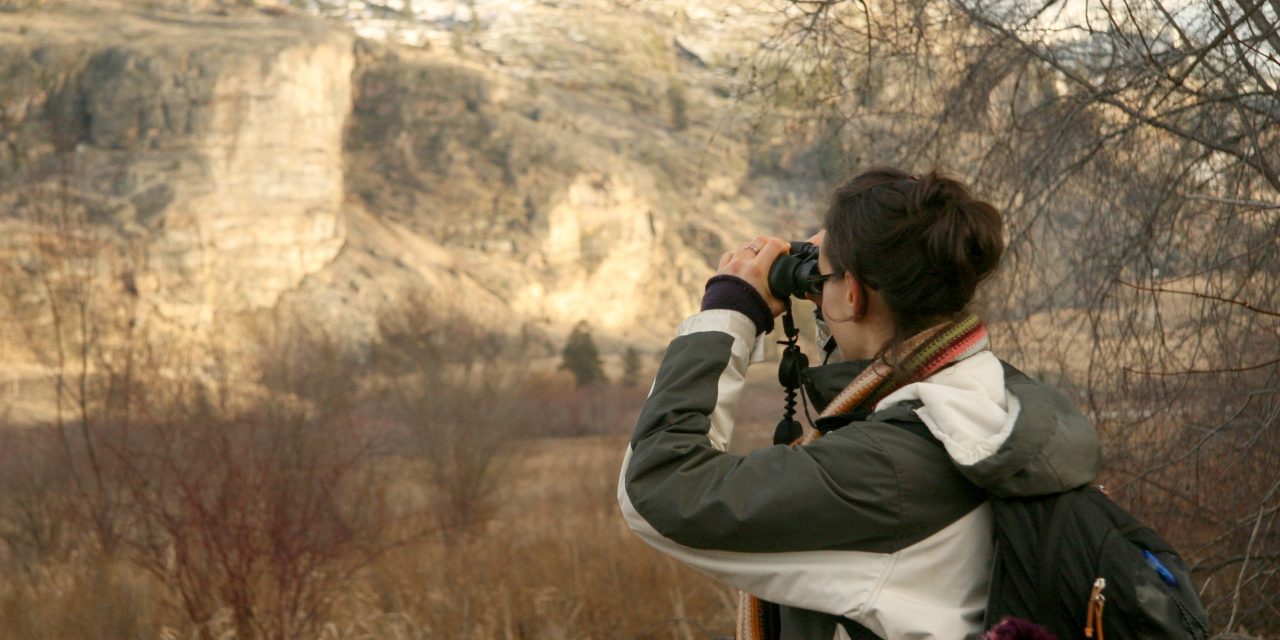
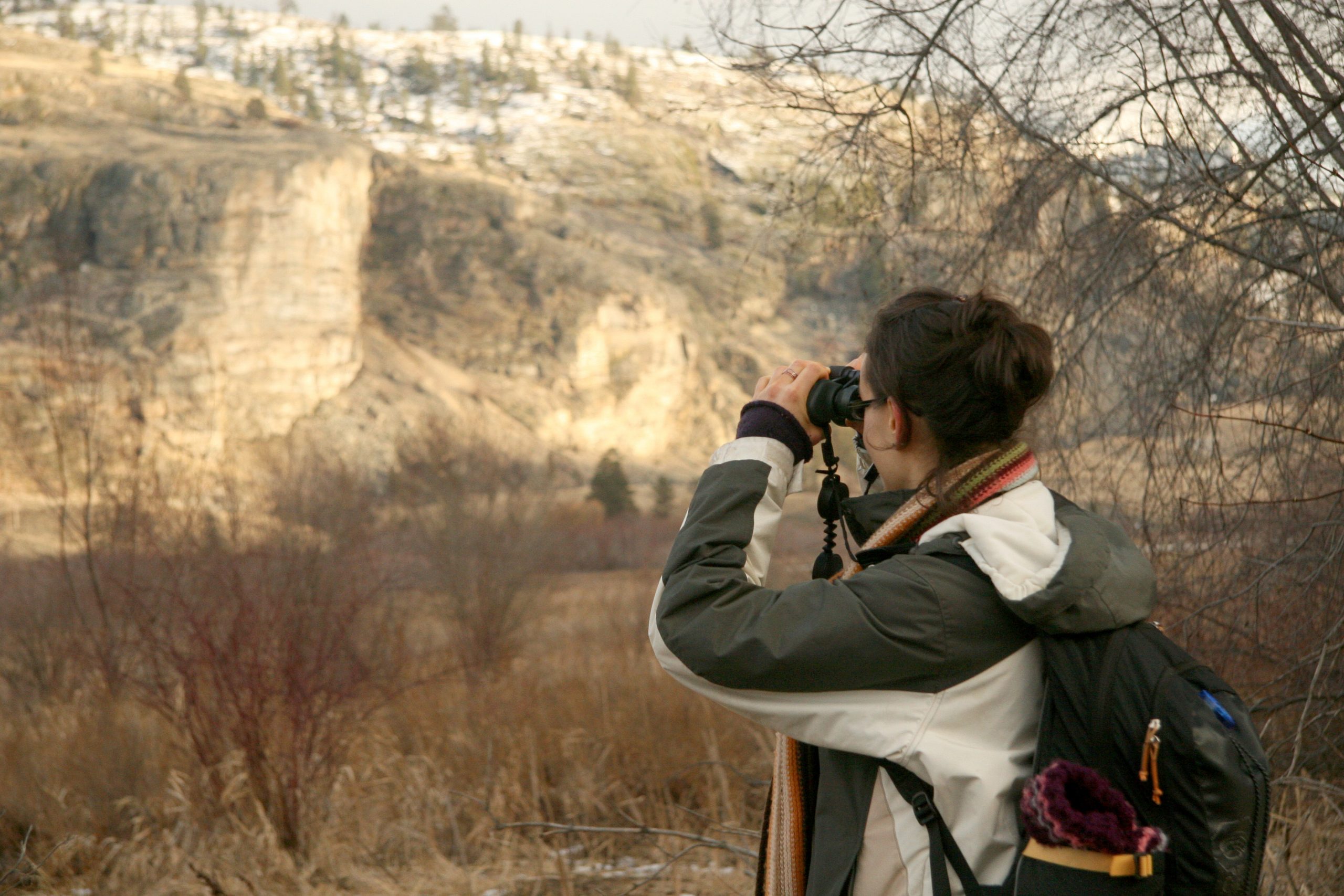
Jennifer Smith looks through binoculars for birds near Vaseux Lake during a previous Oliver-Osoyoos Christmas Bird Count. Organizers for this year’s event, set for December 29, are looking for participants. Photo by Dick Cannings.
Later this month local bird watchers, naturalists and other volunteers will be fanning out to do a census on the vast numbers and species of birds around Osoyoos.
The 34th annual Oliver-Osoyoos Christmas Bird Count takes place December 29 and is part of a continent-wide count held between December 24 and January 5.
Local organizer, Doug Brown, of the Oliver-Osoyoos Naturalist Club, says previous years’ bird counts in Osoyoos have involved roughly 40 volunteer observers, with the highest number being 49 in 2003.
He’s hoping more people will become involved, either as observers in the field or as feeder watchers who monitor feeders at their homes.
“I keep hoping to get more people out, or more feeder watchers,” says Brown. “We don’t expect (feeder watchers) to sit there and watch it all day, but just to look out a couple times in the day and count what’s in the yard.”
By knowing ahead of time that someone will be monitoring birds at their feeder, it frees up volunteers to cover other areas and avoids double counting of birds, Brown explains.
While birders like Brown are passionate about our winged neighbours, there are also practical reasons for doing bird counts, including the information they provide about climate change patterns.
“This is not just about counting birds,” says Dick Cannings, Bird Studies Canada program co-ordinator from Penticton. “Data from the Christmas Bird Count is at the heart of hundreds of peer-reviewed scientific studies and informed decisions by wildlife managers across Canada.”
This is the 113th Christmas Bird Count, and recent counts have revealed the dramatic impact climate change is already having on birds and a decline in common birds, including the Rusty Blackbird, he said.
Local participants will be covering from the north edge of Oliver to Boundary Point across the border and from Anarchist Mountain to the west end of Richter Pass.
Adjacent areas are being covered by other counts based at Vaseux Lake, Bridesville and Cawston.
Osoyoos has a particularly active bird population, says Brown, who notes this area tends to lead counts in the B.C. interior, although more species are usually found on the coast.
“We’ve had over 100 species every year since 2000,” says Brown. “In 2007 we set the record with 121, which is large.”
The more common birds around here include Mallard Ducks, Canada Geese and the House Finch along with about 100 others, Brown said.
With climate change, however, more Canada Geese are wintering here rather than migrating as in the past. The result is that counts in earlier years might identify about 300 to 400, while recent years have resulted in counts of 2,000 to 3,000 each year, said Brown.
Less common birds are sometimes spotted. These may be endangered birds like the White-headed Woodpecker or they may be birds from other regions such as the Pacific Loon or the Eurasian Widgeon. The volunteers will break off into groups of two or three to cover different portions of area assigned to the Oliver-Osoyoos Christmas Bird Count.
Brown, who at 55 is one of the younger members of the Oliver-Osoyoos Naturalist Club, would like to see more young people participate. Those interested in participating by going into the field or by recording birds at their feeders should contact Doug Brown at 250-495-6164 or by email at: [email protected].