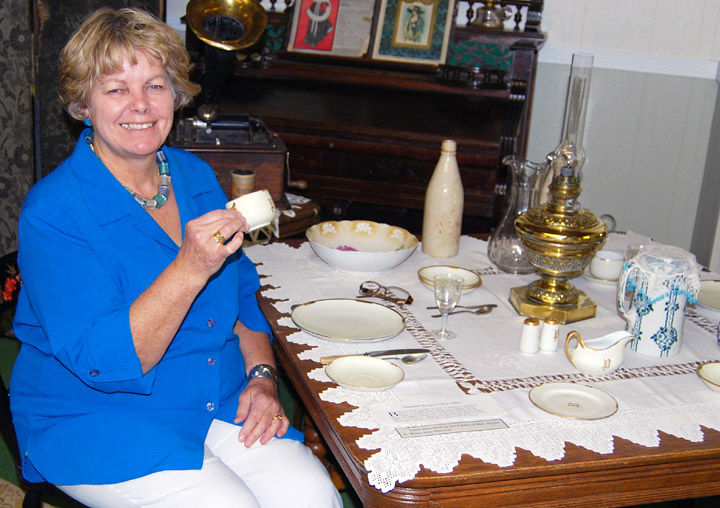
Osoyoos Museum curator Gayle Cornish has announced she will retire from her position this October. Here, she sits at Judge John Carmichael Haynes’ dining room table, one of the museum’s exhibits. Photo by Laurena Weninger - Click on picture for larger image
OSOYOOS TIMES-August 25, 2010
By Laurena Weninger – Osoyoos Times
“Obviously it’s really hard to give up something you’re so committed to,” admitted Gayle Cornish, curator of the Osoyoos Museum, about her decision to retire this fall.
“There’s a point when you have to step back and relax a bit. I love what I do but I know there is a time to do some of the other things in life.”
Cornish stepped up as president of the Osoyoos Museum Society in 2004.
At the time, there was little in the way of paid staff at the facility.
“We had a summer student one day a week and that was all we could afford,” Cornish said. “It was run by volunteers and only open in the summer.”
That wasn’t enough, as far as Cornish was concerned – and anyone who has met the woman knows she is fierce about getting what she wants.
“When I got here I was just driven to do something about the museum,” she said. “I don’t know why. I don’t know where it comes from.”
Cornish grew up in Osoyoos and moved to Rossland in 1959.
That’s where she graduated from high school before moving to the Lower Mainland.
There, she went to art school and university for art education.
But as a twist of fate would have it, in 1978 her husband, George, got a teaching job in Osoyoos.
That brought Cornish back to the small town to raise her two children, Patrick and Sonaiya.
The rest, as they say, is history.
The Osoyoos Museum was founded in 1963 by long-time Osoyoos resident Katie Lacey – another woman who was passionate about preserving the past.
The first museum was located in the building where the Town’s development services branch now resides.
In 1974, volunteers moved the museum to the current building, which was formerly a curling rink, built in 1954.
“They moved (the artifacts) into this massive space without realizing (it) is the worst thing you can do because of the temperature extremes,” Cornish said.
Part of the building has no proper heat or cooling system and that’s just hard on the artifacts.
The artifacts were also stashed in the space with little organization and they weren’t well-protected.
“We were losing our history,” Cornish said. “We had no map cabinets. The maps were rolled up in acidic tubes. We also realized we had to digitize and photograph the artifacts.”
Cornish had some knowledge of such matters, thanks to her art studies.
“I had some background in conservation and that helped,” she said.
But it took more than what she already knew to upgrade the facility.
“I wasn’t afraid to ask people,” she said with a laugh.
She also learned to ask people for money, in the form of donations, and then mastered the art of grant-writing.
Before too long, the museum had some money available to hire a full-time curator.
In the summer of 2006, Cornish started working for pay in the position that, technically, consists of 35 hours per week.
“Oh. Fifty or 60,” she said, about how many hours she actually puts in each week. “It’s been all-consuming. The catch of it is, it’s so infinitely interesting.”
During her time at the museum, there were some happenings she considers major milestones.
“Obtaining basic core funding,” she said.
In March, 2006, the Town and Regional District Okanagan-Similkameen’s (RDOS) rural Area A came through with a total of $50,000 to fund the museum – $39,000 from the Town, $11,000 from the RDOS.
“That was huge. Absolutely huge for us.”
It meant the museum could be opened year-round and it was clearly a sign of the recognition and understanding of how important it is to preserve Osoyoos’s history.
Other highlights of Cornish’s time at the museum include working with the Osoyoos Indian Band to develop a touring art collection of work done by students from the Inkameep Day School.
“That was a huge job for a small museum,” Cornish said.
She is also proud to have overseen the organization of the museum’s archives to national standards, which makes them accessible to the world.
But her favourite part?
“Working with the photos and researching. Those are the things I love,” Cornish said, her passion for the job written all over her face.
While she is taking a step back for now, she’s not making any promises about what lies ahead.
Down the road, Cornish may pop up again near the museum to help with specific projects on a less-committed basis, she said, recognizing she won’t be able to walk away entirely.
“I’ve got to take time for my family and friends,” Cornish said. “But I will never abandon the museum.”
[email protected]