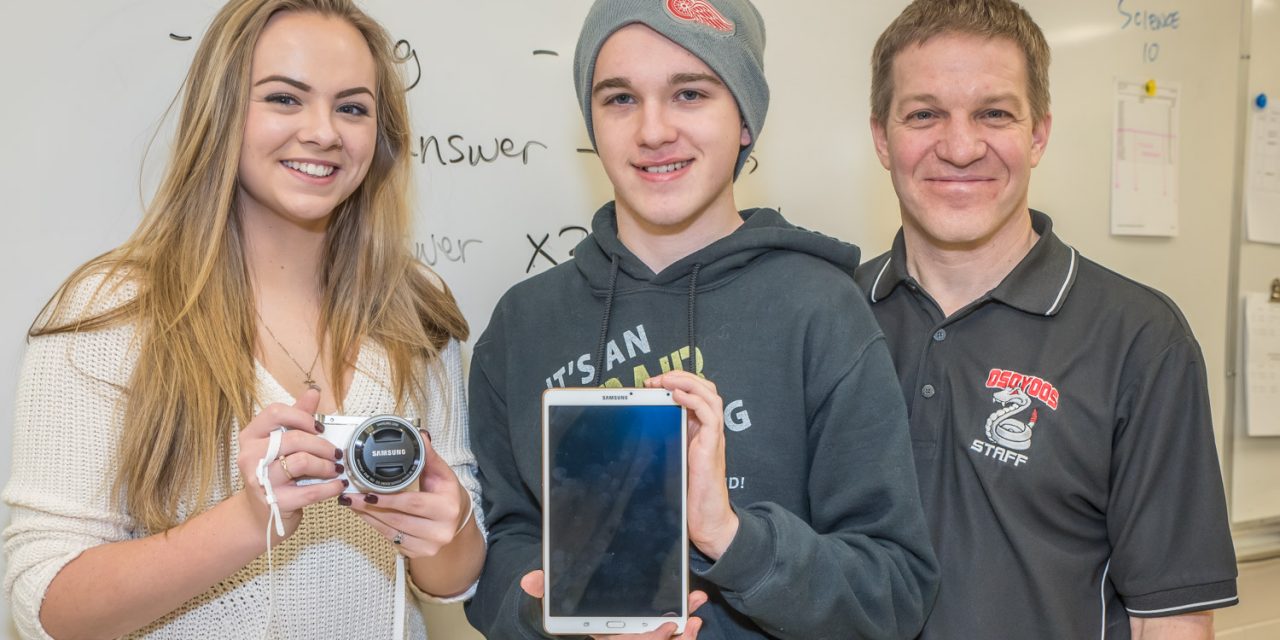
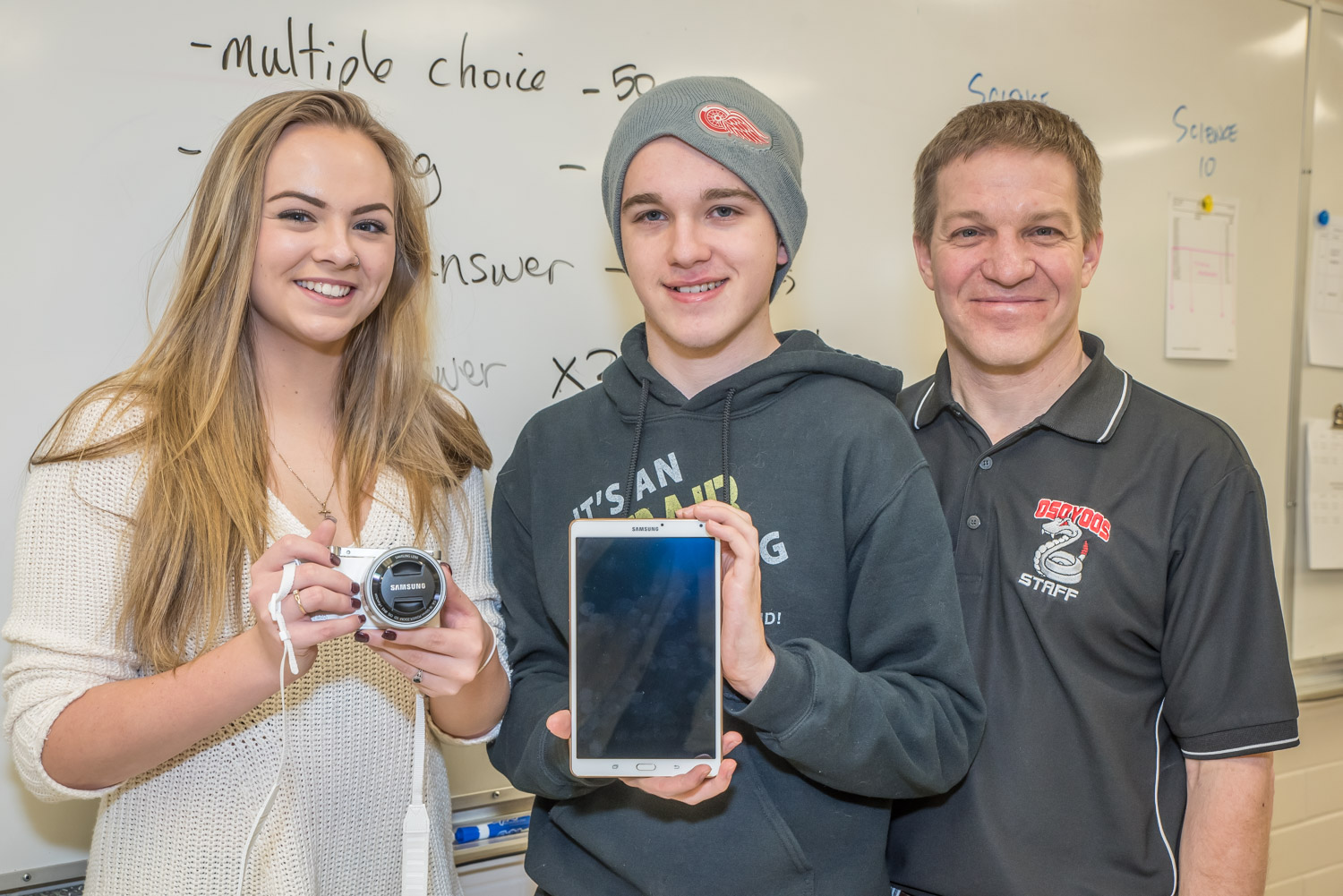
Students Taylor Price and Adair Langsmith, both in Grade 11 at Osoyoos Secondary School (OSS), show off a camera and tablet the school received from Samsumg for placing as semi-finalists in the Samsung Solve for Tomorrow Challenge. OSS was one of 55 semi-finalists chosen across Canada, based on a proposal put forward by teacher Peter Gajda, right. The students will look into ideas the Town of Osoyoos can use to conserve water. (Richard McGuire photo)
Peter Gajda, a teacher at Osoyoos Secondary School (OSS), is inspiring his students to seek a solution to the challenging problem of water conservation in a national competition.
Last week, Samsung Canada announced that Gajda’s proposal was selected as one of 55 semi-finalists for the next phase in Canada’s first-ever Samsung Solve for Tomorrow Challenge.
There were more than 700 entries in the first round.
The competition encourages Canadian students in Grades 6 through 12 to apply their natural curiosity to think big using science, technology, engineering and math (STEM) to solve everyday problems in their local communities, Samsung says.
“I think anytime we can take kids out of the regular learning environment and put them in real-world situations, that’s really where the curriculum is going,” said Gajda. “We want kids to become real-world problem solvers. Let’s give them real-world problems.”
For submitting the proposal and being chosen as a semi-finalist, the school received a Samsung NX 3000 digital camera capable of producing video, along with a Samsung Galaxy S8 tablet and a gift card to obtain Adobe editing software from Google Play.
In the next step, students must produce a three-minute video of their project using the equipment they’ve received.
Water conservation has been controversial in Osoyoos as some residents have balked at twice-weekly lawn watering restrictions last summer and some have opposed the introduction of universal water meters – a program being considered by the current town council.
“I proposed looking at something related to water conservation, water restriction and water metering in town,” said Gajda. “Obviously it’s a big community issue.”
He plans to use volunteers from his Biology 11 class to work on the project after school.
The students will meet with Gajda to talk about what the town is currently doing to reduce water consumption and then to “think outside the box” about what could be done.
This, he suggests, could involve such ideas as watering more often but for a shorter period of time to use less water, or using sensors to detect leaks in the town’s water system.
They will also discuss an education program to educate the public about water conservation.
The students will also meet with town council on Feb. 15 and also try to bring in experts from the Okanagan Basin Water Board.
“The students this year in Biology 11 looked at living things, ecology and cycling of nutrients and plants so this really fits well with those,” said Gajda. “I like to take things outside the classroom, so it’s not a surprise that when this came up, it seemed like a great opportunity to try to get them out.”
Gajda said the next phase of the Samsung competition will be to select 11 winners.
The final winners will be judged by the communities as a whole.
The 11 finalists will receive $20,000 in classroom technology.
“You will post your video online and get people to vote for it,” he said. “They’re going to pick two grand prize winners from that 11 with a chance to win $50,000.”
Gajda said when he presented the idea to his students and asked for volunteers, about 15 hands went up.
“I feel really fortunate I have such a good relationship with most of my classes,” he said. “I have kids that don’t want to be in front of the camera, but they are really good behind the camera. I have kids that are going to do the narration and kids who want to go to town council and present – they like to talk and be heard. So it’s a great mix of kids that are bringing their skill sets to the project.”
The Samsung Solve for Tomorrow Challenge is being run in partnership with Canadian YouTubers AsapSCIENCE and educational organizations Let’s Talk Science and The Learning Partnership.
“We’ve been impressed by both the variety and creativity of the schools’ STEM-based solutions to solve their local community issues,” said Mark Childs, chief brand officer with Samsung Electronics Canada. “From an anti-bullying app seeing students home safely, to an anti-freezing plumbing solution for Canadian winters, these are tangible, real-world innovations that are wholly inspired by STEM. We can’t wait to see how students bring these projects to life to benefit their communities across Canada.”
RICHARD McGUIRE
Osoyoos Times