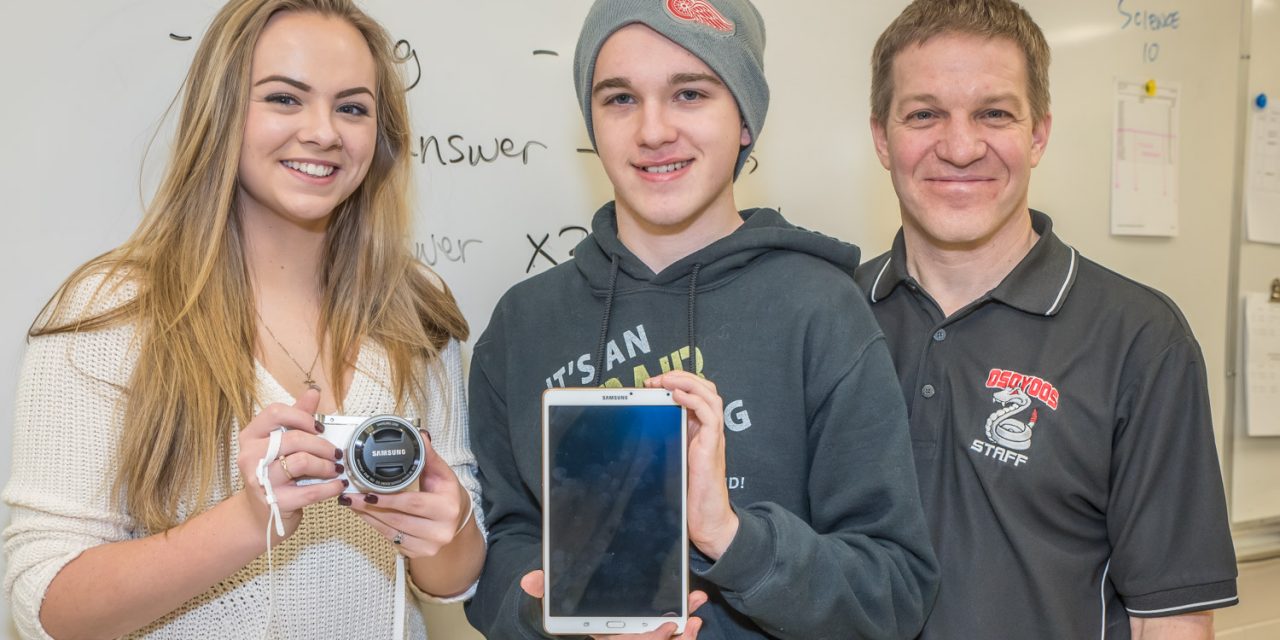
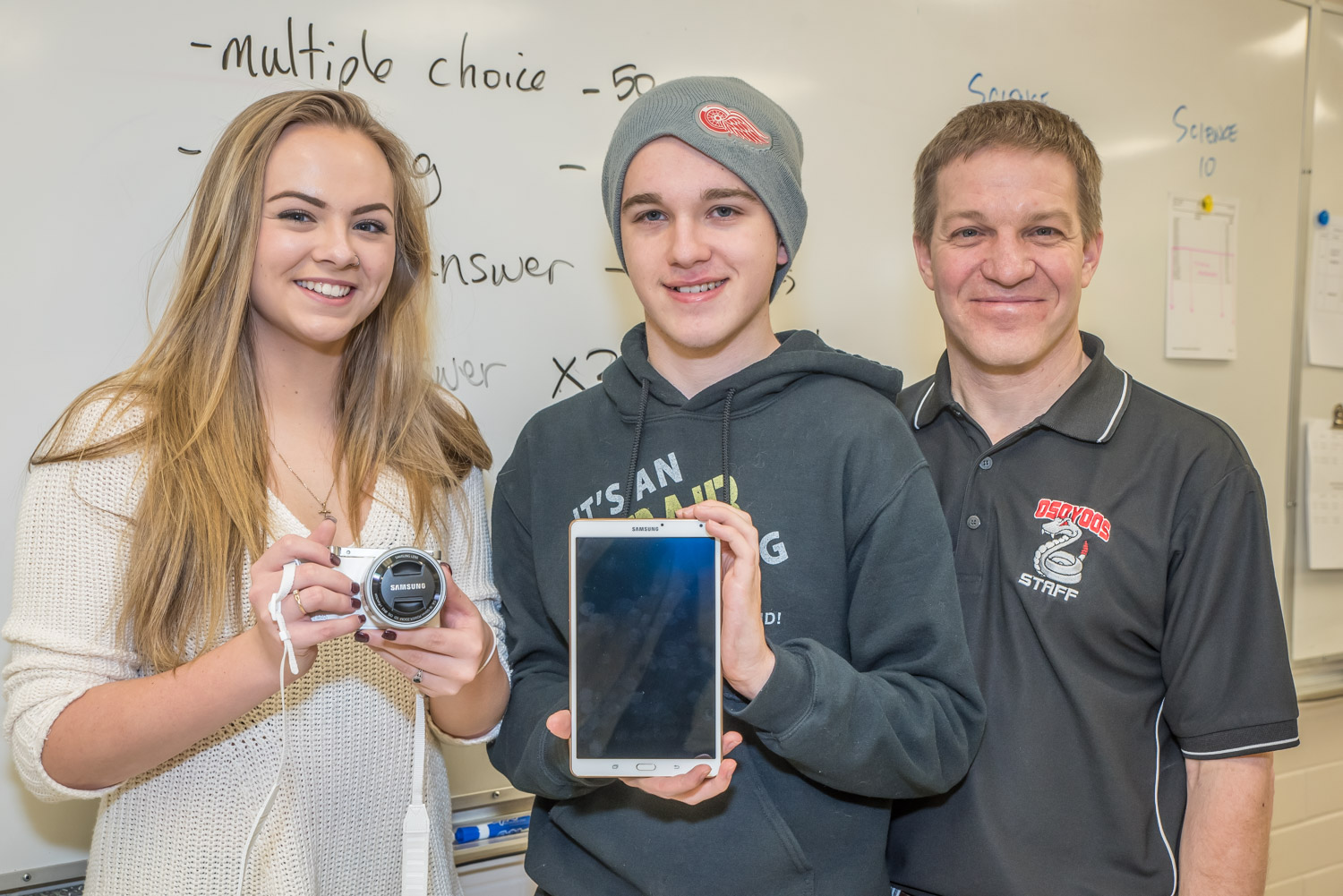
Osoyoos Secondary School Grade 11 students Taylor Price and Adair Langsmith, show off the camera and tablet the school received from Samsumg for placing as semi-finalists in the Samsung Solve for Tomorrow Challenge. OSS was one of 55 semi-finalists chosen across Canada, based on a proposal put forward by teacher Peter Gajda, right. Gajda and several other students appeared before Town of Osoyoos council on Monday detailing how they would like to share their information to help the town with its water conservation initiatives. (Richard McGuire photo)
Students from Osoyoos Secondary School who are enjoying great success in a national competition want to work with the Town of Osoyoos to implement water conservation initiatives.
OSS Principal Mike Safek, teacher Peter Gajda and four students from Gajda’s Biology 11 class made a presentation to Town of Osoyoos council Monday saying they would be more than willing to share the information they’ve gathered with the town to pursue water conservation initiatives in Osoyoos.
Hanna Shiels, said all of the students involved in her class are thrilled to have been selected as one of 55 semi-finalists for the next phase in Canada’s first-ever Samsung Solve for Tomorrow Challenge.
There were more than 700 entries from high school students across Canada in the first round.
The competition encourages Canadian students in Grades 6 through 12 to apply their natural curiosity to think big using science, technology, engineering and math (STEM) to solve everyday problems in their local communities, said Shiels.
For submitting the proposal and being chosen as a semi-finalist, the school received a Samsung NX 3000 digital camera capable of producing video, along with a Samsung Galaxy S8 tablet and a gift card to obtain Adobe editing software from Google Play.
In the next step, students must produce a three-minute video of their project using the equipment they’ve received.
That video must be submitted to contest organizers by March 8 and national finalists will be announced two weeks later, said Gajda.
There will be two grand prizes of $50,000 in the latest digital technology for the classroom to the two best video submissions.
Shiels said the scientific work done by the students as part of this process could assist the town in its well-publicized water conservation initiatives.
“We think we have some possible solutions to ongoing concerns” about water conservation, she said.
For the first time in years, Osoyoos town council implemented water conservation initiatives over several months last year due to prolonged drought conditions by limiting lawn watering to twice a week. The restrictions were in effect from early June until the end of September.
Some of the information they have gathered over the past few months in relation to water conservation issues in Osoyoos include a recommendation to implement “staged watering systems” instead of having property owners dump water on their lawns for several consecutive hours, she said.
“Six hours of continuous watering is not the best,” she said.
The students in her class are trying to develop a digital computer app (application) that would involve combining water usage with weather conditions, including temperature and wind conditions, said Shiels.
The students have also discovered that the amount of grass clippings and fertilizers used on lawns is directly related to the amount of water usage needed to keep a healthy and vibrant lawn, she said.
The students would love to be able to work with the town and share their findings, said Shiels.
“We’re excited to work with you on real life problems for our community,” she said.
Mayor Sue McKortoff thanked the students for their outstanding work and doing so well in the national contest.
The town is looking at hiring a student as a water ambassador this summer to educate the public about the importance of water conservation initiatives and working with members of the public who don’t adhere to water restriction programs, said McKortoff.
Coun. C. J. Rhodes said “the future of Osoyoos is in very good hands” with young students like this committed to improving their community.
If the OSS students make the national finals in this contest, local citizens will be asked to go online and vote for them, said Shiels.
Water conservation has been controversial in Osoyoos as some residents have balked at twice-weekly lawn watering restrictions last summer and some have opposed the introduction of universal water meters – a program being considered by the current town council.
It was because of this issue that Gajda proposed looking at something related to water conservation, water restriction and water metering in town.
“Obviously it’s a big community issue,” said Gajda.
The students have met with Gajda over the past several weeks to talk about what the town is currently doing to reduce water consumption and then to “think outside the box” about what could be done.
When it was announced the OSS Grade 11 class had moved on to the national semi-finals, Gajda said their enthusiasm and hard work obviously paid off.
“The students this year in Biology 11 looked at living things, ecology and cycling of nutrients and plants so this really fits well with those,” said Gajda. “I like to take things outside the classroom, so it’s not a surprise that when this came up, it seemed like a great opportunity to try to get them out.”
A total of 11 national finalists will receive $20,000 in classroom technology.
The two grand prize winners of $50,000 in classroom technology will be selected from those 11 finalists.
The Samsung Solve for Tomorrow Challenge is a partnership with Canadian YouTubers AsapSCIENCE and organizations Let’s Talk Science and The Learning Partnership.
KEITH LACEY
Osoyoos Times