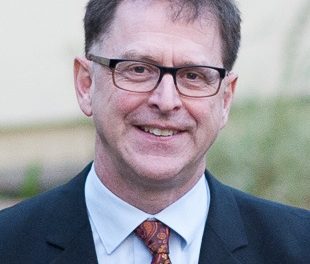
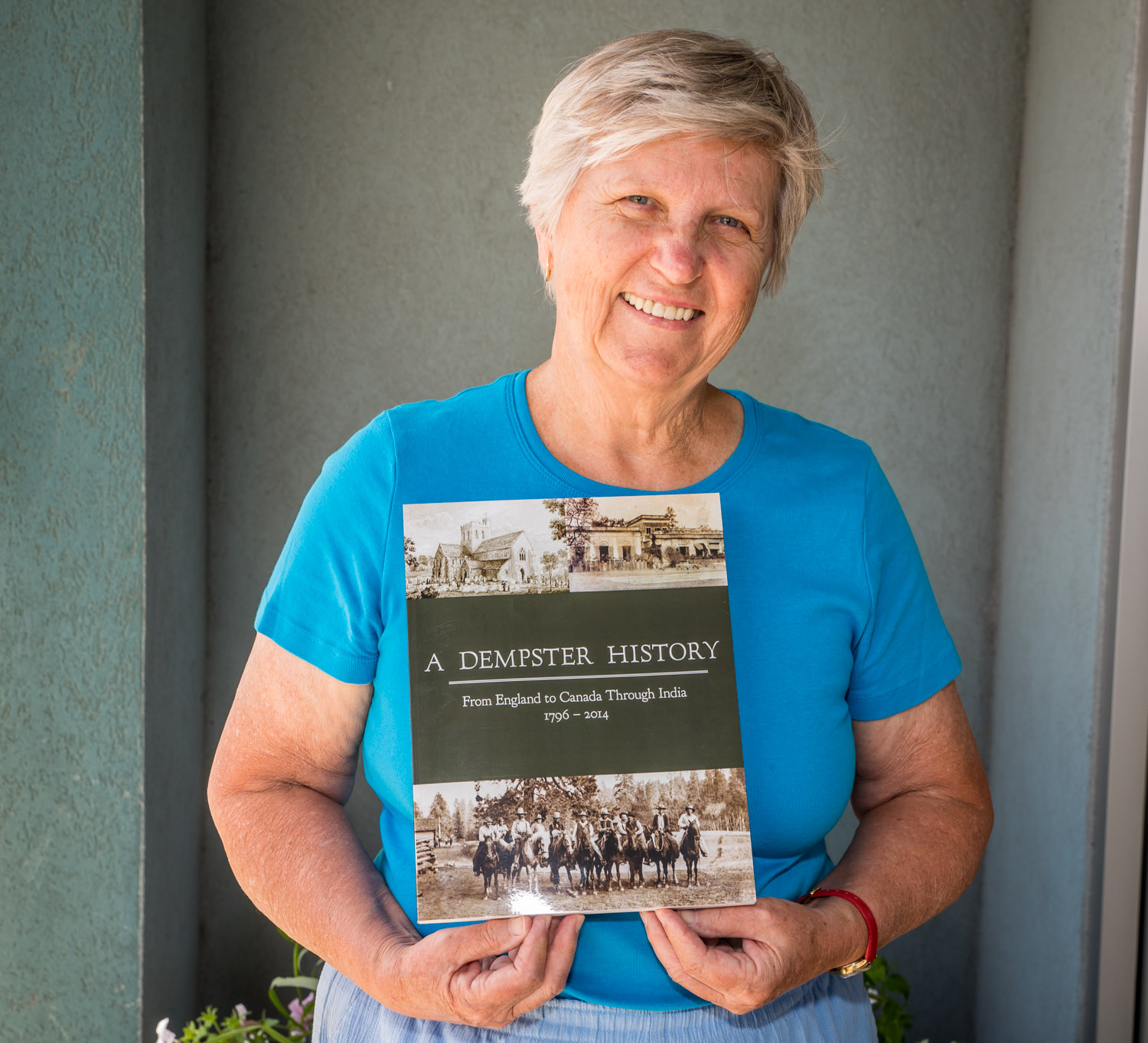
Eleanore Dempster received the B.C. Genealogical Society Family History Book Award for 2014 for her history of her husband’s family. (Richard McGuire photo)
It began as an innocent question about a family crest on a ring 35 years ago and turned into an obsession.
Last week Eleanore Dempster, of Osoyoos, was recognized for those 35 years of research when she won the 2014 B.C. Genealogical Society Family History Book Award.
Ironically, Dempster never completely solved the question about the crest used by her husband Peter’s family. There’s still a missing link.
But in her work that she calls a “compulsive addiction,” she uncovered years of her husband’s family history dating back to the 1700s. She also learned much about heraldry, as it relates to family coats of arms.
“What got me started happened at a tea party in Peter’s mother’s garden,” said Dempster. “The family was gathered and the three brothers were talking about a ring that one of them had with a crest on it. My husband asked how we knew it’s our crest – it was supposed to be the Dempster crest – and when he asked the question, I immediately said, ‘Well, I’ll find out.’”
When she began, Dempster was so inexperienced that she had to look up “genealogy” in the dictionary.
She began by solving the mystery of her husband’s paternal grandfather, William Dempster, who the family wouldn’t talk about.
She learned he died in Seattle many years ago and she managed to track down his death record from Washington State.
“What a life-defining moment that was!” she said. “There was enough information in the document to paint a small vignette of William, including his birthplace in India. I was hooked!”
In the 35 years since, Dempster learned that a crest actually belongs to one person and the family doesn’t own title to it.
She discovered the person in Scotland, John Dempster, who was awarded the coat of arms with that crest in 1673, but she wasn’t able to prove her husband’s direct lineage to him.
She did, however, uncover a fascinating history of her husband’s family, who came from England and served many years in the civil service of colonial India during the British Raj.
Asked why she would research her husband’s family history rather than her own, Dempster replies: “His seems so much more interesting than mine.”
She also said her family comes from European countries such as Austria, Germany and Russia where many records are missing and she doesn’t speak the languages.
Her beautifully produced book has photographs and illustrations, some in colour, showing her husband’s family history and the places his ancestors lived.
She only produced 75 copies, mainly for family members.
In order to win the award, the book had to meet a number of criteria – the main one being that all births, marriages and deaths had to be documented with legitimate records.
Finding those records is what makes the research so challenging.
These days, the internet has transformed genealogical research and many records are online.
Services like Ancestry.ca make it possible for genealogists to share information and look up records, though Dempster suggests using them with caution.
“It’s very useful for getting started, but then you need to do your own research,” she said, noting that much of the online genealogical information is contributed by users and isn’t properly sourced.
When she started 35 years ago, however, the internet didn’t exist.
She wrote letters to distant relatives, often waiting a long time to receive a reply.
She spent considerable time looking at parish records, often at family history centres at the Church of Jesus Christ of Latter-Day Saints, the Mormon Church, for whom genealogical research is an important part of their beliefs.
“I got a tremendous amount of information from their library,” she said.
When she couldn’t find parish records, she would turn to census information, but there were few censuses prior to 1841.
Prior to 1837, there was no mandatory registration of births, marriages and deaths with the government and some of the parish records prior to then were incomplete or poorly recorded.
Unlike some researchers, Dempster didn’t travel overseas to conduct her search. And other than looking at a few tombs of her own family in Saskatchewan, she didn’t do any graveyard hunting.
Dempster was able to confirm her husband’s family as far back as 1796, but she gathered unconfirmed information dating back to 1735.
She also found considerable “collateral family” information on cousins, aunts and uncles.
She advises anyone conducting family history research to be meticulous about record keeping. You may want to revisit your research in later years and you need to know where you found certain information, she advises. And somebody else reading the history may want to check the information.
“Start with yourself and go back one generation at a time,” she advises. “Don’t be tempted to drift off into other generations or other family lines.”
What do you do when a record doesn’t exist?
“Well you cry,” said Dempster. “That’s what happened to me. I got back to 1796 and I searched for almost 20 years trying to find his birth record. I paid professional researchers to help me in England. Other family members who live in England were helping me and none of us could find his birth record. And that then wove a mystery around his existence. It’s all in the book.”
Dempster said she is happy to give advice to other local residents doing their own family research. She can be contacted at 250-495-2092.
RICHARD McGUIRE
Osoyoos Times