Photo by Keith Lacey
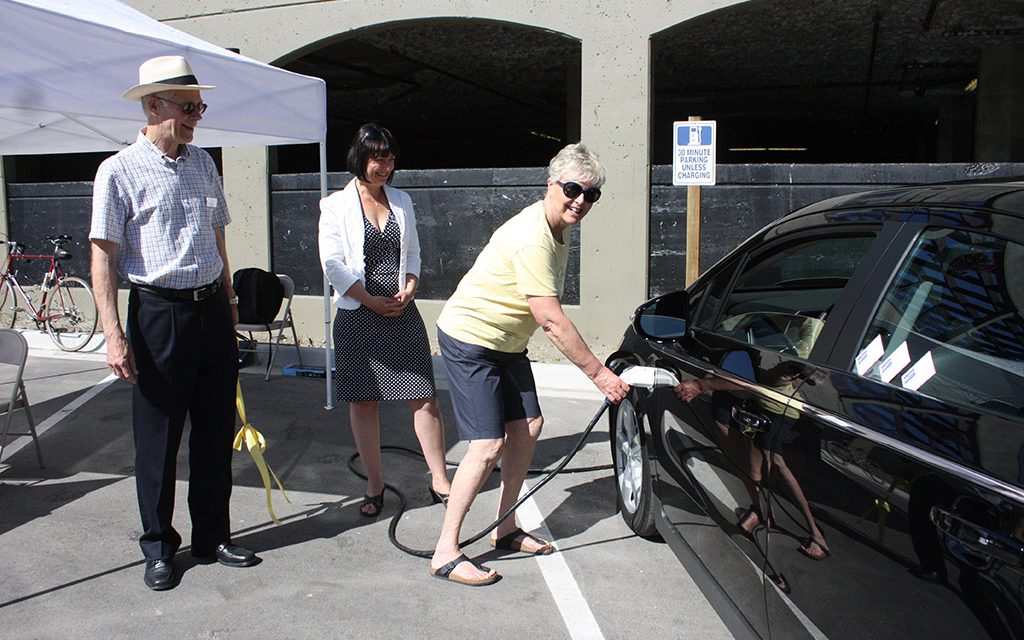
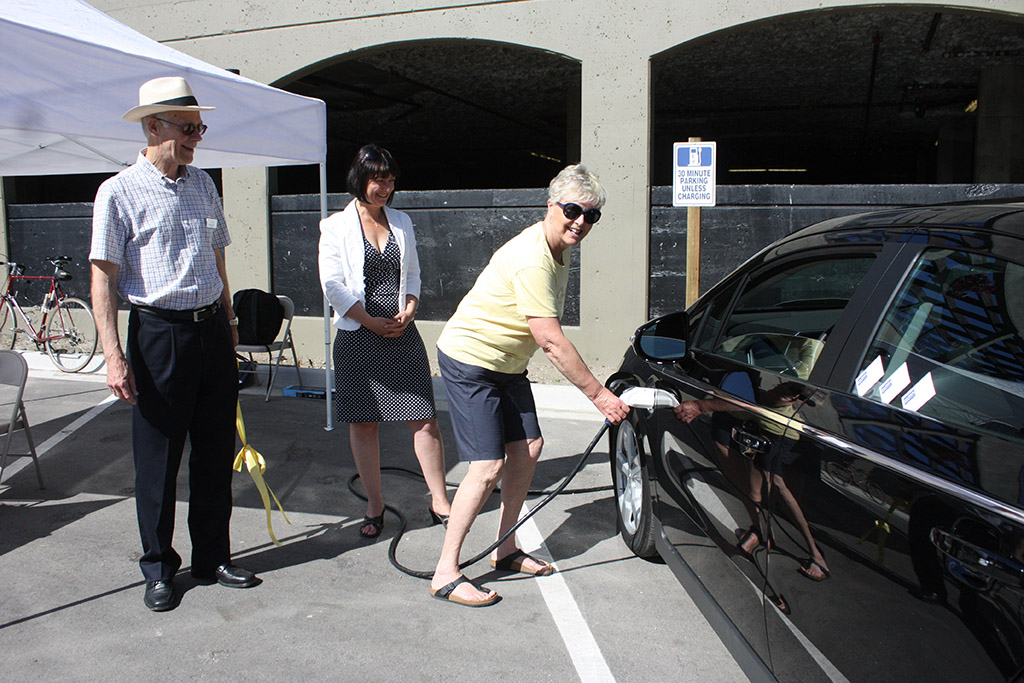
Coun. Sue McKortoff (right) connects a cable to charge an electric car at the new charging station near Gyro Park, while Coun. Michael Ryan and vehicle sales professional Tracy Cameron look on.
The Town of Osoyoos has joined the rapidly-growing list of communities across British Columbia to offer electric vehicle charging stations.
On Saturday morning, town councillors Michael Ryan and Sue McKortoff, town planner Phil Armstrong and Tracy Cameron, a sales professional from the Huber Bannister Chevrolet dealership in Penticton (which sells the 2013 Chevrolet Volt electric automobile) were on hand as the town officially unveiled its two new charging stations.
Both electric vehicle charging stations are located in the town’s large parking lot behind the Owl Pub and Restaurant near Gyro Park.
There are now more than 570 electric vehicle charging stations in this province and with more people than ever considering purchasing electric or hybrid vehicles, the time was right to introduce these stations in our community, said Ryan.
The Town of Osoyoos received a grant from the provincial Community Charging Infrastructure (CCI) fund to install the two stations, which were purchased from Canada’s AddEnergie, said Armstrong. The grant covered $8,000 or 75 per cent of the capital costs to install them.
As part of the deal, AddEnergie, thanks to a federal grant, was able to waive the communication and management fees for five years saving the town’s operating budget at least $2,000, he said.
The town is originally providing this service free of charge to residents and visitors to promote environmental sustainability. Starting next spring, vehicle owners using the charging stations can purchase power by using a credit card.
The CCI fund is part of the provincial government’s $14.3 billion Clean Energy Vehicle Program, which offered B.C. residents with up to $5,000 off the pre-tax sticker price for qualifying new battery electric, fuel-cell, plug-in hybrid and compressed natural gas vehicles.
The current town council is committed to environmental initiatives and trying to reduce greenhouse gas emissions and offering these charging stations is a positive step forward towards those goals, said Ryan.
“We want our town to stay clean and we want our citizens to stay healthy … we want to be one of the healthiest places to live in all of Canada,” said Ryan.
The electric charging stations are both 240-volt stations, which will recharge an electric car in roughly four hours. It would take roughly 10 hours to recharge the current models now on the market by using a regular electrical plug-in at home.
The Chevrolet Volt can now travel just over 80 kilometres on a single charge, said Cameron, who said her dealership sold three Volts in 2012.
Electric and hybrid car sales have skyrocketed in the United States so rapidly that there are now tens of thousands of charging stations spread across the country, she said.
“Even places like Wal-Mart are offering charging stations as they realize customers can come in and do some shopping while their vehicle recharges outside,” she said. “As more and more electric vehicles come into the market, the more charging stations will be opening.”
The generator used to charge the battery in the Volt is fuelled by regular gasoline and the engine automatically switches to gas when the battery loses its charge after 80 km, she said.
Major American automobile manufacturers are planning on introducing many new electric and hybrid models in the next three or four years, including the Chevy Spark which GM brass has hinted will be able to go up to 350 km on a single charge, she said.
The Volt has “incredible power” and runs very smoothly and is a bargain at a sticker price of $47,000 when you consider you don’t have to pay for gasoline, she said.
BY KEITH LACEY
Osoyoos Times