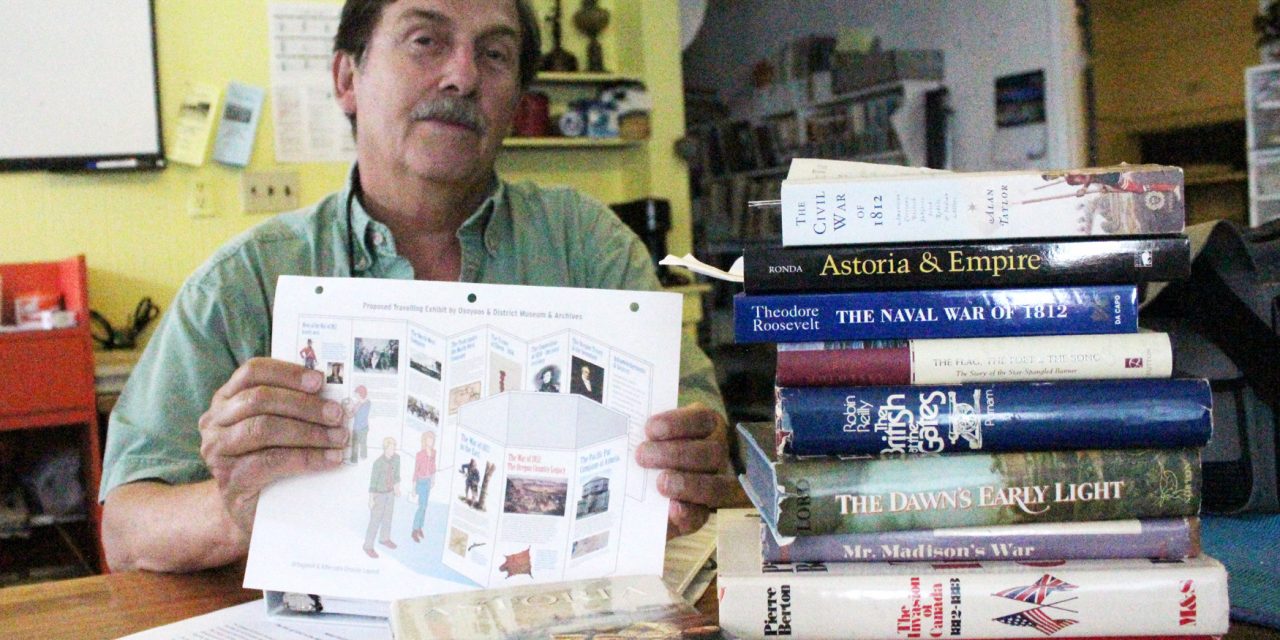
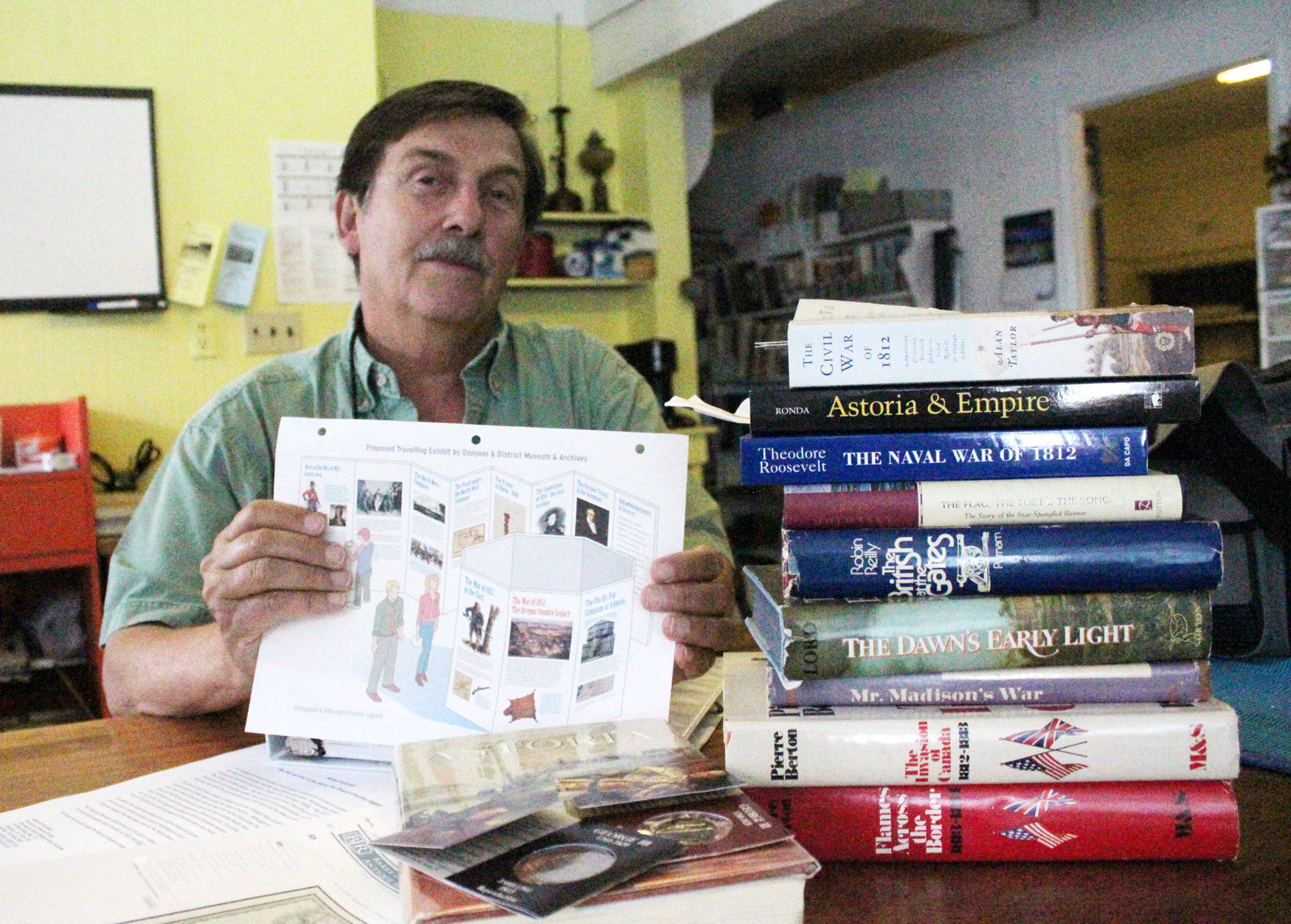
Ken Favrholdt, executive curator at the Osoyoos and District Museum and Archives, could be found sitting in his office above the Osoyoos Museum on Friday, July 20, sifting through a number of text books in preparation for the museum’s upcoming War of 1812 project. The Osoyoos Museum was recently granted more than $70,000 to put together an exhibit on the war and the effect it had on western Canada and the United States. The exhibit is expected to open sometime in early 2013 at the Osoyoos Museum, before it’s taken on a tour across the province. Photo by Mathew White.
Sitting in a small office above the Osoyoos Museum Friday afternoon, Ken Favrholdt is surrounded by books, diagrams, blueprints and notes, all in preparation for one of the Osoyoos Museum’s biggest projects since it was formally established in 1963.
“This is very exciting,” said Favrholdt, executive curator at the Osoyoos and District Museum and Archives. “This will probably be one of the biggest projects the museum has ever done.
“This isn’t really about Osoyoos, although there is a small connection. It is to promote the education about the War of 1812.”
The exhibit is being called The War of 1812 in the West: The Oregon Country Legacy and likewise will focus on the War of 1812 and the impact it had on western Canada and the United States.
As most people know, the War of 1812 was mainly centred on the east side of our country, particularly in southern Ontario and the St. Lawrence area, but what a lot of people don’t know is the war also had a significant impact on the west.
“It relates to the fur-trade era in what was known as the Oregon Country, a region of southern British Columbia, Washington and Oregon,” said Favrholdt.
“So I’m telling the story of how the war affected the whole region.”
Focusing on this lesser known part of the war and what resulted from it became his hook, and after filling out the proper forms and sending them through the right channels, the Osoyoos Museum was approved for a $71,000 grant from James Moore, the Minister of Canadian Heritage and Official Languages, said Favrholdt.
“There was funding from the federal government to commemorate the War of 1812 and the funding is Canada-wide so that made me wonder if there was some way we could tap into that,” said Favrholdt.
“I finally found a hook.”
Once the funding was approved, Favrholdt said he immediately went to work.
His first step has been to research the war to ensure historical accuracy.
After that will come the actual construction of the project, he said, which will be a “modular exhibit” that can be fitted and formatted in different ways.
Once completed, which Favrholdt said should be in early 2013, the project will initially be located in the Osoyoos Museum, but it will also spend two years traveling all over British Columbia (Penticton, Kelowna, Kamloops, etc.), visiting other museums and sharing the history of this land.
“It is also going to travel to other museums, including the Lower Mainland,” said Favrholdt. “We hope it will also be shown in Fort Langley and the Peace Arch Border Crossing.”
Right now the project is only expected to travel to museums in B.C., but Favrholdt said they are considering applying for more funding in order to make an additional bilingual exhibit, which would be allowed to travel across the country.
“It has to be bilingual under the terms of the government funding if it’s to leave B.C.,” said Favrholdt.
The entire project will wrap up with a ceremony in Kamloops in the spring of 2014. Kamloops is a location which boosted its own fur-trading post back in 1812.
Following the final ceremony, the project will officially become the property of the Osoyoos Museum, at which point Favrholdt said he would like to see it travel to the United States as well, visiting historic locations relating to the War of 1812.
Besides the traveling exhibit, the funds will also be used to create a virtual exhibit, which people will be able to access through the museum’s website (http://www.osoyoosmuseum.ca).
Finally, the funds will also go towards the creation of educational and learning materials.
“We’re making this very accessible to school children,” said Favrholdt.