By Don Urquhart, Times Chronicle
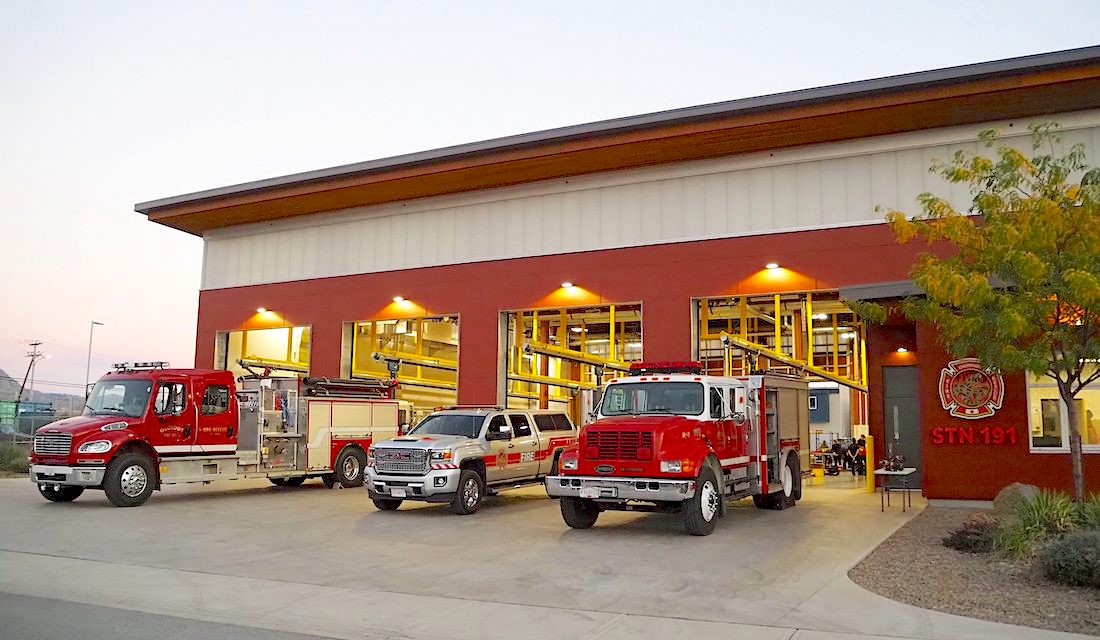
Commercial insurance rates in Osoyoos could see a drop within the next year or two following a request by the fire department for a review of the town’s fire insurance grading by the Fire Underwriters Survey.
Fire Underwriters Survey provides data to program subscribers regarding public fire protection for fire insurance statistical and underwriting evaluation which ultimately determines the cost of insurance.
Speaking at the Committee of the Whole meeting of July 16, former OFR Fire Chief Corey Kortmeyer said that as a result of the review the Public Fire Protection Classification (PFPC) for Commercial Lines of insurance improved from grade seven to grade six out of ten where one is the best grade. Unfortunately for homeowners the grade remains the same.
In August 2023, Osoyoos Fire Rescue requested Fire Underwriters Survey (FUS) to review the fire insurance grading for the Town of Osoyoos. “All departments collaborated on the materials needed for the submission,” which covers 19 assessment areas Kortmeyer noted. The FUS replied to the review request and provided the “Fire Insurance Grade Update 2024” on June 6, 2024.
The FUS is a national organization representing approximately 90 per cent of the private sector and casualty insurers operating in Canada. The underwriter surveys and casualty statistical companies provides actuarial tables for municipalities which are then used by at least 90 per cent of casualty insurers across Canada, including both personal and commercial lines, Kortmeyer explained.
He noted that the town had not had a review for quite some time and although there was no way of knowing whether it would be a “great idea, or potentially a bad idea . . . because you just never know if they will increase your table rates.”
The results of this, he noted, could impact residents, commercial and industrial businesses in the local area of Osoyoos.
The PFPC grading system evaluates the ability of a community’s fire protection programs to prevent and control major fires that may occur in multi-family residential, commercial, industrial, institutional buildings, and construction developments.
In this case all of the gradings remained the same except for Hydrant Protected – Commercial Lines insured properties within 5 km of the of Town of Osoyoos fire station and within 150 m in hose lay of a recognized hydrant on a Town of Osoyoos water distribution systems.
In response to a question from council he said that the result holds out the potential for savings or anywhere from 10-15 per cent, but it’s up to the insurance companies to filter it down and he added that Osoyoos commercial businesses would likely not see anything until at least 2025 or 2026.
The second grading system, titled Dwelling Protection Grade (DPG), Personal Lines of insurance for insured dwellings did not change, remaining at 3A for Hydrant Protected, 3B for Firehall Protected and 5 for unprotected dwellings. In this case five is the maximum bottom ranked grade.
In order to do the review a substantial amount of information is required with Kortmeyer thanking the town’s two deputy fire chiefs for their work in preparing the information.
“That means that there will be potentially savings for those business enterprises within the town of a Osoyoos,” he says. The caveat is that it doesn’t necessarily mean all insurance companies will offer a discount.
In a large part it depends on insurance companies using that particular source of underwriting or “actuarial” data to generate their insurance tables.
It’s none-the-less a win, Kortmeyer emphasized. “It is something that wasn’t there before and by doing some hard work and pushing things forward it actually made a bit of difference.”
Kortmeyer noted that a number of recommendations were compiled by the OFR based on areas where credit could be gained to improve further. With this he noted that council now has the information to be able to decide if and where to spend money in potentially improving the ratings for residential or other categories.
“These areas of assessments should be proposed by Staff and considered by council in strategic looking-term planning for public fire protection services or municipal infrastructure development.” These can then result in improved fire insurance grading which intern may result in a reduction in insurance cost for town residents and surrounding areas served by the OFR.
“So you can look at where your your best money is spent for the credit given, and that may filter down to a lower insurance rate. So we’re going to be diligently working forward that and pushing to get some of those answers completed, and working on our program in hopes that we can get further reduction.”
He added that “this is a perfect example of putting some time in and having a positive outcome for many businesses within the community.”
The rating improvement was the result of gains in a number of areas including significant credit gains for Training and Qualifications, Engine Service, Engine and Ladder Pump Capacities, Engine and Ladder Company Unit Manning, and Pre-Incident Planning, amongst others.
Areas where the most improvement could be made include Ladder Service (due to the lack of a ladder engine), Total Fire Force Available, Pre-Incident Planning and Fire Ground Operations.