Warning: Article contains content about suicide, mental health and violence that may be triggering to some readers.
Kim Montgomery remembers the triple homicide like it was yesterday.
She had just moved back home to the Syilx/Okanagan Nation when it happened. She recalls how the 2004 shooting that killed three and severely injured two shook the Indigenous community to the core.
Montgomery’s cousin in law was one of the victims killed that night.
“There (were) no answers because they had left the bodies up there for like a full day before anybody even knew who it was, and then once they brought the bodies down, they still didn’t know at the hospital who actually died. They found out who was shot, but they didn’t know who died for hours and hours later.”
Few families in the Syilx/Okanagan Nation were untouched by Vincent Paul’s violent crime, but what really got the nation angry was the lacklustre response by health officials.
Health Canada sent three social workers to the Penticton Indian Band to provide mental health support to the individuals affected, but their approach was culturally insensitive and badly received.
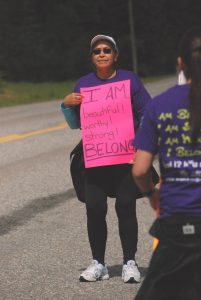
A woman of the Syilx/Okanagan Nation holds up a sign with an inspiring message at the Syilx Unity Run. Photo: Okanagan Nation Alliance Facebook page)
“They were non-Indigenous people and the one person that was Indigenous worked from a different kind of framework, and was very not engaging,” she recalls in a phone call from her house in the mountains of the Syilx/Okanagan territory. “It was like, you come to me, I’ll just sit here. And the community didn’t engage.”
Montgomery remembers the support workers stayed for only a day or two, because the Penticton Indian Band families did not want to speak to them. She called it a “you come to me in my office” approach that just did not take cultural practices and histories into account.
The half-hearted attempt sparked a fire in the Syilx/Okanagan community for change.
Grand Chief Stewart Phillip was the chief of the nation at the time of the homicide. According to Montgomery, he sat in on a talk by Ray McGuire, who started a team of Indigenous social responders in an Indigenous community on Vancouver Island.
Grand Chief Phillip brought the idea back to the Syilx/Okanagan Nation, and called up Montgomery to help lead the charge.
She helped develop training materials, building the new Okanagan Nation Response Team (ONRT) from scratch. With a masters in social work from the University of British Columbia and Okanagan heritage, she was a uniquely perfect fit for the team lead position.
She and the rest of the Okanagan Nation Alliance behind the team asked each of the seven member communities to nominate two community members to participate in the team on a voluntary basis. Each member would undergo ten training sessions and learn how to support victims of trauma, mental health, grief and violence in the home.
“People sent youth, they sent elders, they sent their councillors, they sent knowledge keepers, they sent construction crew, like it didn’t matter what profession they had, their go-to people came,” remembers Montgomery, who helped lead the training sessions.
Trained in cultural histories, intergenerational trauma, non-violent communication, diffusion techniques and suicide prevention, the idea was each volunteer could help their own community deal with traumas from within.
Formed in 2006, the first round of volunteers finished training just before the start of Vincent Paul’s trial. This would be the first of many trials and traumatic situations Montgomery and the Okanagan Nation Response Team would face in the coming years.
Ali Butler ONA Okanagan Nation Response Team (ONRT)
Ali Butler ONA Okanagan Nation Response Team (ONRT) Community Coordinator explains what harm reduction is and the importance of this approach. -Life has its up and downs. We have good days and we have bad days. Therefore, it is important to reach out when life becomes overwhelming. Reach out to friends, family, or to the helpers in your community. You can call the Okanagan Nation Response Team at 250-869-9350 for more information on the supports available. You can also call any of the following crisis lines:The Crisis Centre 1-800-784-2433KUU-US Crisis Society 1-800-558-8717Canada Suicide Prevention Services 1-833-456-4566Local BC Crisis Line 1-888-353-2273Mental Health Support Line 310-6789
Posted by Okanagan Nation Alliance on Tuesday, August 25, 2020
An Indigenous-informed approach
The second team of its kind in the province, the Okanagan Nation Response Team is bankrolled by government funding for the prevention of suicide in First Nations communities.
Originally, suicide prevention and response was the team’s main focus, but responses have since evolved to include mental health support, wellness checks, grief support, and domestic and family violence.
Indigenous people are three times as likely to experience violent crime than non-Indigenous Canadians, while roughly a quarter of all Indigenous Canadian women report being victims of domestic abuse. Youth and family violence are also much higher in First Nations communities across the country than among non-Indigenous.
Combined with intergenerational trauma and high levels of other social issues like drug and alcohol abuse but little mental health support, First Nations are often left with a desperate need for more mental health support.
But in the instance of the aftermath of the Vincent Paul shooting, non-Indigenous mental health workers with little or no knowledge of Indigenous cultures are not the way to go, said Montgomery.
This is why she believes the Okanagan Nation Response Team is so vital.
“One of our values, strong, sharp values, is relationships, and it’s the hub of everything we do,” she said. “So we don’t push things, we don’t move things so they go faster. We work with the family at their pace, and one of the biggest things is our people helping our people. That is a whole different way of doing work from an Indigenous perspective.”
Montgomery described a situation she was called on to help with involving the Osoyoos Indian Band. The process involved bringing a group of OIB influencers to the table.
Montgomery said she and the OIB stakeholders listed all the families touched by the incident in question and determined who at the table or in the community was best to reach out to each individual and family affected.
“I’m not going okay, I’m going to phone all these people and I’ll make sure they’re all okay, don’t worry about this, I’ve got it. So it’s really about who knows Joe, who knows Tom, who knows Bill? Okay, you take that person.”
She and the others at the table then took a day to reach out and assess which families and individuals did not have the support they needed and plans were made for them to get it.
“That’s an example of an Indigenous approach versus send me a list, send me their email, my group’s coming in, if we need you, we’ll call,” said Montgomery, referencing the way the provincial and federal health systems deals with trauma support.
It’s what she calls a wrap around approach, based on relationships and trust. And it’s an approach that has been very successful.
Montgomery and her team have been recognized for their work nationally, taking the original five year pilot program and turning it into a never ending stream of support. Her team is constantly expanding by training new volunteers whenever possible to have as many community members trained in trauma response as possible.
She believes a huge part of the success is due to the wholly Indigenous model, informed from those within the communities they serve even down to the administrative tasks. The team keeps files open for at least a year, because they will likely be needed again before the year is over.
“Even the admin approach is from an Indigenous perspective,” said Montgomery. “It’s not like okay we responded, peace out. That’s that hit and run model, this is not. It’s very much an engagement focused model and supportive model and that’s how we do work differently.”
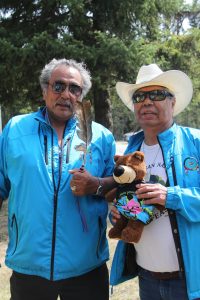
Leon Louis and Wilfred Barnes, resource team members and Elder advisors, hold Tupa the bear, a tool used to help kids dealing with trauma, and a feather, a traditional symbol of the Okanagan people. (Photo: submitted by the Okanagan Nation Alliance)
Putting community needs first
Working differently is what Jennifer Lewis believes is most important for the Okanagan Nation communities. As the wellness manager for the Okanagan Nation Alliance, she oversees the ONRT and other programs aimed at improving health and wellness among the Syilx/Okanagan communities.
She remembers when the team got started and the work they’ve done since to tackle the social issues that have plagued the Okanagan Nation in the past.
But the most important aspect of the response team is not the work they’ve done in the past, but the fact they are a community initiative informed by the culture of the people they serve.
“We have a right to support our nation members in a cultural manner, in a way that we decide as a people, that is needed. And that has to do with sovereignty as well,” said Lewis.
She explained that sovereignty is a big part of the ONRT. They use it to inform everything they do, including waiting to be asked to step in and help. Respecting boundaries is a big part of Syilx/Okanagan culture, stemming from the generations where self sovereignty was stripped from their people through residential schools, over policing and racist government policies.
Lewis believes that’s why the ONRT is so important for the communities, because relationships with first responders and government response teams have been so negative in the past.
“Our community has a long standing history with the RCMP, of mistrust and harm,” she said. “they have their own structures and their own policies, right? Like they have their own work hours, and their supports, like how are they able to adapt to community needs?”
That’s what it’s all about in the business of crisis response. Community needs should and always will be at the forefront for the ONRT. They’re focused on putting community protocols and practices into action to improve the health and wellness of their nation members, no matter what the crisis may be.
When asked why the team is so vital to the community, Lewis said it’s because they know how to treat their own people.
“We know cultural protocols. We know families and family histories. We know our community,” she said. “Where we have relationships we have more trust and willingness to ask for, and accept, support.”