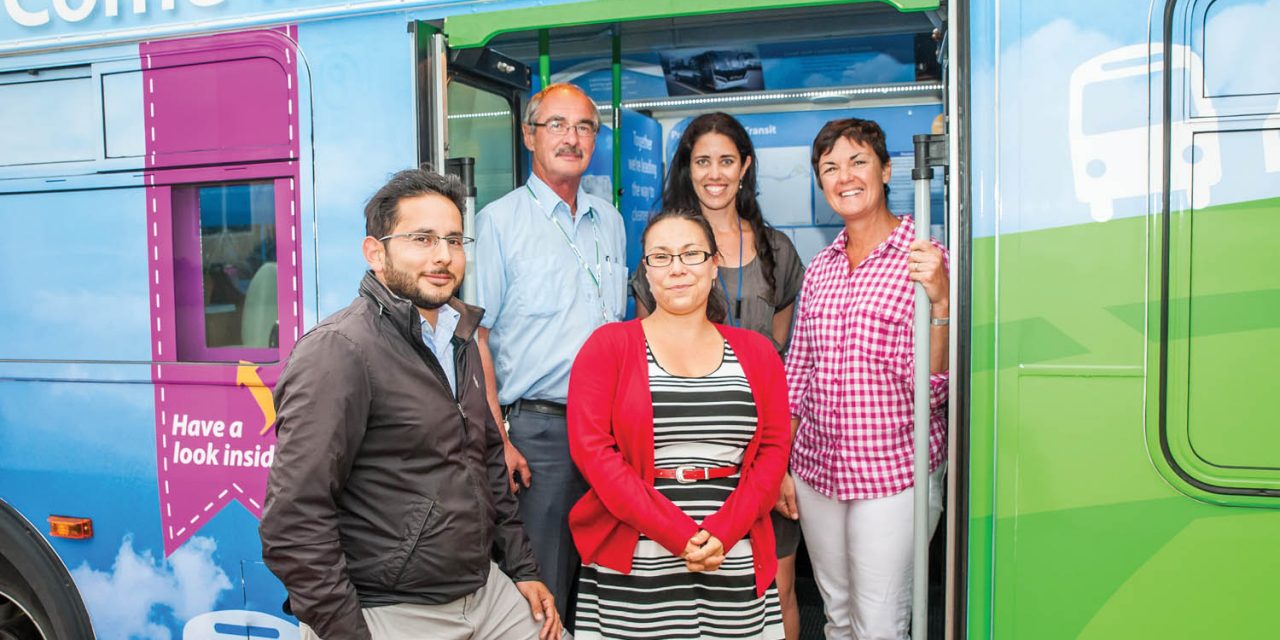
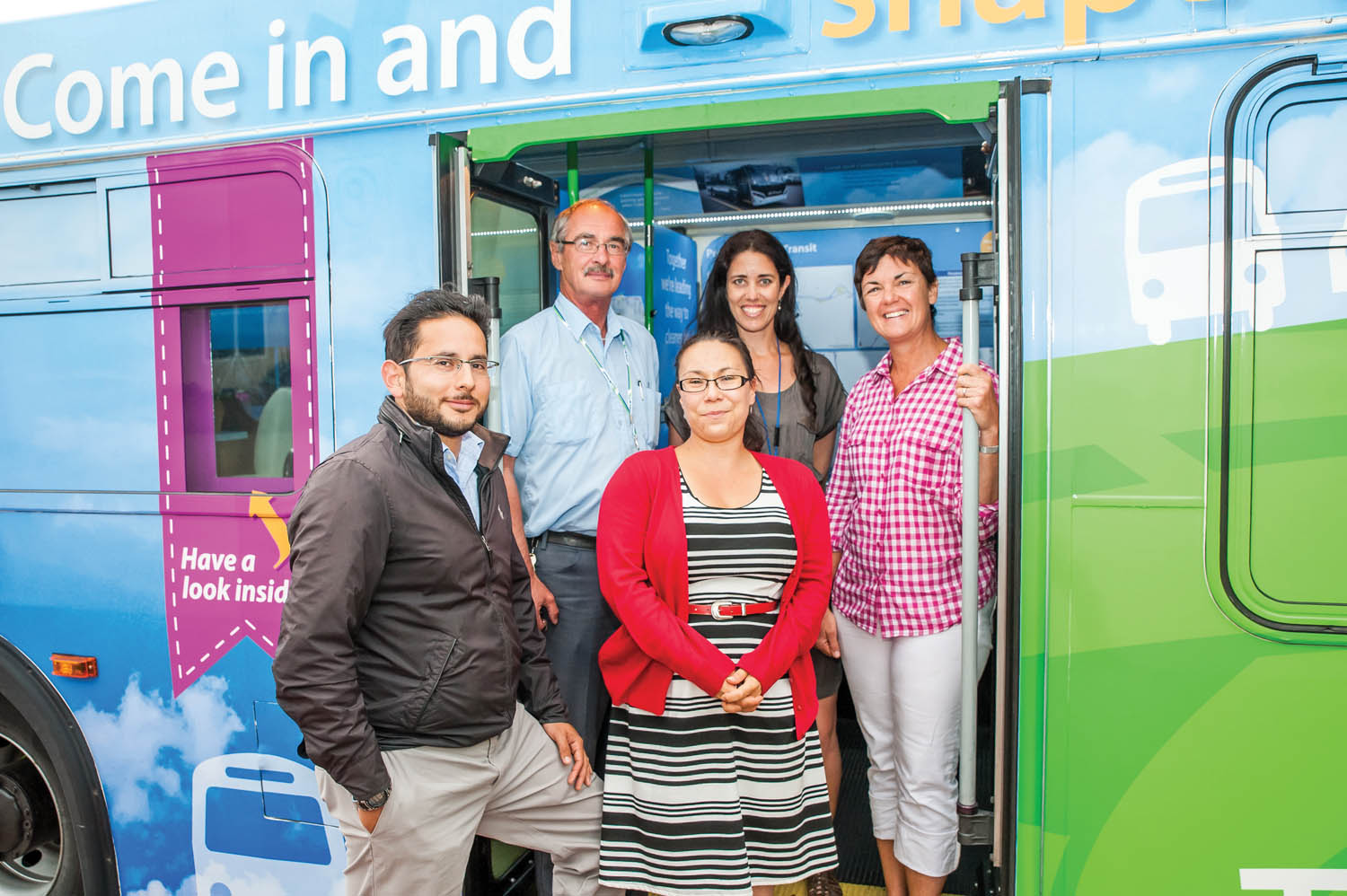
The BC Transit Future Bus team was in Osoyoos on July 23 to hear from local residents about their priorities for transit service. Front from left are Daniel Pizarro and Adriana McMullen, both of BC Transit. Behind from left are George Neil, the driver from Penticton Transit, Sarah Phillips and Maria Lockley. McMullen made a presentation to Town of Osoyoos council on Monday about big plans for BC Transit to increase ridership in Osoyoos and across the South Okanagan over the next 25 years. (Richard McGuire file photo)
The recent introduction of a private shuttle service between Osoyoos and Kelowna – and all communities in between – won’t deter plans for BC Transit to dramatically increase its ridership targets over the next 25 years in this region.
Adriana McMullen, transportation manager for BC Transit, informed Town of Osoyoos council about the organization’s Transit Future Plan for the next 25 years in the South Okanagan.
It’s a plan that forecasts a 10-fold increase in ridership from 45,000 to 450,000 annually for riders in Osoyoos, Oliver and Okanagan Falls to Penticton and an increase of riders from 450,000 to over 1.2 million from Penticton to Kelowna over the next 25 years, said McMullen.
The public transit system will continue to grow across the Okanagan Valley and other parts of B.C. despite increased competition from private companies like Let’s Go Transportation, which recently started a daily shuttle service between Osoyoos and Kelowna International Airport – and all towns in between – a couple of months ago, said McMullen.
With an aging demographic in most communities across the Okanagan Valley, BC Transit management has determined there will be a growing need for public transit service across this region, she said.
“A lot of people who may not be interested in transit services now … are going to be very interested in the future,” said McMullen, noting the aging population base of many communities in the South Okanagan.
“When asked how they foresaw their transit needs in 25 years, 63 per cent of survey respondents expected to be using transit more frequently than two or three times per week,” she said. “There is also a strong desire for transit in communities that do not have local transit in towns like Oliver, Keremeos and Okanagan Falls.
“Timing connections, transfers and information between transit systems need to be improved.”
The ultimate goal is to increase ridership to 1.74 million annual transit trips in the South Okanagan by 2040.
The 25-year plan creates a vision for what the transit network will be like and describes what steps will need to be taken to achieve the vision, she said.
The future plan will also provide guides and prioritize future investment in the system, sets ridership targets, identifies key transit corridors the supporting local transit network and identifies the fleet, service hours and infrastructure that will be needed to support a rapidly growing transit network, she said.
A series of workshops, open houses and surveys held across the South Okanagan were used to gather information to begin long-term planning and future expansion of the system, she said.
The key issue identified by most respondents was to improve the inter-regional connections across the South Okanagan, with particular emphasis on allowing residents from small towns like Osoyoos to easily hook up with connections to Penticton and/or Kelowna, she said.
The best way to increase ridership in smaller communities like Osoyoos is guarantee easy and accessible transfers to larger cities like Penticton and Kelowna and expansion of service on existing routes while improving Sunday and evening service, she said.
BC Transit’s vision statement reads, “By the year 2040, transit in the Regional District of Okanagan-Similkameen connects people and communities locally, regionally, and inter-regionally through cost-effective, convenient, integrated, accessible and user-friendly services.”
To attain this goal, the transit system must be a viable alternative to using private vehicles by being convenient and reliable, accessible to everyone, comfortable, fast and direct and affordable, she said.
The transit future network would feature an integrated network of targeted transit services that would serve to link RDOS communities to one another and also connect to transit services in the central Okanagan region, said McMullen
“Service improvements will be ongoing as communities and ridership evolve,” she said. “This would feature the introduction of frequent transit to Penticton and integrating with existing local transit. It will also mean continued improvements to existing local transit to enable better access to frequent transit and targeted transit.”
Short term implementation of these goals will take place over the next five years, with medium term implementation taking place over the next decade and long-term implementation over 25 years.
Implementation is dependent upon availability of funding, community growth factors, phasing in of major projects, service demands and opportunities for value added partnerships.
Another goal has been to add two more round trips from Penticton to Kelowna from Monday to Friday and two additional mid-day round trips on Monday, Wednesday and Friday to connect with existing service in Osoyoos and Princeton and introduce three round trips per day on Saturday.
There is also a plan underway to increase service to two rounds trips per day from Monday to Friday in Osoyoos to allow connecting with mid-day Kelowna service from Penticton.
There’s also a plan to increase service to four round trips per day, Monday to Friday, to provide northbound and southbound commuters access to major employers in the Oliver area.
A complete final draft of the Transit Future Plan will be finished this fall and presented to the RDOS board for endorsement in early 2015, said McMullen.
Implementation plans will begin shortly after.
KEITH LACEY
Osoyoos Times