 If your child is burdened by anxiety, don’t fret; you’re not alone.
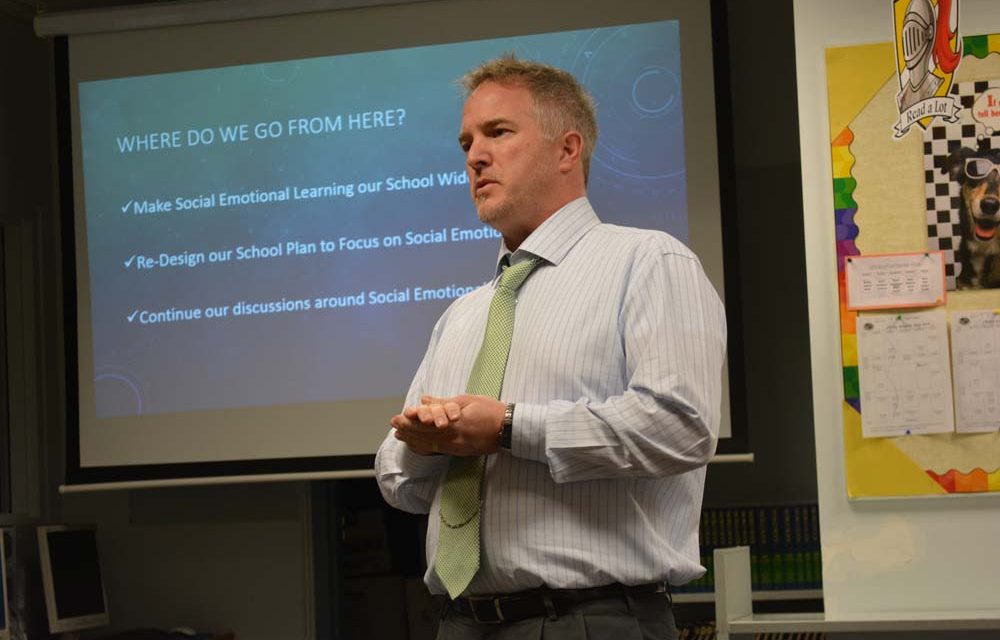
That was evident at last week’s learning forum at Oliver Elementary School, where educators spoke about social/emotional learning.
Three area schools presented what they are doing to address the growing problem of anxiety among children.
Tuc-el-Nuit principal Shendah Benoit said 10 to 20 per cent of Canadian children can’t manage their anxiety, which is interfering with their learning.
She noted that a Middle Years Development Instrument (MDI) survey indicated that 43 per cent of Grade 4 students at Tuc-el-Nuit have a low sense of well-being, while 38 per cent indicate they worry about things.
Benoit agrees with anxiety disorder expert Dr. Lynn Miller who says that without basic coping strategies, the emotional problems that kids face will compound. In fact, 70 per cent of children who do not learn how to manage their anxiety will be plagued with depression, Benoit said.
But staff at Tuc-el-Nuit are working on the problem by introducing programs such as MindUP, a “self-regulation” initiative founded by actress Goldie Hawn.
Behavioural support teacher Tuson Pearle said students who struggle with regulating themselves (focusing, setting goals and solving problems) are “just not going to learn in school.”
Social worker Pam Tiegen said a lot of children experience a lot of “transition” in their lives, but schools are implementing strategies that will hopefully protect these kids for the rest of their lives.
Tiegen said one of the most important things they teach students is to breathe when their emotions take over.
“We teach kids that when their emotions are relaxed, they think clearly.”
Tracy Harrington, vice-principal at Southern Okanagan Secondary, said their focus is trying to get students to feel connected at school. That is what staff have been working on during inquiry time, she pointed out.
Social/emotional surveys showed that some Grade 9 students were not as connected as staff thought.
Harrington indicated that some students feel like the school is not doing enough to discourage negative behaviour, while others feel that the school is supportive, welcoming and friendly.
Harrington teaches a grad transition class for Grade 12 students, who evaluate themselves and plan for the future.
“It’s very empowering to find out the great things the kids are doing that we don’t know about.”
She noted it was heartbreaking to hear a couple of students talk ill of themselves by saying they don’t do anything of value.
“We need to build their self-esteem.”
Harrington pointed out that the school hosts many clubs that keep students connected. They also have a “buddy system” that helps kids who don’t feel connected.
“They have to be connected or they’re like little lost souls,” she stated.
Barton Tumlinson, principal of Oliver Elementary, outlined the school’s focus on engaging pupils and giving them a sense of belonging.
“Our students plan all of our assemblies . . . I do nothing now (in that regard). They do a way better job than I do.”
Tumlinson said they also have various clubs and jobs that students love doing, such as salad bar helpers, office helpers and front door greeters.
“It’s weird, but our students are dying to pick up garbage. The kids just flock to it, and I don’t really understand why. I think they feel like they are making a difference.”
Tumlinson said a couple of students came to him asking if they could sell bracelets to raise money for new library books.
The principal pointed out a flyer that the school published for parents. It encourages them to support their children’s social/emotional learning.
Tumlinson shared his own experience of how he changed his family by cancelling their cable TV subscription. Everyone agreed there would be no “screen” time during the week – only on weekends.
Wow! What a difference after a year.
“We have so much more time as a family. Our house is clean, homework is done, we actually read and sign our childrens’ planner, we cook together, we talk more as a family . . .”
One parent/guardian at the forum said her little girl has anxiety and won’t get involved in anything.
“Her self-esteem is so low . . . she considers herself stupid.”
Tumlinson immediately urged the woman to talk to him about it and work towards a solution. He also encouraged parents to pick up the school’s new flyer.
Nicola MacNaughton, the district’s professional development chairperson, said a number of factors lead to anxiety among children, such as lack of sleep, too much screen time, not enough active play and poor nutrition (not enough fruits and vegetables.
Lyonel Doherty
Oliver Chronicle