By Lexi McFarlane, Tines Chronicle
The remuneration policy for Oliver Council will not be changed, following a brief discussion on the topic.
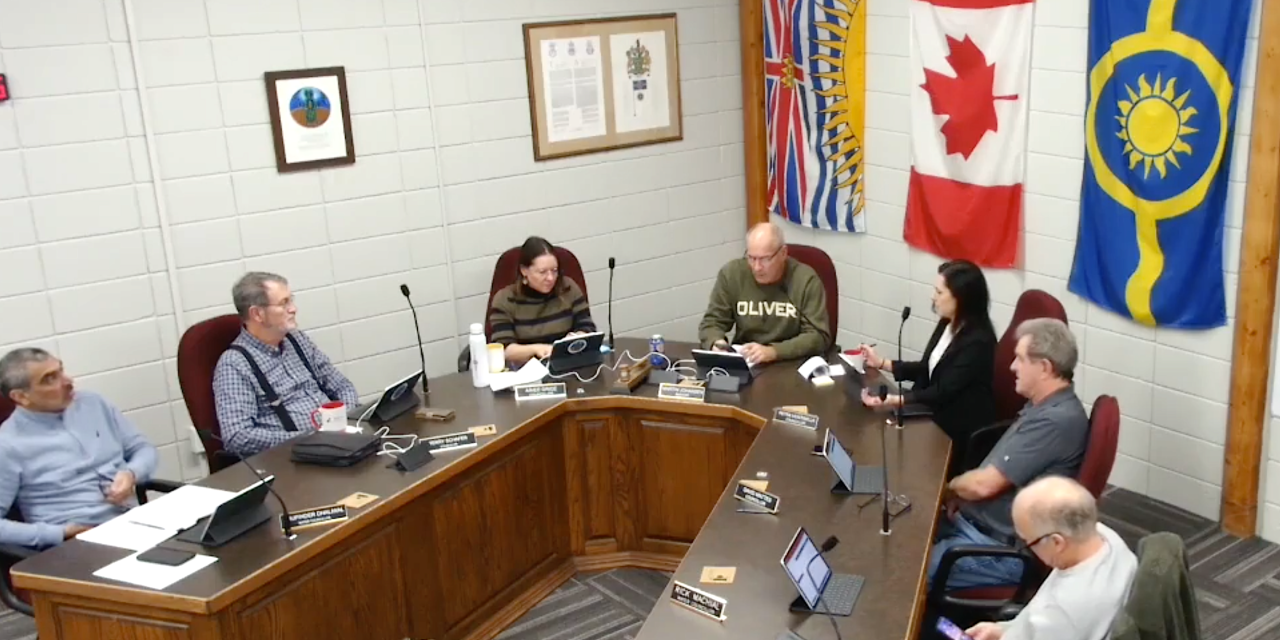
At the Committee of the Whole (CoW) meeting on Monday, Corporate Officer Rochelle Lougheed brought forward on behalf of Town staff, the active remuneration policy for review. The policy states that Council members’ remuneration is subject to increase every January 1, by the amount of the British Columbian Consumer Price Index (CPI), or inflation measurement.
The policy also includes a provision that it must be brought for review during the last year of a given Council term, which led to its presentation on Monday, given that this is the last year of the current Council term.
Previously, in 2022, a task force was proposed to address the remuneration topic, and outreach began in January. After not being able to find enough people to constitute a task force, the idea was abandoned in April of that year, and the policy remained the same.
As of 2025, the Mayor of Oliver, currently Martin Johansen, earns $34,789, while the four Councillors (Aimee Grice, Petra Veintimilla, Terry Schafer, David Mattes) earned $18,554, and the two Water Councillors (Rick Machial and Bhupinder Dhaliwal) earned $6,957 in annual remuneration.
Included in the same category as remuneration are policies for Council equipment and travel expenses that can be covered by the Town of Oliver.
The equipment policy provides an iPad for business use for each Council member during the term, in addition to a business smartphone for the Mayor. Upon departing Council for the final time, Council members are given the option to purchase them “at fair market value as determined by the Chief Financial Officer”.
The financial policy follows the guidelines of the Canada Revenue Agency, as they recommend for reimbursable expenses such as meals and travel. The guidelines restrict travel reimbursement to working days only, have specific maximums set for meal “per diems”, and cover lodging costs at the “conference rates”.
The equipment policy was one that Veintimilla wondered if the language could be edited, so as not to limit options for tablets and laptops.
“There’s been conversation around the table about what works best for different people,” Veintimilla said. “[For example], I’m an Apple user, and don’t know how to use (another) tablet. Another expressed his dislike of Apple to the core – no pun intended – and wishes he had another tablet. Someone else mentioned a laptop.
“Does everybody have to be on the same device?”
Mattes was steadfast in the belief that the way the remuneration policy is set currently is the way it should be.
“This policy was brought in specifically to take it out of the hands of Council,” Mattes said. “There used to be a discussion exactly around this… That’s why the policy was developed the way that it is; here’s the baseline, and we’ll go up by CPI every year.”
Machial echoed Mattes’s perspective, pointing to the types of people who may only want the job for money.
“There’s a danger when you start increasing it too much, and you get the people who might not want to help the community, but want that wage,” Machial said. “That’s a real danger. I look at those numbers, and I think we’re well-paid.”
Grice, chairing the CoW meeting, gave a reminder that, while they didn’t want an Oliver Council job to be all about the money, it isn’t just all about showing up and heading out either.
“We want to think about who we want to attract to this table for the next term,” Grice explained. “If it’s only people who have the time and don’t need the money, that’s a concern as well. We don’t just want people who are retired, or independently wealthy. It’s a public service.”
A motion, moved by Mattes and seconded by Machial, was made to leave the remuneration policy exactly the way it is. The motion passed on a 4-3 vote, with Schafer and Dhaliwal joining Mattes and Machial in favour.