By Lexi McFarlane, Times Chronicle
Oliver’s domestic and irrigation water systems will be split, yet still one within the budget, as council held a lengthy and at times somewhat fractious discussion on changing financial reporting around the two water systems with the hope it will lead to new sources of grant funding.
With both the domestic and irrigation systems requiring major upgrades in the coming years – $79 million for the canal system alone – Mayor Martin Johansen urged Council to accept that things had to be done in different manner moving forward as the traditional way – applying for grant funding and continuously raising rates to build reserves – is not sustainable.
The decision was reached during the April 27 Committee of the Whole (CoW) meeting. Wayne Anderson, the Town’s Chief Administrative Officer, noted that Oliver’s financial reporting has combined both domestic and irrigation water systems since the Town inherited irrigation services in 1991.
Through that 1991 amalgamation process, the Town of Oliver inherited 1,000 former South Okanagan Lands and Irrigation District (SOLID) accounts, with about 600 of them being for irrigation. Today, in addition to the 600 irrigation profiles, the Town manages about 2,400 residential profiles and 175 commercial accounts.
The estimated total value of all of the Town’s water assets is over $450 million, with over $256 million of that being the worth of the irrigation system. Anderson noted that it is the largest irrigation system that any municipality in British Columbia is responsible for.
A major motivating factor in separating the reporting is to be able to better identify the different amounts of funding needed between domestic and irrigation water, and to potentially secure more provincial and federal funding. The water system as a whole in Oliver, Anderson said, will need a significant amount of major upgrades in the near future, which will be significant cost-wise even when done piece by piece.
“The cost to replace even a kilometre of pipe for domestic water users, or a kilometre of the canal, could be anywhere from one million to ten million dollars,” Anderson said.
Most of the costs centre around replacing Asbestos Cement (AC) pipes in the water systems that are at the end of their life spans. This is especially the case for irrigation, where 88 per cent of all pipes currently are AC pipes. A further 37 per cent of domestic systems are comprised of the AC piping requiring replacement.
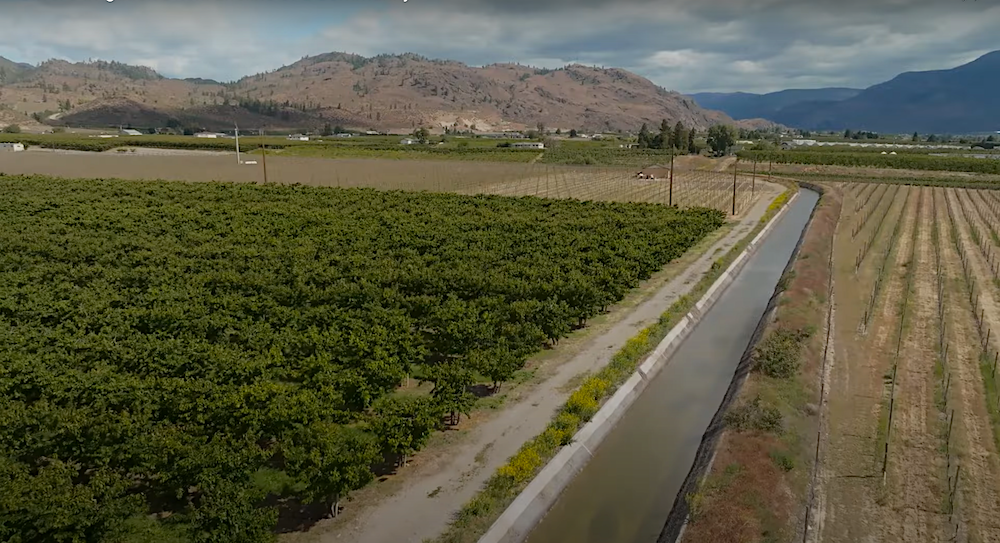
Upgrades to the canal system, which is also maintained and upgraded by the Town, will require $79 million investment in the coming years. This, combined with the large domestic water system stretching municipal reserves thin, and irrigation systems having to be funded through debt, are why provincial and federal funding are necessary.
Anderson did allude to how both those levels of government are seeing the importance of agriculture in the South Okanagan to the economy.
“The question is, do we have a case when reaching out to the provincial and federal government for funding, and the short answer is yes,” Anderson said, going on to reference Mayor Martin Johansen’s recent discussions with the BC government.
“The discussion that the Mayor had in Victoria has opened the eyes of the provincial representatives, and the Prime Minister recognized recently that the local agriculture industry is a source of ‘Made in Canada’ products.”
The proposed split in financial reporting would be able to better cover things such as the ratio of funding coming from irrigation users versus domestic users. Prior to amalgamation, irrigation users paid eight times more than domestic users, a figure that in 2026 has gone down to 5.4 times more.
At the same time, there would still just be one water fund to cover all costs associated with upgrades of the systems, regardless of domestic or irrigation designation.
Water Councillor Rick Machial nevertheless voiced significant concern that these changes would disproportionately affect irrigation users who are already burdened with rising costs of doing business.
“The Town of Oliver is the rural area, as far as income generation,” Machial said. “We’re the Wine Capital of Canada… The economic driver of this area is the hundred-plus million dollars that comes from the rural areas.
“I’m really fearful that this is the first step in separating (rural and urban), and we’re going to have major increases in water rates if we do this.”
Machial also was skeptical of the ability for separate reporting to bring in more grant funding.
“I didn’t see anything in this report that would lead me to believe we have more access to grant funding if we separate the (reporting)… We can have all the same numbers be generated, without separating.”
Something Anderson also pointed out in his presentation was the Town of Osoyoos previously looking into splitting financial reporting. As Councillor David Mattes explained, however, different motives were at play there.
“We’re in kind of the opposite situation of Osoyoos,” Mattes said. “The Water Councillors asked for the separation down there because the domestic system was faced with a $40 million bill… and the agricultural people in Osoyoos said ‘we really don’t want to be involved’. That’s why they separated; it isn’t because they needed separate bookkeeping.”
Mattes supported separate bookkeeping, so long as yearly budgeting continued to be done as an amalgamated profile.
“I see the benefit of keeping separate ledgers, so that when we do apply for grants, the data is available to support either a domestic grant or an agricultural grant. I do see the benefit of seeing it in a quarterly basis potentially… But when it comes to the budget at the end of the year, it should be amalgamated as it is today.”
Councillor Aimee Grice concurred that it would only be worth separating information, not anything else to do with the water systems.
“I’m not looking at receiving these quarterly reports out of fear,” Grice said. “If we’re trying to get some money from upper levels of government, it’s going to be important that we’re able to present a firm case, and we need those numbers to present that case.
“I’m not looking at separating the systems by any means. But I am looking at having the information that’s required, so that we can fund what we need from the Province or the (Federal government).”
Water Councillor Bhupinder Dhaliwal questioned if the ultimate focus of the Town should be to find additional consistent revenue streams, rather than relying on provincial grants.
“We have a lot of data available that should be sufficient to provide for grant purposes; the focus should be on how to access provincial and federal water funds, and be persistent,” Dhaliwal said.
“That’s an angle we have to take, we got to see what we can get for (our) special, unique situation; (like with) food security – the provincial government talks about food security all the time. We’re number one in vineyards and tree fruit. There’s infrastructure funds that are available for communities to build on aging infrastructure. Grants are tailored for all of BC.”
This led to an additional grievance from Machial, as it pertains to “policy shifts”.
“Council sets policies, as far as I’m concerned. And staff is there to enact those policies. I’m seeing too many things coming from staff that bothers me, because these are policies. This is a policy shift. We shouldn’t be debating with staff – we should be debating amongst ourselves.”
Johansen took the impassioned stance that the way things have traditionally been done is simply not as feasible in the present day as it may have been previously, and did not mince words.
“Grant funding isn’t going to get us out of this fix that we’re in, and clearly, talking to the Ministers, ‘demonstrated need’ is something that we have to (include),” Johansen stated. “The writing’s on the wall that this is not sustainable. We looked at our budget last year, and we’re raising rates. We can’t continue to raise rates 10 per cent, 20 per cent, 30 per cent to try and get the money into our reserves.
“If we continue to hang on to the way we’ve been managing this asset, we’re doing a disservice to the people in the South Okanagan. We need to be able to say ‘we have a problem here, and we can demonstrate that we have a problem here’… We can continue to sit here and put our head in the sand, but we have a problem. And we’ve got to start doing something about it.”
Holding up the ultimate vote was how the proposed motion was worded. After Johansen tried to move the motion as it was offered, Mattes determined that it would have a different result than what the intention ultimately was of Council.
“This motion says ‘and annual water budgets that show separate accounting’,” Mattes explained. “It is the budget that is going to show separate accounting, according to this motion… The reports can be separate. But the budget should be one.”
Mattes proposed a friendly amendment to the motion, which caused significant discussion, and required an answer from John Kurvink, Chief Financial Officer on two separate occasions. Kurvink specified, through his responses, that while the budget would have “separate columns” on the water side, the budget would still be as one.
Eventually, it was agreed upon by Council that the specific text of the motion alluding to “budgets” in the plural would have to be amended as Mattes proposed. With the motion updated to make mentions of the annual budget singular, and specify reporting an additional time, it was passed unanimously by Council.