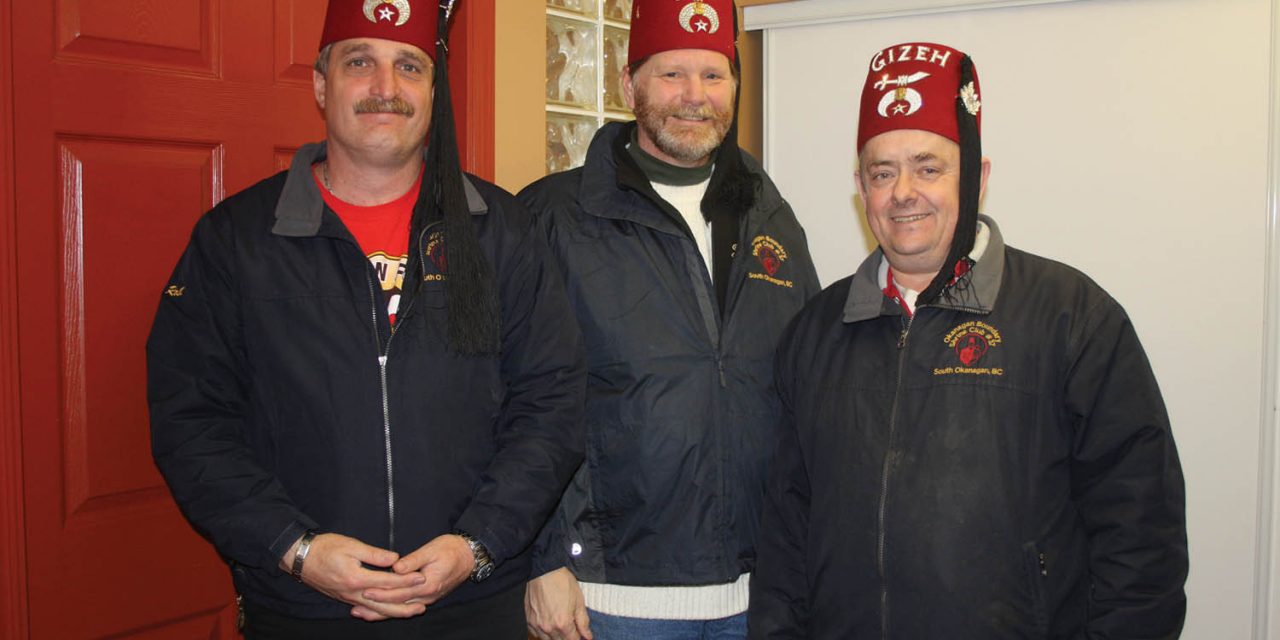

Ray Verbann (far left) is the past president of the Okanagan Boundary Shriners Club, while Peter Beushkens (centre) is the secretary and Trevor Long is current president. The club has been doing good work in Osoyoos and across the South Okanagan since 1971 and is looking to recruit new members. The club is also the game sponsor for Friday’s home game between the Osoyoos Coyotes and Beaver Valley Nitehawks. (Keith Lacey photo)
A community organization that has been raising money to assist worthy causes in Osoyoos and across the South Okanagan for more than 40 years is looking for new members.
The Okanagan Boundary Shriners Club was first formed in this region way back in 1971 and has been doing good work in Okanagan Falls, Oliver and Osoyoos ever since, said current club president Trevor Long.
The club’s regiona headquarters is the Masonic Lodge located in Oliver.
“Our membership basically runs south of Penticton, even though we have a couple of members from Penticton,” said Long. “Even though we have been around as long as we have, there are far too many people who don’t know we exist and don’t know what we do.”
Shriners are members of the Masonic Order and all members must adhere to the principles of Freemasonry, which includes brotherly love, relief and truth and indulging in the spirit of philanthropy to help your neighbours and community at large, said Long.
Freemasonry dates back hundreds of years to when stonemasons and other craftsmen worked together on building projects and would gather in shelter houses and lodges.
Through the years, these gatherings changed in many ways until formal Masonic lodges emerged, with members bound together not by trade, but their own wishes to be fraternal brothers, said Peter Bueshkens, an Osoyoos resident who is secretary of the Okanagan Boundary Shriners Club.
“You have to be a freemason to become a shriner,” he said. “The simple goal of freemasons is to make the world a better place.”
There are more than 400,000 Shriners in North America and they share the common goal of enjoying philanthropic community work, said Rob Verbann, past president of the club.
The first Shriners temple was organized by a small group of 13 freemasons in New York City back in 1872.
The most noticeable symbol of being a Shriner is the distinctive red fez that all members wear at official functions, he said.
The biggest claim to fame of the Shriners is their support of 22 Shriners Hospitals across North America, including the only one in Canada in Montreal.
Throughout its long history, Shriners of North America have always been involved in charitable endeavours and in the early 1920s, the membership decided to develop and support an official philanthropy, said Long.
They fulfilled this mission by establishing Shriners Hospitals for Children.
They assist tens of thousands of children across North America and around the world suffering from serious burn injuries, birth defects and other physical ailments, he said.
“There are 22 Shriners hospitals for children that provide expert, specialized care to children under the age of 18 with orthopedic conditions, burns, spinal cord injuries, cleft lip and palate and other conditions,” he said. “All services are provided at no charge.”
Shriners have assisted more than 800,000 children across North American over the last 90 years and millions more have benefitted as recipients of treatments and techniques developed by physicians who work at Shriners hospitals.
This Friday evening, the club is the official game night sponsor of the hockey game between the Osoyoos Coyotes and Beaver Valley Nitehawks at the Sun Bowl Arena.
The first 50 women to enter the arena will receive roses and numerous gift packages will be handed out to those in attendance during a draw during the second intermission. There will be a shootout involving young minor hockey players during the first intermission.
Anyone wanting more information about becoming a Shriner can talk to any club member at Friday’s game or Google Okanagan Masonic Family.
All proceeds will go towards assisting children from this region, said Long.
KEITH LACEY
Osoyoos Times