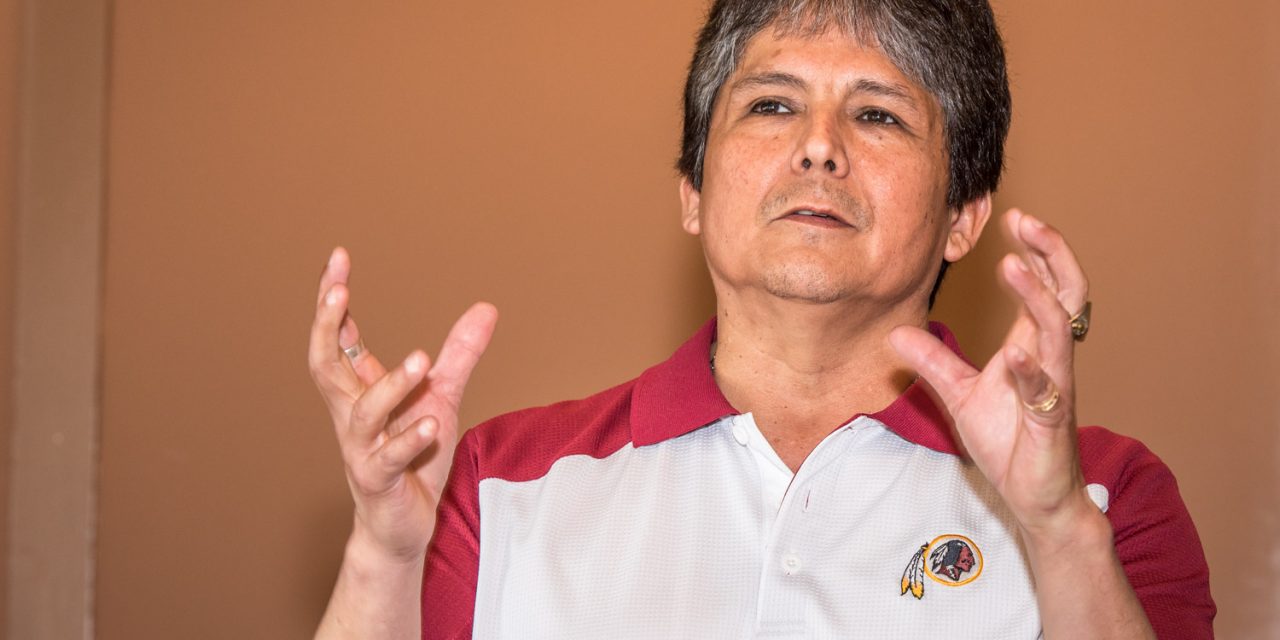
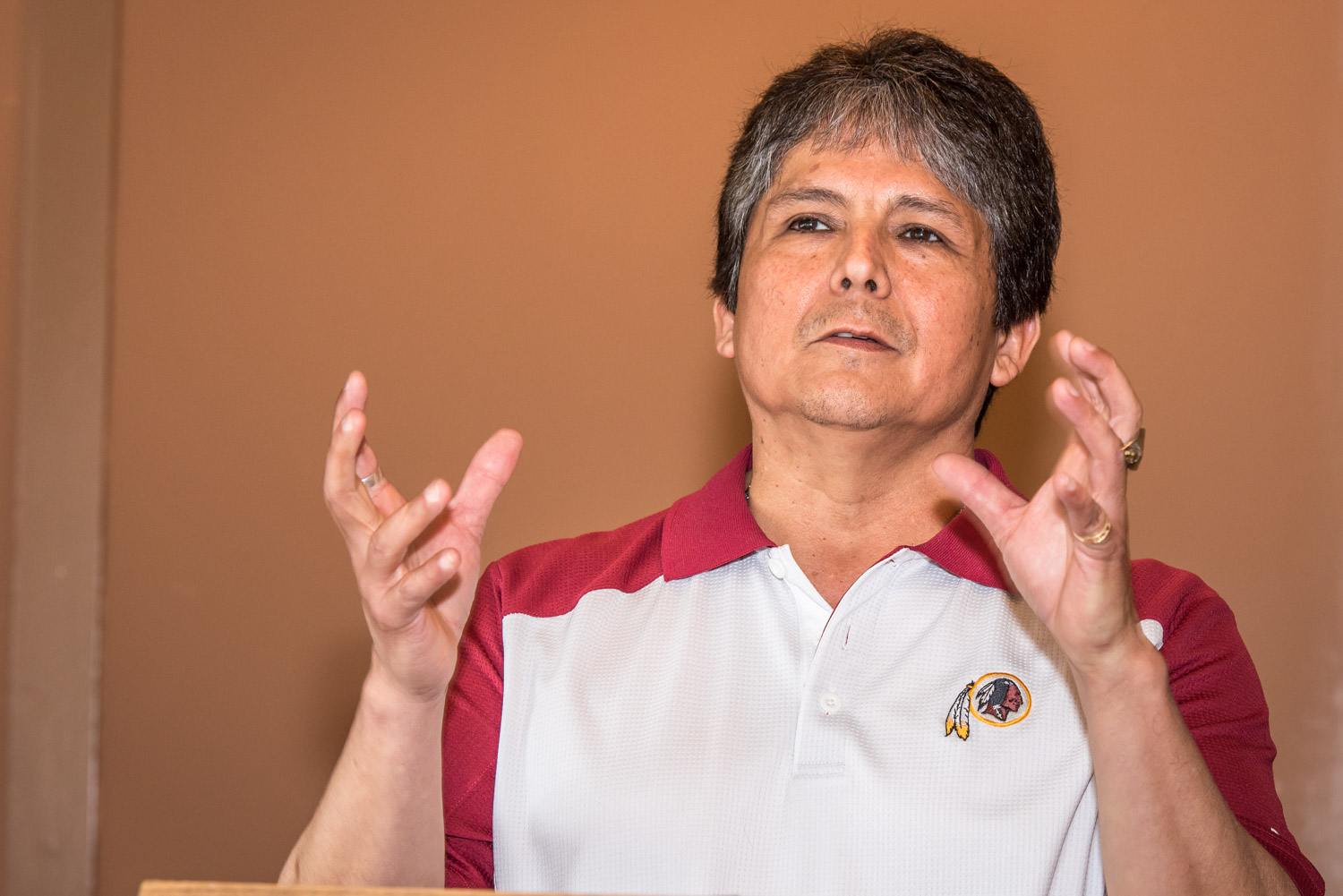
Osoyoos Indian Band Chief Clarence Louie had some strong and candid views about relations between aboriginal and non-aboriginal people that he expressed last week in the speech to the Rotary Club of Osoyoos. (Richard McGuire photo)
If residents of Osoyoos aren’t happy that the name of Haynes Point Provincial Park will soon be changed to an aboriginal name, they can “suck it up,” says Chief Clarence Louie of the Osoyoos Indian Band (OIB).
Louie was guest speaker last Thursday at the Rotary Club of Osoyoos where he delivered a speech of more than 40 minutes, mostly about the injustices First Nations people have experienced from non-natives since the time of colonization.
“To non-native people, Haynes might be a hero, but to us he’s a land thief,” Louie said, referring to John Carmichael Haynes, the judge, customs officer and rancher after whom the point and provincial park are named.
“He stole 4,000 acres of our most prime acreage, all our bottomland from the head of Osoyoos Lake to north of Oliver,” said Louie. “That’s a historical fact.
“We’re changing the name of Haynes Point and I know the majority of Osoyoos residents ain’t going to like it. That’s fine. There’s a lot of things that you, that people did to us that we didn’t like, but we had to suck it up. So when the time comes and the media interviews me about the non-natives not liking the name changes, well you know what, suck it up.”
Louie made the comments at the end of a more general talk about the history of native and non-native relations in North America.
In February, the province and the OIB announced an agreement that will see the OIB manage Haynes Point and Okanagan Falls provincial parks and rename both parks and McIntyre Bluff to traditional nsyilxcen (Okanagan) place names.
The agreement followed the discovery last year of bones buried at Haynes Point that were radiocarbon dated to about 1,224 years old – proving that they belonged to a First Nations ancestor.
Louie said the provincial government wanted the OIB “to be good little Indians” and dig the bones up and bury them on the reserve. He asked a provincial cabinet minister when graves of non-natives no longer mattered.
“I told him we’re not going to move those bones,” Louie said.
“We could do what happened in Ipperwash,” he said, referring to a 1995 violent confrontation at a provincial park in Ontario when police killed an unarmed native protestor.
“I told the government your armies don’t scare us, your RCMP don’t scare us, your SWAT teams don’t scare us, because if you want to have a battle like they did at Ipperwash, we could have the same battle here at Haynes Point because we wouldn’t even have to make phone calls. If a standoff is going to occur, there’d be natives from Ontario with us over there.”
When Louie finished his speech, he quickly left, skipping lunch, for a band council meeting, only taking one question from Town of Osoyoos councillor Jim King about the proposed Area 27 car racetrack.
Rotarians and guests were left discussing his comments among themselves, some reacting positively and some negatively.
When club president Judy Miller-Bennett thanked him, she told Louie: “You only speak from your heart and you told us something today that I think we all needed to hear, so I really appreciate it.”
When the “happy bucks” time came in the meeting, however, and Rotarians put a dollar into a fund and tell of something that makes them happy, one club member joked: “I’m happy that I held my tongue.”
Louie began his talk by praising the first item in the Rotary Club’s ethical Four-Way Test: “Is it the truth?”
“You can be entitled to your own opinion, but you’re not entitled to your own facts,” he said.
Among the “facts” he emphasized was that government doesn’t give things to native people. Rather, they are forced by their own court system to recognize the treaty rights of First Nations.
Government agencies, he said, talk about stakeholders.
“I tell government if there’s ever a stakeholders meeting, whether it’s provincially or federally, don’t invite the Osoyoos Indian Band,” said Louie. “We’re rights holders, not stakeholders.”
Louie participated in the singing of O Canada at the start of the meeting, but he told Rotarians during his talk that it made him uncomfortable.
“I can sit here and sing O Canada, but at the same time I think, ‘Where’s the truth in this?’” Louie said referring to unsettled land claims. “There’s some unfinished truth that Rotary and all the stakeholder groups have to understand and have to admit. As a native person, I shake my head and bite my tongue a little bit when I sing O Canada because I’ve spent over 30 years researching and being involved in the trenches on the relationships between native people and non-native people on both sides of the border.”
Pointing to the Canadian and American flags at the front of the room, Louie argued that what they represent comes from overseas, from kings and queens.
“The Okanagan people, we’re a cross-border tribe like the Mohawk people and the Blackfoot people and all the First Nations along the 49th Parallel,” said Louie. “That was an arbitrary line. There’s no rhyme or reason to it. It goes back to this kings and queens stuff and most people don’t study the history of those flags. Being a cross-border tribe, those two flags cut our people in half.”
Louie said he keeps a quote on his desk from Canada’s first prime minister, Sir John A. Macdonald, calling for assimilation of native people.
The first U.S. president, George Washington, he said, only wanted two things from Indians – peace and their land.
The original treaties, he said, were intended to be a business relationship, “not a dependency relationship, which the government and settlers turned it into.”
He dismissed the idea of some people that talk of these treaties should be relegated to history, adding that non-natives don’t consider the establishment of “the imaginary line” of the 49th parallel to be “old history.”
Despite the mistreatment of native people, the highest rate of volunteers to fight for Canada and the U.S. during wars has come from native people, Louie said.
The Canadian government will be taking Louie to Europe on a speaking tour and he said he plans to visit the grave of an OIB volunteer, Ernest Baptiste, who was killed in northern Italy in 1944.
Responding to the only question he took, on the Area 27 car racing track, Louie said that there wasn’t unanimous support among the band for it, but he supports it because it will bring more money to the area than its previous use as a corn field.
“I want millionaires hanging around,” he said. “The type of people that will come to this track, they’ve obviously got some money to leave in Oliver and Osoyoos, both on the rez and off the rez.”
RICHARD McGUIRE
Osoyoos Times
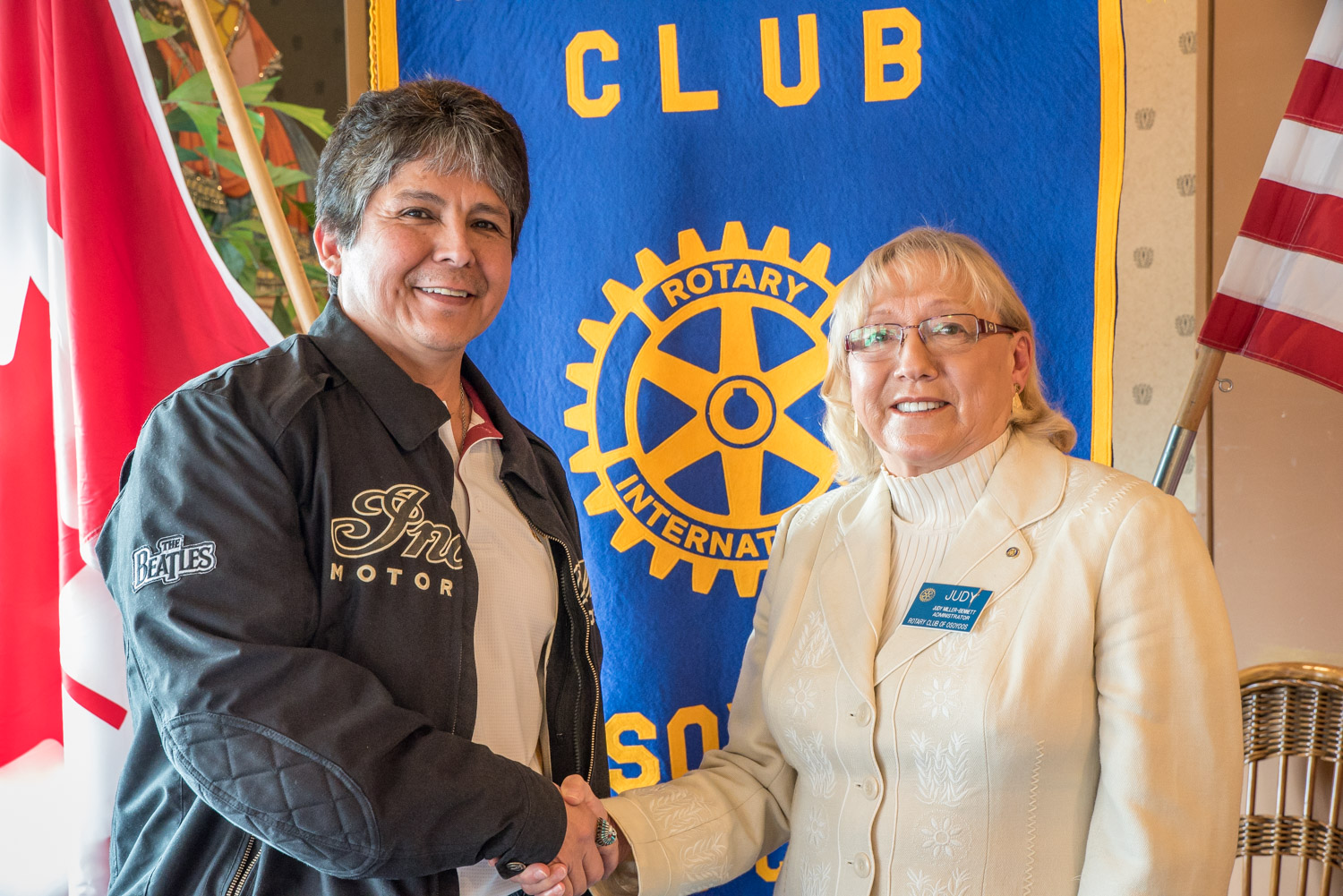
Osoyoos Indian Band Chief Clarence Louie had some strong and candid views about relations between aboriginal and non-aboriginal people that he expressed last week in the speech to the Rotary Club of Osoyoos. He was thanked by club president Judy Miller-Bennett, who said his comments were ones that needed to be heard. (Richard McGuire photo)