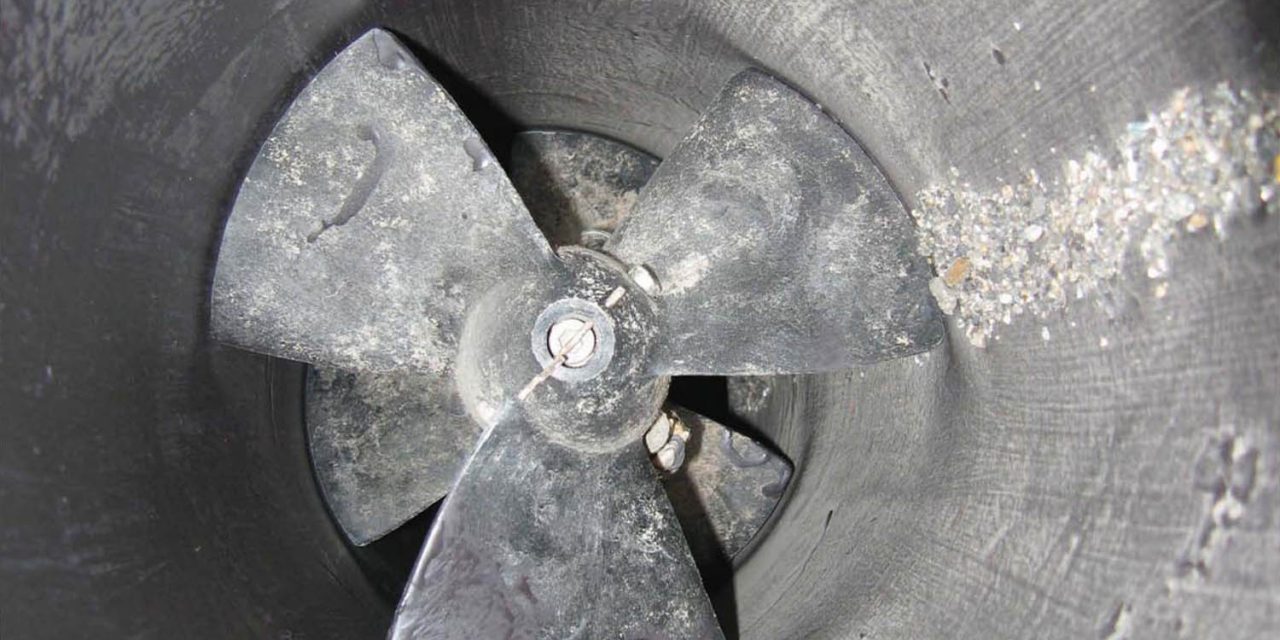
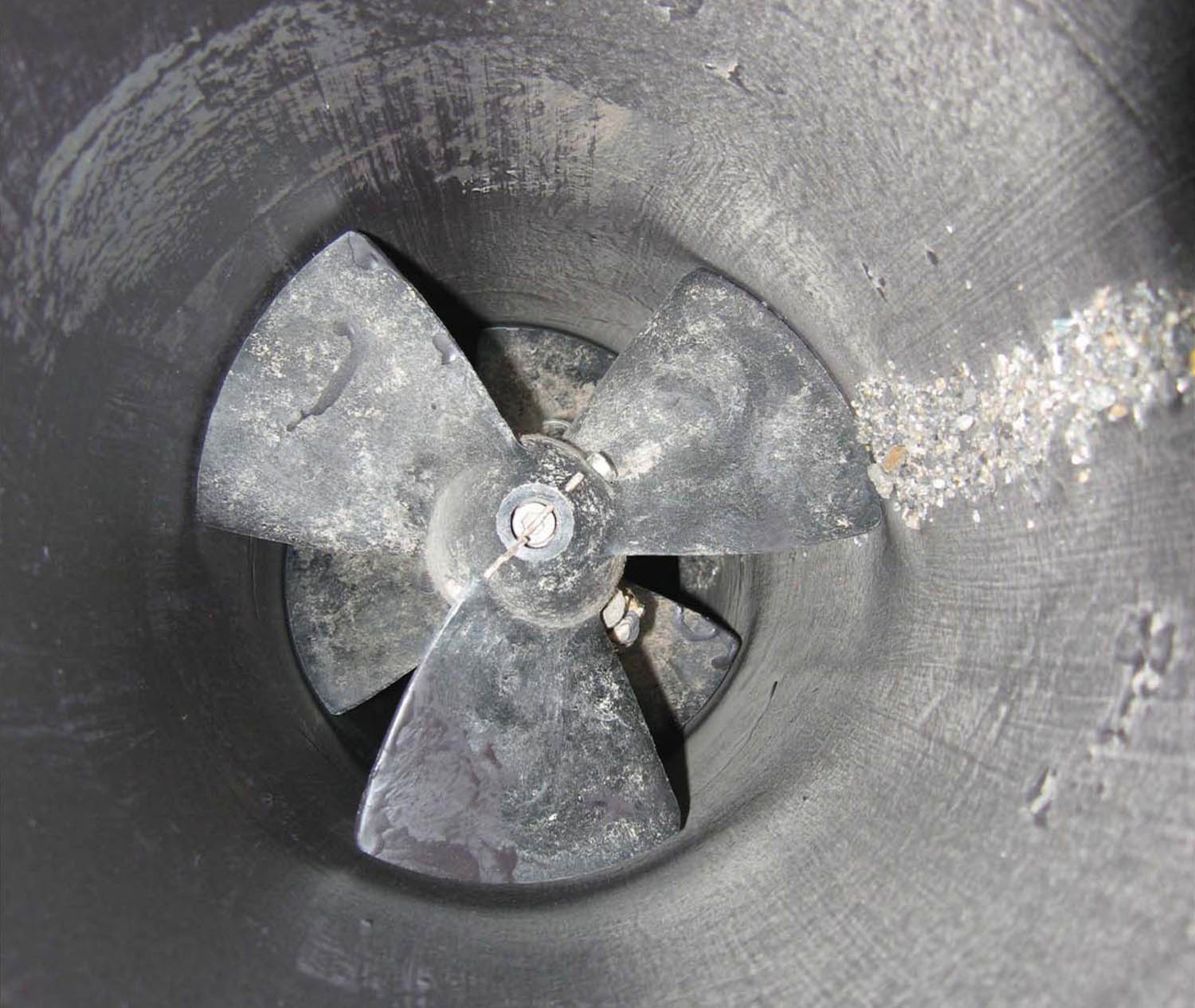
A photo of the boat’s propulsion system taken by a CBSA border services officer shows quagga mussels to the right of the blade. These weren’t found when the boat was inspected in Idaho. (Canada Border Services Agency)
When a boat contaminated with invasive quagga mussels crossed into B.C. at Osoyoos in March, border officials told the province they had no legislative authority to detain it or send it back to the United States.
That information is contained in provincial government documents made public last week that show neither federal nor provincial officials were fully prepared to handle such a situation.
The 44-foot boat remained at the border overnight, not because quagga mussels were found on it, but because the load was wide and there was no pilot vehicle to escort it beyond the border until the next morning, the documents say.
Meanwhile, officials from the B.C. Conservation Officer Service (COS) and the Ministry of Environment’s lead aquatic invasive species specialist, Matthias Herborg, argued in a March 13 conference call about whether to turn the boat back to Washington or allow it to come into B.C. for decontamination.
Sgt. Jim Beck, field supervisor with the COS in Penticton, argued the government should not risk allowing the boat into B.C. and that “the optics of this was that the province was not taking the issue of mussels seriously enough and we should not be making concessions.”
Herborg argued that the risk was negligible and he wanted to work with the boat hauling industry.
“He was concerned that if we did not work with them that there would be problems with co-operation in the future,” wrote Conservation Officer Bob Hamilton in a report on the discussions. “This (commercial) hauler stated that his company brings about 400 vessels a year into B.C.”
In the end, Herborg’s argument prevailed and the boat was allowed into B.C. for decontamination at Kelowna.
The report was contained in a package of redacted documents released by the provincial government in response to a freedom of information request filed by the Penticton Western News.
As it turned out, the boat had been out of the water long enough that the quagga mussels were dead, the driver was co-operative and the boat was decontaminated in Kelowna before being allowed into Okanagan Lake.
The boat was being transported by a commercial hauler, Cardinal Boat Movers Inc., based in Delta, B.C., to a new owner in B.C.
It had been used in Arizona for the previous two years. The government has censored the name of the lake it came from, but Lake Mead, Lake Havasu and several waterways in central Arizona are known to be contaminated.
The boat was inspected in Idaho and the driver was given an inspection certificate showing it was clean even though mussels were encrusted on its bow thrusters and propeller shaft mount.
Idaho officials notified Herborg on Wednesday, March 12 that the boat was coming as part of Idaho Department of Transport’s standard procedures.
When the boat arrived at the Osoyoos border crossing around 6:15 p.m., staff of the Canada Border Services Agency (CBSA) observed mussel shells on the boat.
Aaron Lane, a CBSA border services officer, contacted COS officials and provided details and photos showing the mussels.
In a timeline of the incident prepared by Herborg, he acknowledges: “There is no federal legislation that allows for the boat to be stopped at the border and sent back to the United States.”
Lane told Conservation Officer Jeff Hanratty that he did not believe he had authority to deny entry because CBSA cannot enforce provincial legislation which prohibits the transportation of invasive species. It can only enforce federal legislation, which currently lacks regulations to deal with invasive mussels.
The federal Department of Fisheries and Oceans (DFO) has been working for years on regulations that would give CBSA officials the power to detain boats carrying invasive mussels, but DFO hasn’t given details on when these regulations will come into effect.
In an email exchange at the end of March, Herborg asked Lane if he could use the incident as an example to deliver training to CBSA officials.
“Since I have heard someone mention that you might have been reprimanded for these actions, I wanted to check first,” Herborg wrote to Lane.
He also asked that if Lane “got into trouble” if there was “anything we can do on the provincial side to express our gratitude towards your actions.”
Lane wrote back to say he would not be reprimanded because everything he did was according to law and policy.
“I have subsequently found CBSA’s (standard operating procedures) that outline what to do if zebra mussels are found and they clearly direct me to contact provincial authorities.”
When provincial authorities were told the CBSA had no power to detain or refuse entry to the boat, Sgt. Beck argued all that was needed was to communicate with the driver that “if he continued into B.C. he would be in violation of the Wildlife Act for possessing or transporting mussels and his vessel could be seized and there were fines up to $100,000 and that should be effective in keeping the vessel and hence the threat out of B.C.”
While the incident showed authorities were unprepared, the documents also suggest that actions were taken afterwards to address gaps in the system.
Herborg initiated training for CBSA officers about provincial legislation and pending federal legislation around mussels. He also agreed to follow up with commercial boat haulers to inform them about the laws.
“This was the first time we dealt with a boat at the border,” said Herborg in an email to his provincial colleagues in which he said he was pleased with how well communication worked.
Herborg also said he would “explore potential to restrict the number of border crossings and times boats can enter B.C. to reduce the number of locations we need to monitor.”
RICHARD McGUIRE
Osoyoos Times