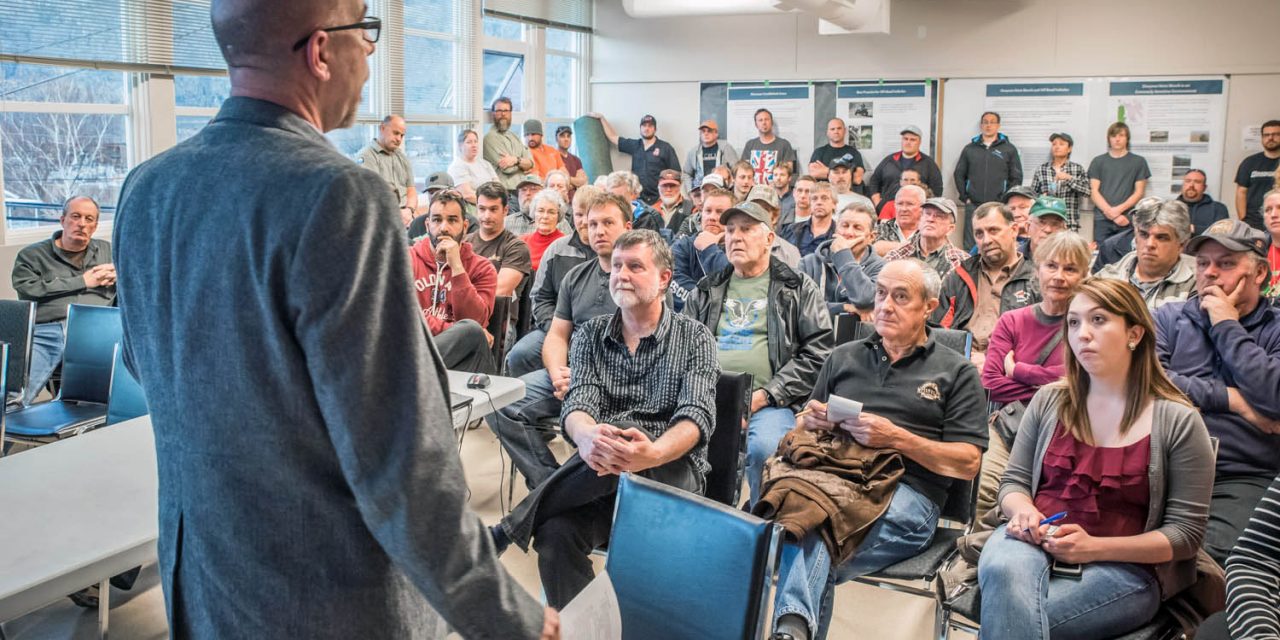
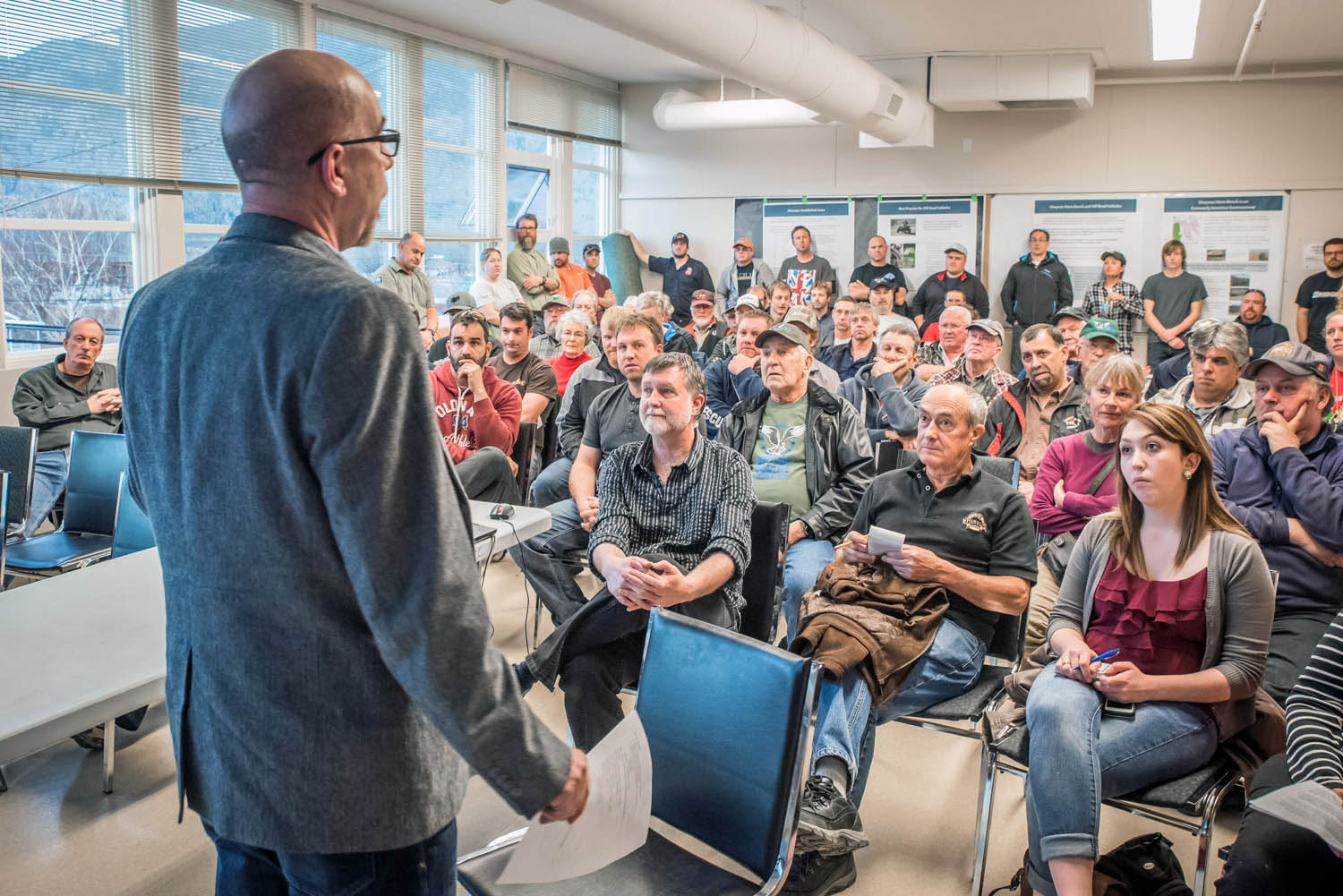
Grant Furness of the Ministry of Forests, Lands and Natural Resource Operations spoke to an audience of about 50 people Wednesday evening about the challenges to the environment posed by off-road vehicles on the Osoyoos West Bench. Many in the audience had their backs up, suspecting a government agenda to close areas they use for recreation, but Furness insisted he was just there to seek input. (Richard McGuire photo)
Discussions between the provincial government and off-road vehicle users got off to a shaky start last week at public forums in Osoyoos and Oliver.
The forums were intended to begin a dialogue about the environmental impact of off-roading on ecologically sensitive areas of the Osoyoos West Bench and Oliver Mountain.
About 50 people turned out last Wednesday at the Sonora Community Centre in Osoyoos where they listened to a presentation by Grant Furness, a biologist with the Ministry of Forest, Lands and Natural Resource Operations (FLNRO).
A similar number attended a meeting at the Elks Hall in Oliver the following night that also discussed developing a designated off-road area at Sawmill (Burnell) Lake west of Oliver.
Most attending the Osoyoos meeting were users of various types of off-road vehicles, but a few environmentalists also attended to listen without entering the discussion.
As Furness ran through a PowerPoint presentation discussing the history of the Okanagan-Shuswap Land and Resource Management Plan (OSLRMP), and efforts in the past 15 years to find a suitable motocross area near Oliver, some of the off-road vehicle users voiced concern that the government’s real aim is to close down the trails and roads they like to ride on.
They accused the government of moving forward to shut off their access to these areas without any prior consultation.
As more and more all-terrain vehicle (ATV) users interrupted the presentation to ask questions about what areas they will be allowed to use, Furness insisted that nothing has been decided at this point.
“We didn’t come with answers,” he told the audience. “We came here to seek input.”
Many in the audience weren’t buying it.
“What I see here is government making decisions without the user groups,” said Ken Sward, past president of the B.C. Wildlife Federation, Okanagan Region. “You’re an eyelash away from having a hostile crowd.”
In a later interview, Sward acknowledged that there is a lot of bad will currently among the outdoor recreation community towards the provincial government because of recent policies that reduce the access permits of B.C.’s resident hunters to hunt larger game.
This hostility, he suggested, spilled over into the meeting in Osoyoos.
“I felt that they (government officials) came with a predetermined agenda and I was disappointed that there was a lack of prior consultation with the different user groups in developing a strategy to implement a plan,” Sward said.
Prior consultation should have included the Osoyoos Wildlife Federation at a minimum and possibly a B.C. Wildlife Federation representative, Sward said, referring to groups that promote the interests of hunters.
“There should have been an off-road vehicle group, whether it was a provincial body or local, because there isn’t really a local one,” Sward said.
That, says Terry Wardrop, is exactly the problem. Wardrop was at the forum to represent the Quad Riders Association of British Columbia, but he said the lack of a local group makes it difficult for the government to consult local stakeholders.
“We don’t have any clubs down there,” Wardrop said, referring to Osoyoos. Wardrop is from Kamloops. “If the local riders are really interested in getting more strength to their voice, organizing a club will help them in this issue right here.”
Wardrop believes an active local club could be part of the solution by assisting with trail plans and promoting trail etiquette, something his organization has programs for.
“We’re very strong on environmental sustainability, safe riding and balancing the trails community,” said Wardrop. “We’re finding that we can help keep things in balance for both the non-motorized as well as the motorized.”
Norm Eady of the Osoyoos Wildlife Federation agrees that users can police themselves and ensure that other users don’t cause damage.
Most riders, he said, are responsible and try not to cause environmental damage because they know that this would only increase the pressure to close down more roads and trails.
“If things start to get torn up, all you’re going to do is make somebody mad in a department that’s got more power than what you have,” said Eady. “They’re going to say, ‘We can’t control this anymore, so now we’ve got to close the whole thing off.’”
Eady said last week’s meeting in Osoyoos didn’t provide much information. He wants to know how any road closures will affect the access of hunters.
He also suspects the government is planning closures, although he thinks most roads should stay open. Only about 10 to 15 per cent of the roads should close where there are erosion problems, Eady said.
Different riders, he said, have different needs. Some such as hunters will take a main road and then park and walk. Others may just want to go for a ride and do figure eights on smaller roads.
When Furness outlined a number of best practices that riders can use to avoid environmental damage, he showed a photograph of a web of crisscrossing trails over a grassland area as an example of what the government doesn’t want to see.
“Those are just roads that people ride around on,” said one member of the audience defending the practice. “They’ve still got the grasslands in between that aren’t disturbed.”
Others also questioned Furness’s claims about environmental damage.
“My concerns are that they really haven’t done any physical study if there’s been any sort of impact by off-road use to the local area,” said J.F. Launier, an outdoors enthusiast from Osoyoos. “We’ve been using it for 40 years and before that it was used for mining and the species all survived. I think our practices have been pretty good and I think that the area is dry enough that you don’t see all these marshlands and wetlands.”
Launier also pointed out that the local ecosystem is resilient and grows back when disturbed. He points to the construction of the airport as an example of land that was disturbed, but the natural plants came back.
Nathan Ondrus, another Osoyoos rider, acknowledged that some harm to the habitat may occur, but said this is no different than other pressures on the land such as expansion of the town or putting in vineyards.
“I don’t think we’re doing as much damage as they think that we’re doing,” Ondrus said. “You’re never going get 100 per cent of us riding in one spot, but we all ride on the trails or roads that have been there for years. Animals don’t hang out on roads or trails and there’s no grass on the roads, no sagebrush or antelope brush on the roads.”
Ondrus said his family uses quads and dirt bikes and this is one of the few activities that families can do together.
Furness, however, reiterated the government has no current plans to close trails, but there will be signs posted before the end of the month outlining best practices.
These include staying on existing trails and staying off sensitive areas.
The government will also be looking at suggestions and comments on feedback forms people filled out from the meetings, he said.
RICHARD McGUIRE
Osoyoos Times
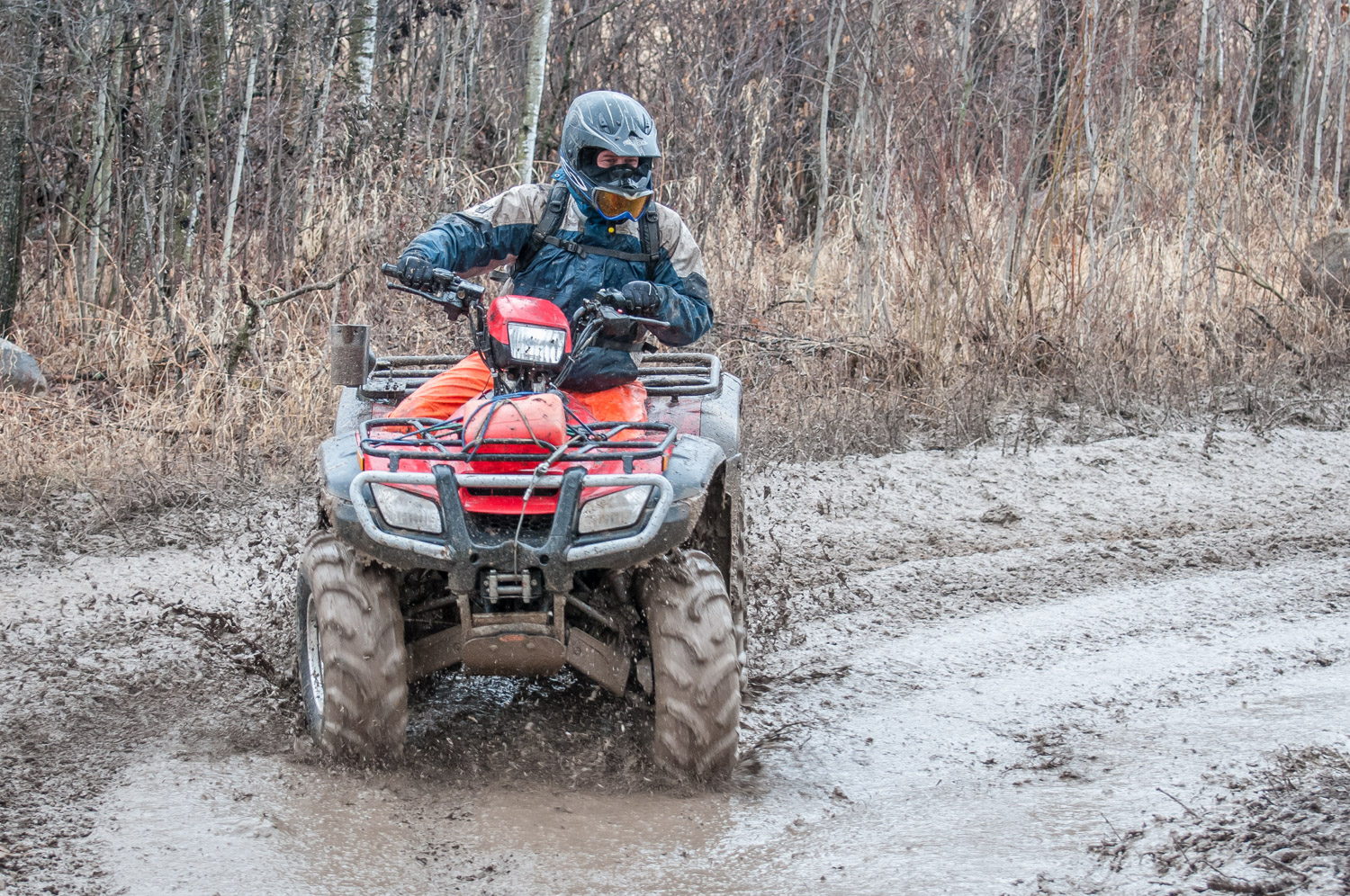
A quad rider drives through a bog in this file photo not taken in the Okanagan. Government officials want riders to avoid making new trails through environmentally sensitive areas such as wetlands and antelope brush grasslands. Local riders fear this means the government will close trails.. (© Richard McGuire file photo)